BrowserCopilot
BrowserCopilot is an AI-powered browser extension that acts as your personal copilot across the web. It understands the …
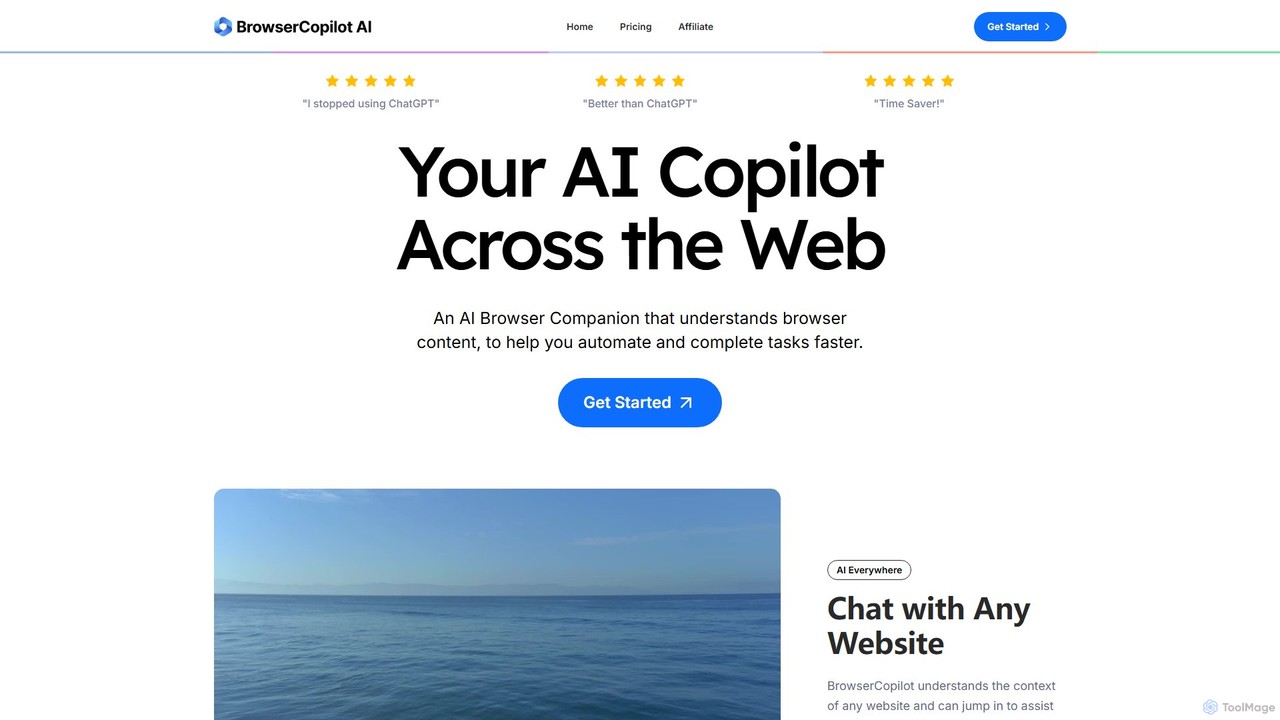
BrowserCopilot is an AI-powered browser extension that acts as your personal copilot across the web. It understands the context of any webpage, helping you to read, write, research, and automate tasks faster without switching tabs. It integrates multiple leading AI models like GPT-4o and Claude 3.7.
About Research
Research AI tools are a specialized category of AI-powered applications designed to streamline and enhance various stages of the research process. These tools leverage advanced algorithms, natural language processing (NLP), and machine learning to automate tasks such as data collection, literature review, data analysis, and hypothesis generation. They empower academics, market researchers, R&D professionals, and data scientists to uncover insights faster, manage information more efficiently, and make data-driven decisions with greater accuracy. By automating repetitive and time-consuming tasks, Research AI tools significantly accelerate discovery and innovation across diverse fields.
Core Features
- Automated Literature Review: Quickly scan, summarize, and synthesize vast amounts of academic papers, articles, and reports to identify key themes, authors, and research gaps.
- Data Synthesis & Analysis: Process and analyze complex datasets, including qualitative text, quantitative figures, and multimedia, to extract meaningful patterns and insights.
- Hypothesis Generation: Suggest potential research questions and hypotheses based on existing data and identified trends, guiding new avenues of inquiry.
- Trend Identification: Detect emerging trends, anomalies, and correlations within large bodies of information, crucial for market analysis and scientific forecasting.
- Experimental Design Assistance: Provide recommendations for experimental setups, variable selection, and statistical analysis methods to optimize research outcomes.
Applicable Scenarios
Research AI tools are invaluable for professionals across various sectors. Academics and university researchers utilize them to accelerate literature reviews, identify novel research questions, and analyze complex experimental data. Market research firms employ these tools to quickly process consumer feedback, analyze competitor strategies, and identify emerging market trends. R&D departments in industries like pharmaceuticals and technology leverage AI to synthesize scientific literature, generate new product ideas, and optimize experimental protocols, significantly reducing time-to-discovery.
How to Choose
When selecting an AI research tool, consider its compatibility with your data types (text, numerical, image), the depth of its analytical capabilities (e.g., statistical modeling, sentiment analysis), and its integration options with existing research workflows or databases. Evaluate the tool's ability to handle specific research tasks, such as literature mapping or qualitative coding. Furthermore, assess its user-friendliness, collaboration features for team projects, and the transparency of its AI models, especially for critical decision-making processes. Finally, consider the pricing structure and the level of customer support provided.

ResearchUse Cases
Automating Comprehensive Literature Reviews
Academic researchers often spend hundreds of hours manually sifting through scientific papers. AI research tools can ingest thousands of articles, identify relevant studies based on keywords, summarize key findings, and even map out the intellectual landscape of a field, highlighting influential authors and emerging topics. This allows researchers to quickly grasp the state-of-the-art and pinpoint critical research gaps, saving up to 70% of the time typically spent on initial literature searches.
Identifying Novel Research Gaps and Opportunities
Ph.D. students and R&D teams struggle to find truly novel areas for investigation. AI tools analyze vast datasets of published research, patents, and grant applications to detect under-explored connections, contradictory findings, or areas with sparse data. By visualizing these gaps, the AI helps researchers formulate unique and impactful research questions, increasing the likelihood of groundbreaking discoveries and successful grant applications.
Synthesizing Complex Qualitative and Quantitative Data
Market researchers and social scientists frequently deal with mixed methods data, combining survey responses, interview transcripts, and statistical figures. AI research tools can process this diverse data, perform sentiment analysis on text, identify recurring themes in interviews, and correlate qualitative insights with quantitative trends. This enables a holistic understanding of phenomena, providing deeper, more nuanced insights than manual analysis alone.
Generating and Refining Research Hypotheses
Scientists and innovators often face challenges in formulating testable hypotheses. AI research tools can analyze existing scientific literature, experimental results, and biological pathways to suggest novel hypotheses. By identifying logical connections and potential causal relationships that might be overlooked by human researchers, these tools accelerate the hypothesis generation phase, leading to more focused and potentially fruitful experimental designs.
Analyzing Global Market Trends and Competitor Strategies
Business strategists and market analysts need to stay ahead of industry shifts. AI research tools continuously monitor news, social media, industry reports, and financial data to identify emerging market trends, consumer preferences, and competitor moves. They can predict future market directions and highlight strategic opportunities or threats, enabling businesses to make proactive decisions and maintain a competitive edge.
Assisting in the Design and Optimization of Experiments
Experimental scientists in fields like chemistry or biology often face complex challenges in designing efficient experiments. AI research tools can simulate various experimental conditions, predict outcomes based on historical data, and recommend optimal parameters for maximizing desired results or minimizing resource usage. This reduces the need for extensive trial-and-error, accelerating the discovery of new materials, drugs, or processes.