
ToolMage
Sign in

Best 1 Customer Experience AI tools for Hospitality

Popular Customer Experience AI tools in Hospitality include Menyo AI, helping you work more efficiently.

Menyo AI
Freemium

Menyo AI

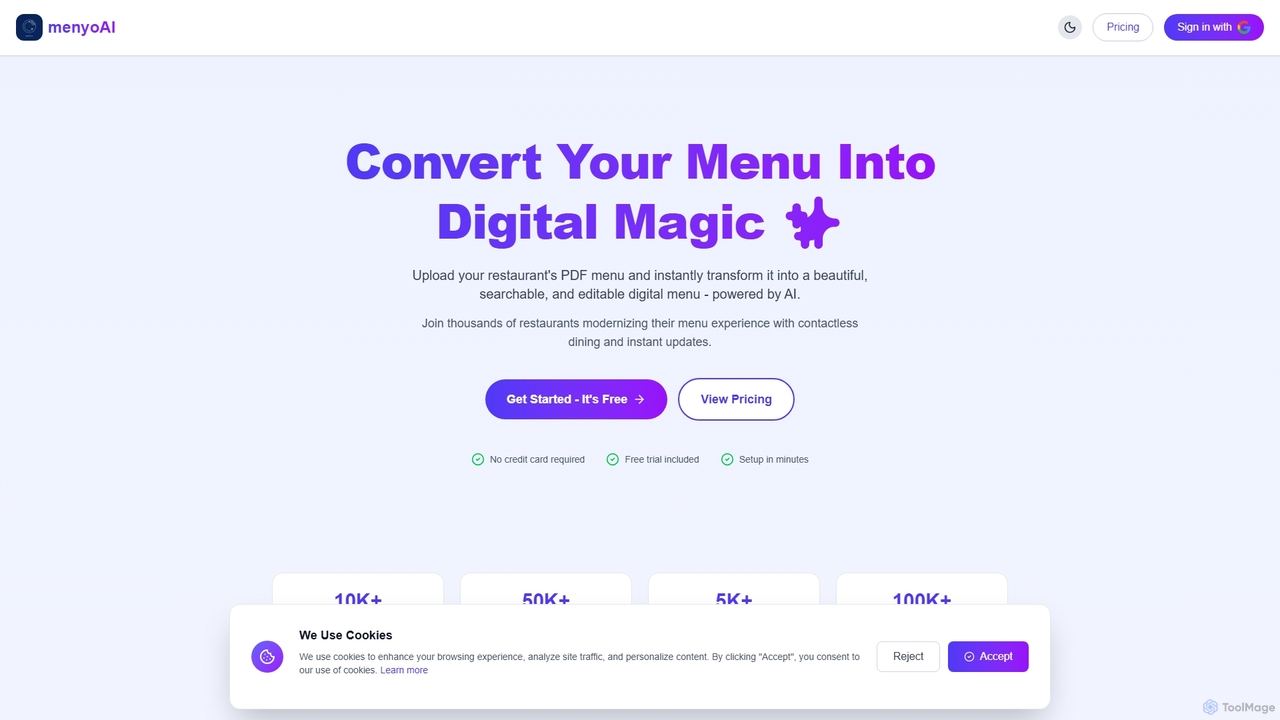
Menyo AI is an AI-powered platform that transforms traditional PDF restaurant menus into interactive, digital experiences. It enables restaurants to effortlessly create, manage, and update beautiful, searchable, and multi-language digital menus, complete with custom QR codes and real-time analytics, enhancing customer engagement and operational efficiency.

Restaurant Insights
Visits 5.8KFavorites 154Likes 150

About Customer Experience

Customer Experience AI tools are a category of AI-powered solutions designed to enhance interactions and satisfaction throughout the customer journey. These tools leverage artificial intelligence for personalization, automation, and data analysis, enabling businesses to understand and respond to customer needs more effectively. They are crucial for improving service efficiency, personalizing communications, predicting customer behavior, and resolving issues faster, particularly within service-oriented sectors like hospitality.

Core Features

  • AI Chatbots & Virtual Assistants: Provide automated 24/7 support, instant answers to common queries, and efficient routing of complex issues to human agents.
  • Personalized Recommendations: Deliver tailored product, service, or content suggestions based on individual customer preferences, past interactions, and behavioral data.
  • Sentiment Analysis: Analyze customer feedback from various channels (text, voice) to gauge mood, identify pain points, and detect emerging trends or satisfaction levels.
  • Predictive Analytics: Forecast customer churn, identify potential upsell or cross-sell opportunities, and anticipate future needs to enable proactive engagement.
  • Automated Feedback Collection: Streamline the process of gathering customer insights through surveys, review analysis, and aggregation of feedback from multiple platforms.

Applicable Scenarios

These tools are widely adopted across industries focused on service delivery. In hospitality, hotels use AI chatbots for booking and concierge services, while restaurants personalize menu recommendations. E-commerce businesses deploy AI for product recommendations and automated customer service. Service industries benefit from proactive issue resolution and personalized support, ensuring consistent, high-quality interactions.

How to Choose

When selecting Customer Experience AI tools, consider their integration capabilities with existing CRM and booking systems to ensure seamless data flow. Evaluate scalability to handle fluctuating customer volumes efficiently. Assess customization options to align the AI's voice and service protocols with your brand. Prioritize solutions with robust data privacy and security features, ensuring compliance with regulations like GDPR, and verify the accuracy of their Natural Language Processing (NLP) for diverse customer queries.

Customer Experience use cases

1

Automated Guest Inquiry Handling

Hotels utilize AI chatbots to provide instant, 24/7 answers to common guest questions regarding amenities, check-in/out times, local attractions, and room service. This reduces staff workload and ensures guests receive timely information, enhancing their stay experience.

2

Personalized Dining Recommendations

Restaurants leverage AI to analyze guest preferences, past orders, and dietary restrictions, offering tailored menu suggestions, wine pairings, and special promotions. This creates a highly personalized dining experience, encouraging repeat visits and increased satisfaction.

3

Proactive Issue Resolution in Hospitality

Resorts deploy AI systems that monitor guest feedback across social media, review sites, and in-app messages for sentiment analysis. The AI automatically flags negative comments or potential issues, alerting staff for immediate intervention before problems escalate, thus safeguarding guest satisfaction.

4

Streamlined Booking and Reservation Management

Travel agencies and hotels employ AI-powered virtual assistants to guide customers through the booking process, confirm reservations, and manage changes or cancellations efficiently. This reduces manual errors, speeds up transactions, and provides a smooth customer journey from initial inquiry to confirmation.

5

Targeted Upselling and Cross-selling

AI tools analyze customer profiles, booking history, and behavioral data to identify optimal moments for offering upgrades (e.g., room upgrades, spa packages) or complementary services (e.g., airport transfers, local tours). This strategy maximizes revenue per customer while enhancing their overall experience.

6

Post-Stay Feedback Analysis and Action

Hotels use AI to aggregate and analyze guest reviews and survey responses from various platforms. The AI identifies recurring themes, common complaints, and areas of excellence, providing actionable insights for management to continuously improve service quality and facilities for future guests.

Customer Experience FAQ

What are Customer Experience AI tools?

Customer Experience (CX) AI tools are artificial intelligence-powered solutions designed to optimize and enhance interactions between businesses and their customers across all touchpoints. They leverage AI for tasks like personalization, automation, and data analysis to better understand customer needs, streamline service delivery, and improve overall satisfaction. These tools are vital for creating more efficient, engaging, and consistent customer journeys.

How do AI tools improve customer experience in hospitality?

In the hospitality sector, AI tools significantly enhance customer experience by automating routine tasks and personalizing guest interactions. This includes AI chatbots providing instant booking assistance and concierge services, personalized recommendations for dining or activities based on guest preferences, and sentiment analysis of feedback for proactive issue resolution. They ensure 24/7 support and a more tailored, efficient, and satisfying guest journey.

What are the key features of Customer Experience AI platforms?

Key features of Customer Experience AI platforms typically include AI chatbots and virtual assistants for automated support, personalized recommendation engines that tailor offerings to individual customers, and sentiment analysis tools to gauge customer mood from feedback. Additionally, many platforms offer predictive analytics to forecast customer behavior and automated feedback collection systems to gather and analyze insights efficiently.

How to choose the best AI tool for customer experience?

Choosing the best AI tool for customer experience involves several considerations. Prioritize solutions with strong integration capabilities with your existing CRM, booking, or service systems. Evaluate its scalability to handle varying customer volumes and its customization options to align with your brand's voice and specific service protocols. Also, assess its Natural Language Processing (NLP) accuracy and ensure robust data privacy and security features are in place.

What is the difference between AI-driven customer experience and traditional customer service?

The primary difference lies in their approach: AI-driven customer experience is proactive, personalized, and data-driven, while traditional customer service is often reactive and standardized. AI tools can predict customer needs, automate responses, offer 24/7 support, and continuously learn from interactions to improve. Traditional service relies heavily on human agents during business hours, often providing a less personalized and slower response.