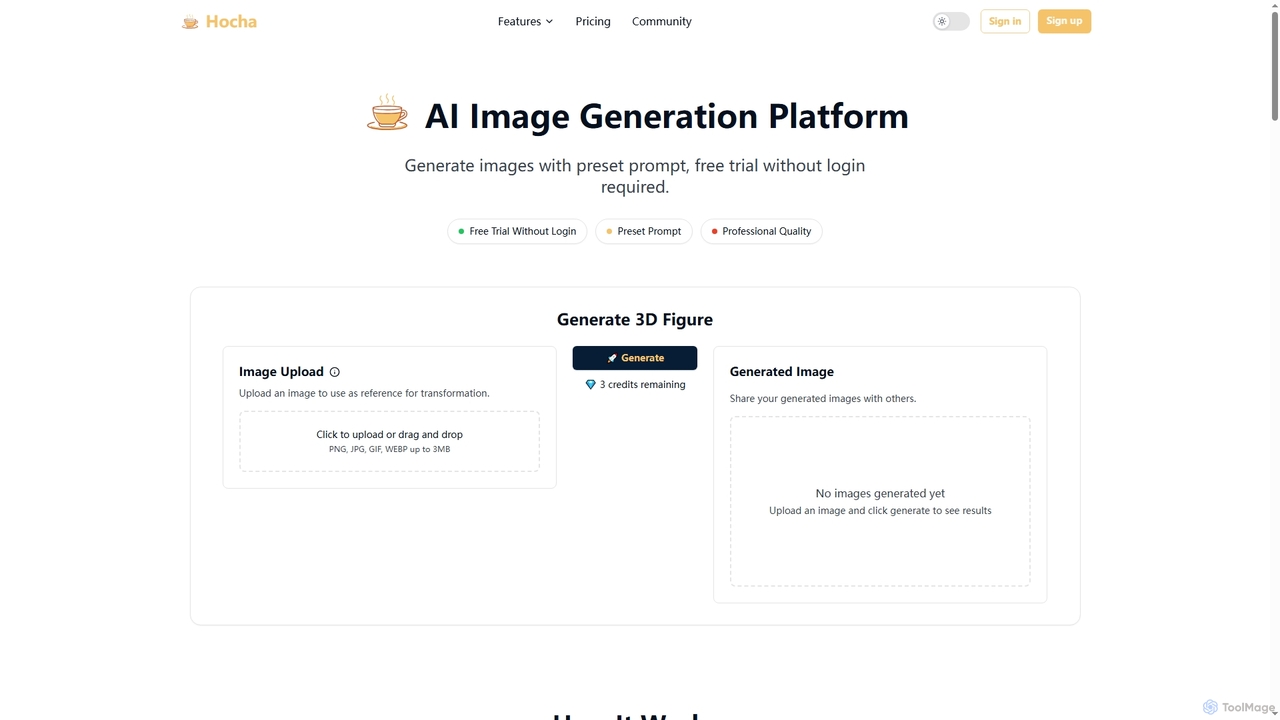
3D Modeling tools are AI-powered applications that enable the creation, manipulation, and generation of three-dimensional digital models. Leveraging advanced AI algorithms like neural networks and generative adversarial networks, these tools can interpret text prompts, 2D images, or even sketches to reconstruct or generate complex 3D geometry. They significantly accelerate design workflows, facilitate rapid prototyping, and democratize access to 3D content creation for various industries, from gaming and animation to product design and architectural visualization.
Core Features
- Text-to-3D Generation: Automatically creates 3D models from descriptive text prompts.
- Image-to-3D Reconstruction: Converts 2D images or multiple views into detailed 3D models.
- 3D Model Editing & Enhancement: Assists in refining, optimizing, and adding details to existing 3D assets.
- Texture & Material Generation: Generates realistic textures and material properties for 3D objects.
- Scene Composition & Layout: Helps arrange and populate 3D scenes with generated or existing assets.
Use Cases
These tools are invaluable for professionals and enthusiasts seeking to streamline their 3D content pipelines. They are widely adopted in game development for generating assets, in industrial design for rapid visualization of product concepts, and in architectural firms for creating preliminary building models and interior layouts. Their ability to quickly iterate on designs makes them essential for creative exploration and efficient production.
How to Choose
When selecting an AI 3D Modeling tool, consider the required output quality and format compatibility with your existing software (e.g., Blender, Unity). Evaluate the ease of use and learning curve, especially for non-experts. Assess the range of AI capabilities, such as text-to-3D versus image-to-3D, and the flexibility of editing options. Finally, compare pricing models and integration possibilities to ensure it fits your workflow and budget.