
ToolMage
Sign in

Best 1 Portrait Creation AI tools for Image Generation

Popular Portrait Creation AI tools in Image Generation include Ziina, helping you work more efficiently.

Ziina
Freemium

Ziina

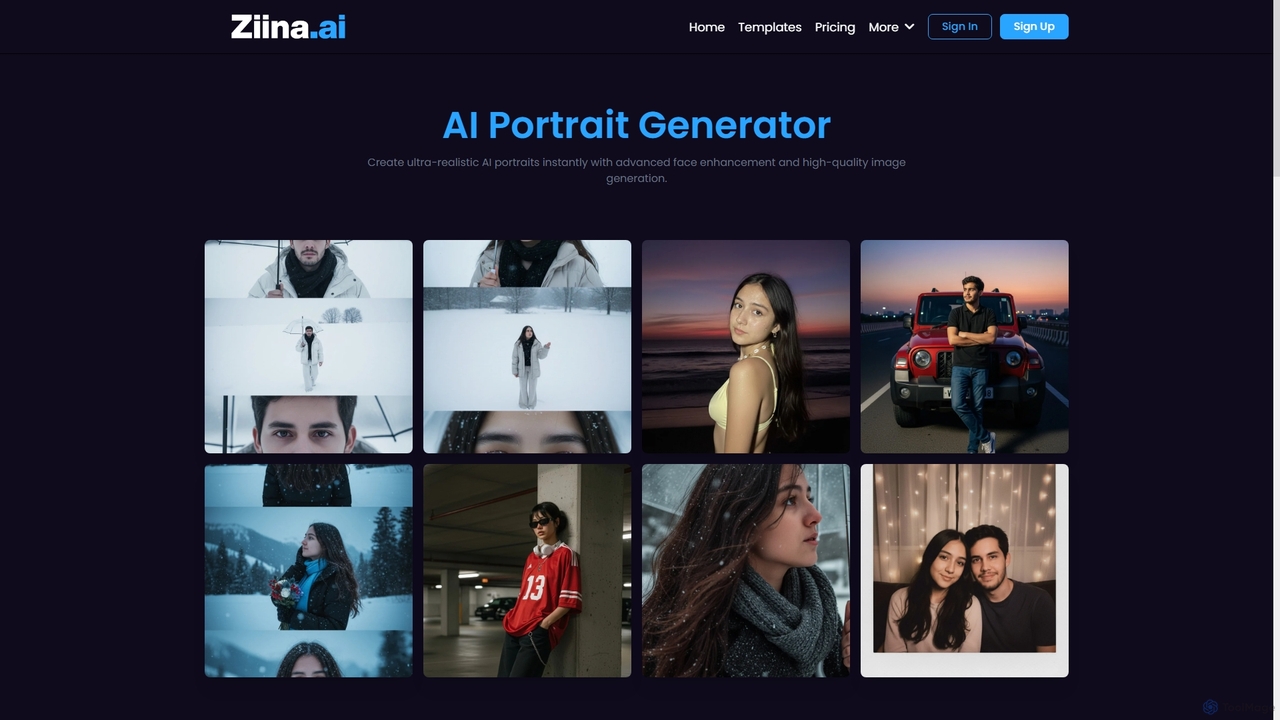
Ziina is an advanced AI tool designed to generate ultra-realistic, studio-grade portrait images with unmatched speed, quality, and simplicity. It offers intelligent face enhancement and multi-format export for various professional and personal uses.

Avatar Generation
Visits 4.9KFavorites 132Likes 137

About Portrait Creation

Portrait Creation tools are a specialized subset of AI Image Generation tools that focus on generating realistic or stylized human portraits. These AI-powered platforms leverage advanced generative adversarial networks (GANs) or diffusion models to create diverse facial features, expressions, and styles. They enable artists, marketers, and individuals to quickly produce high-quality human images for various creative and commercial purposes, significantly reducing the need for traditional photography or manual illustration.

Core Features

  • Facial Feature Customization: Precise control over eyes, nose, mouth, hair, and other facial attributes to achieve desired looks.
  • Style Transfer & Variation: Apply diverse artistic styles, from photorealistic to cartoonish, and generate multiple variations of a single portrait.
  • Expression & Pose Control: Adjust facial expressions (e.g., happy, sad, angry) and head poses to convey specific emotions or actions.
  • Age & Gender Modification: Easily alter the apparent age and gender of subjects, offering flexibility for character design and demographic targeting.
  • Background Integration: Seamlessly blend generated portraits with various backgrounds, from studio settings to outdoor scenes.

Applicable Scenarios

These tools are invaluable for professionals and hobbyists alike. Graphic designers use them for rapid concept art and character development. Marketing teams leverage them to create diverse model imagery for campaigns without expensive photoshoots. Social media creators and personal users generate unique avatars and profile pictures. Additionally, developers can use them to populate virtual worlds or training datasets with diverse human faces.

How to Choose

When selecting a Portrait Creation AI tool, consider the desired level of realism and stylistic flexibility. Evaluate the depth of customization options for facial features, expressions, and poses. Check the variety and quality of pre-set styles and the ease of applying them. Assess the output resolution and file formats supported, as well as the tool's ability to integrate with existing workflows. Finally, compare pricing models and user interface intuitiveness for a smooth creative process.

Portrait Creation use cases

1

Generate Diverse Character Concepts for Games

Game designers and concept artists utilize portrait creation AI to rapidly generate hundreds of unique character portraits with varied facial features, expressions, and costumes. By inputting textual descriptions or reference images, they can explore diverse visual styles and iterations, significantly accelerating the concept art phase and providing a rich visual library for game development.

2

Rapid Character Concept Development for Games

Game developers and concept artists utilize portrait creation tools to quickly iterate on character designs. By inputting descriptions of desired traits, expressions, and styles, they can generate dozens of unique character portraits in minutes. This accelerates the pre-production phase, allowing teams to explore a wide range of visual identities for NPCs or player characters before committing to detailed 3D modeling.

3

Generating Diverse Model Imagery for Marketing

Marketing agencies and e-commerce businesses use these tools to create a wide array of diverse model portraits for advertising campaigns. Instead of expensive photoshoots, they can generate models of different ages, ethnicities, and styles to resonate with specific target audiences. This ensures inclusive representation and provides a cost-effective solution for producing high-quality visual content for ads, websites, and social media.

4

Create Marketing Visuals with Diverse Models

Marketing teams and advertisers leverage portrait creation AI to produce a wide array of diverse model portraits for advertisements, social media posts, and website banners. This eliminates the need for expensive photoshoots and casting, allowing for rapid content generation that is inclusive, brand-aligned, and tailored to specific demographic targets, saving both time and budget.

5

Personalized Profile Pictures and Avatars

Individual users and social media influencers leverage portrait creation AI to design unique and personalized profile pictures or avatars. They can experiment with different artistic styles, expressions, and backgrounds to create a digital representation that truly reflects their personality or brand. This offers a creative and engaging way to stand out online without needing professional photography skills.

6

Generate Unique Avatars and Profile Pictures

Individual users and social media enthusiasts can employ portrait creation tools to generate highly personalized and unique avatars or profile pictures. By customizing facial features, hairstyles, expressions, and artistic styles, they can create digital representations that truly reflect their personality or desired online persona, standing out from generic options.

7

Illustrating Stories and Book Covers

Authors and illustrators employ portrait creation tools to visualize characters for their stories or design compelling book covers. By generating portraits that match character descriptions, they can bring their literary creations to life visually. This helps in maintaining character consistency across different scenes and provides a powerful visual hook for potential readers, enhancing the overall storytelling experience.

8

Visualize Characters for Storytelling and Comics

Authors, comic artists, and illustrators can use portrait creation AI to quickly visualize characters for their stories, novels, or graphic novels. These tools allow them to experiment with different appearances, ages, ethnicities, and expressions, ensuring consistency across panels or chapters and bringing their narrative visions to life with compelling visual aids.

9

Generate AI-Generated Stock Photos of People

Businesses and content creators often require diverse stock photos of people for websites, blogs, and presentations. Portrait creation AI tools offer an ethical and cost-effective solution to generate unique, high-quality images of individuals with specific demographics, expressions, and poses, avoiding licensing issues and the generic look of traditional stock photography.

10

Virtual Try-On and Fashion Design Visualization

Fashion designers and retailers can use AI-generated portraits to visualize clothing and accessories on diverse virtual models. This allows for rapid prototyping and showcasing of new collections without the need for physical samples or models. It helps in understanding how designs look on various body types and skin tones, streamlining the design process and improving product presentation.

11

Historical Figure Reimagination and Art Projects

Artists and historians use portrait creation AI to reimagine historical figures or create unique art pieces. By feeding historical descriptions or existing images, they can generate new interpretations, explore different artistic styles, or even animate static portraits. This opens up new avenues for creative expression and historical exploration, blending technology with traditional art forms.

12

Enhance Virtual Try-On and Fashion Design

Fashion designers and e-commerce platforms can utilize portrait creation AI to generate realistic models for virtual try-on experiences or to visualize new clothing designs. By creating diverse body types and facial features, they can showcase how garments look on various individuals, improving customer engagement and streamlining the design iteration process without physical prototypes.

Portrait Creation FAQ

What are AI Portrait Creation tools?

AI Portrait Creation tools are specialized artificial intelligence applications within the broader field of image generation. They focus specifically on generating human faces and figures, often from text prompts, existing images, or detailed parameters. These tools utilize advanced generative adversarial networks (GANs) or diffusion models to produce highly realistic or stylized portraits, capturing intricate details like expressions, skin textures, and hair. They are distinct from general image generators by their dedicated focus on human likeness.

What are AI Portrait Creation tools?

AI Portrait Creation tools are specialized software that use artificial intelligence, primarily generative models like GANs or diffusion models, to generate realistic or stylized images of human faces and figures. They allow users to create unique portraits from text prompts, reference images, or by customizing various facial attributes, expressions, and styles. These tools are distinct from general image generators due to their specific focus on human likeness and detailed facial control.

How do AI Portrait Creation tools differ from general AI Image Generators?

While both fall under AI image generation, Portrait Creation tools are highly specialized. General AI Image Generators can create a vast array of images—landscapes, objects, abstract art—from diverse prompts. In contrast, Portrait Creation tools are fine-tuned specifically for human faces and figures. This specialization allows them to achieve superior realism, consistency, and control over facial features, expressions, and anatomical details, which is often challenging for general-purpose models.

How do AI Portrait Creation tools differ from general AI Image Generators?

While both fall under AI Image Generation, Portrait Creation tools are highly specialized. General AI image generators can create a wide range of objects, scenes, and abstract art. In contrast, portrait creation tools are specifically trained and optimized for human faces and figures. This specialization allows for much finer control over facial features, expressions, age, gender, and specific portrait styles, resulting in more realistic, consistent, and customizable human likenesses than a general-purpose tool could achieve.

What factors should I consider when choosing an AI Portrait Creation tool?

When selecting an AI Portrait Creation tool, prioritize the level of realism and stylistic versatility it offers. Evaluate the depth of customization for facial features, expressions, and poses, ensuring it meets your specific creative needs. Consider the quality and variety of pre-set styles, the output resolution, and supported file formats. Ease of use, integration with your existing workflow, and the pricing model (subscription vs. one-time purchase, credit system) are also crucial for a smooth and efficient creative process.

What features should I look for in a Portrait Creation tool?

When choosing a Portrait Creation tool, prioritize features like high-resolution output for clarity, robust customization options for age, gender, ethnicity, and expressions, and diverse style libraries (realistic, cartoon, artistic). Look for intuitive prompt engineering capabilities, the ability to use reference images, and efficient batch processing for multiple outputs. Also, consider the tool's ethical guidelines regarding bias and consent, and its licensing for commercial use.

Who can benefit most from using AI Portrait Creation tools?

A wide range of professionals and enthusiasts can benefit. Digital artists and illustrators use them for rapid character design and concept art. Marketing and advertising professionals leverage them for diverse model imagery without costly photoshoots. Game developers utilize them for character prototyping. Social media creators and influencers can generate unique avatars and profile pictures. Even writers can use them to visualize their characters, bringing stories to life.

Can AI Portrait Creation tools generate diverse ethnicities and ages?

Yes, modern AI Portrait Creation tools are designed to generate a wide range of ethnicities, ages, and genders. Advanced models are trained on vast datasets that include diverse human faces, allowing them to produce highly varied and representative portraits. Users can often specify these parameters through text prompts or dedicated controls, ensuring the generated images meet specific demographic or character design requirements while promoting inclusivity.

What are the typical output formats and resolutions for AI-generated portraits?

Most AI Portrait Creation tools typically output images in common formats such as JPG, PNG, or sometimes WebP, offering broad compatibility. The resolution can vary significantly depending on the tool and subscription tier, ranging from standard web resolutions (e.g., 512x512, 1024x1024 pixels) suitable for social media and digital use, to high-resolution outputs (e.g., 2K, 4K, or even higher) suitable for print, large displays, or professional graphic design. Some tools also offer upscaling features to enhance lower-resolution outputs.

Can AI Portrait Creation tools generate diverse and inclusive portraits?

Yes, many advanced AI Portrait Creation tools are designed with diversity and inclusivity in mind. They can generate portraits across a wide spectrum of ages, genders, ethnicities, and styles, helping users create representative content. However, the quality and diversity of output can depend on the training data and specific algorithms of each tool. It's important to test different tools and provide clear, inclusive prompts to achieve desired diverse results.

Are there ethical considerations when using AI Portrait Creation tools?

Yes, ethical considerations are important. Users should be mindful of potential biases in AI models, which might inadvertently perpetuate stereotypes or misrepresent certain demographics. It's crucial to use these tools responsibly, avoiding the creation of harmful or misleading content. Additionally, understanding the source of training data and ensuring proper consent for any real-person likenesses used as input or inspiration is vital. Transparency about AI-generated content is also recommended to prevent deception.