Buddy.ai
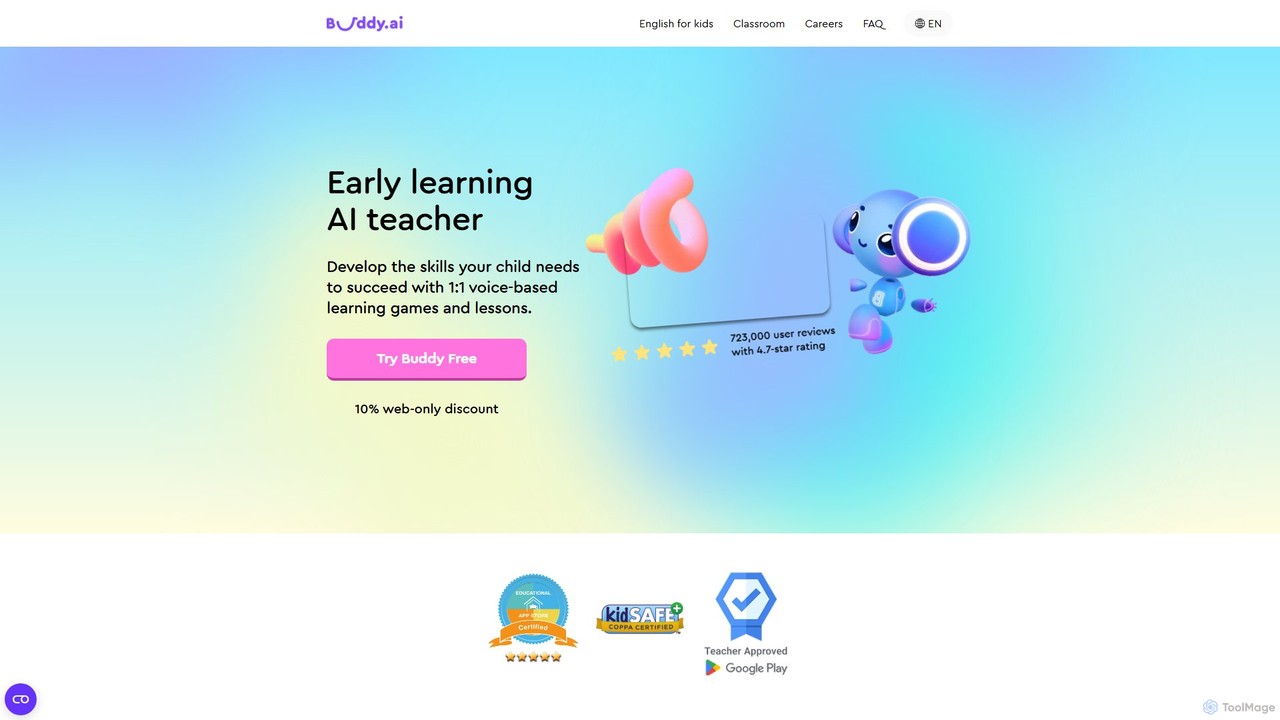
Buddy.ai is an AI-powered English tutor app designed for children aged 3-7. It uses voice recognition and gamified …
Buddy.ai is an AI-powered English tutor app designed for children aged 3-7. It uses voice recognition and gamified lessons to provide personalized 1:1 speaking practice. The app helps kids learn over 1,500 English words and phrases, master pronunciation, and build speaking confidence in a fun, interactive environment, all at a fraction of the cost of a live tutor.
About Early Learning
Early Learning AI tools are a specialized category within Kids AI tools, leveraging artificial intelligence to create personalized and adaptive educational experiences for young children. These platforms utilize AI algorithms to understand a child's learning pace, preferences, and developmental stage, offering tailored content that ranges from foundational literacy and numeracy to social-emotional skills. Their primary value lies in fostering engagement, providing immediate feedback, and adapting challenges to maximize learning potential in a fun, interactive environment.
Core Features
- Adaptive Learning Paths: AI dynamically adjusts content difficulty and progression based on a child's performance and engagement.
- Interactive Content Generation: AI creates engaging stories, games, and activities that respond to a child's input, promoting active participation.
- Speech Recognition & Language Development: Tools use AI to analyze pronunciation and vocabulary, aiding in early language acquisition and communication skills.
- Emotional & Engagement Sensing: Some advanced tools can detect a child's emotional state or level of engagement to optimize the learning experience.
Use Cases
These tools are invaluable for parents, educators, and caregivers seeking to supplement traditional learning methods with technology-driven personalization. They are used in homes for self-paced learning, in preschools for individualized instruction, and by therapists to support children with specific developmental needs, ensuring every child receives attention tailored to their unique journey.
How to Choose
When selecting Early Learning AI tools, consider the age appropriateness and curriculum alignment with recognized educational standards. Evaluate the AI's adaptability and personalization capabilities, ensuring it genuinely responds to the child's progress rather than offering static content. Prioritize tools with strong privacy policies, intuitive interfaces for both children and parents, and engaging, non-addictive content design.

Early LearningUse Cases
Personalized Alphabet & Phonics Practice
Parents or early childhood educators can use AI tools to provide individualized practice for children learning the alphabet and phonics. The AI identifies specific letters or sounds a child struggles with, then generates targeted games and exercises, such as interactive letter tracing or sound-matching activities, ensuring focused improvement and building foundational reading skills at their own pace.
Adaptive Math Skill Building for Preschoolers
For children aged 3-6, AI Early Learning tools can adapt math problems to their current understanding of numbers, counting, and basic arithmetic. If a child masters counting to ten, the AI introduces simple addition. If they struggle with number recognition, it provides more visual and auditory reinforcement, making math engaging and preventing frustration.
Interactive Storytelling for Language Development
AI-powered storytelling apps allow children to influence narratives, choose characters, or even record their own voice to become part of the story. The AI can then generate new story elements or provide feedback on pronunciation, fostering creativity, expanding vocabulary, and improving verbal communication skills in an immersive and fun way.
Early Coding & Logic Games
AI tools can introduce foundational computational thinking and problem-solving skills through gamified coding activities. Children drag and drop visual blocks to control characters or solve puzzles, with the AI adapting the complexity of challenges and offering hints, thereby developing logical reasoning and critical thinking from a young age.
Social-Emotional Learning (SEL) through AI Companions
Some Early Learning AI tools feature virtual companions that guide children through scenarios involving emotions, empathy, and social interactions. The AI can prompt discussions about feelings, offer coping strategies, or simulate social situations, helping children understand and manage their emotions and develop crucial social skills.
Personalized Art & Creativity Exploration
AI tools can offer children a canvas for creative expression, suggesting drawing prompts, generating unique patterns, or even helping them compose simple melodies. The AI adapts to the child's artistic choices, providing gentle guidance or new ideas without judgment, encouraging experimentation and fostering a love for creative arts.