doodletale
doodletale is an AI-powered educational platform that transforms children's drawings and colorings into immersive stories, quizzes, and mini-games. …
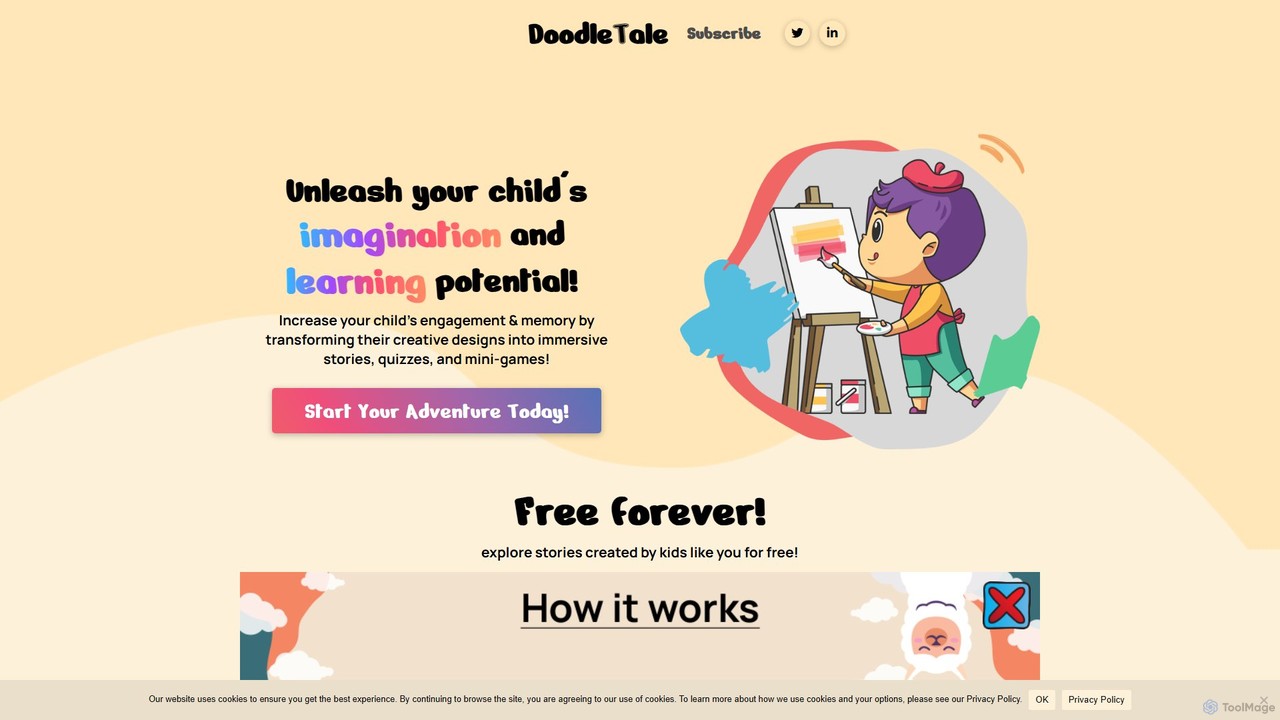
doodletale is an AI-powered educational platform that transforms children's drawings and colorings into immersive stories, quizzes, and mini-games. Designed with educators, it enhances creativity, engagement, and memory in a safe, multilingual environment. Kids can customize scenes, and the AI generates personalized, narrated tales filled with adventures and riddles, making learning a fun and interactive experience.
About Games
AI Games are interactive digital experiences specifically designed for children, leveraging artificial intelligence to create engaging and adaptive play. These tools utilize AI algorithms to personalize gameplay, adjust difficulty, and offer dynamic interactions, fostering both entertainment and cognitive development. They provide a safe and stimulating environment where children can learn, explore, and interact with intelligent virtual characters or environments, making learning fun and accessible. This sub-category within Kids AI tools focuses on enriching children's leisure and educational time through smart, responsive gaming.
Core Features
- Adaptive Learning Paths: AI adjusts game content and challenges based on a child's progress and learning style, ensuring optimal engagement.
- Interactive Storytelling: AI generates dynamic narratives and character responses, making stories unique and engaging with player choices.
- Intelligent Companions/Opponents: AI-powered characters provide responsive companionship or challenging, fair opposition tailored to the child's skill.
- Creative Play & Generation: Tools allow children to generate game elements, stories, or art within the game using simple AI prompts.
- Safety & Moderation: AI helps ensure content is age-appropriate and interactions are safe, filtering out unsuitable material.
Applicable Scenarios
AI Games are ideal for parents seeking personalized educational tools, educators looking for engaging learning aids, and children who benefit from adaptive entertainment. They are used in home learning environments to supplement traditional education, in recreational settings for stimulating play, and for developing cognitive skills like problem-solving and critical thinking through dynamic challenges.
How to Choose
When selecting AI Games, prioritize age appropriateness and robust content safety features, including privacy policies. Evaluate the game's educational value and how effectively it balances fun with learning objectives. Consider the level of personalization and adaptivity offered by the AI, ensuring it genuinely responds to the child's individual needs. Finally, assess the game's engagement factor and its ability to foster creativity and healthy screen time habits.

GamesUse Cases
Adaptive Math Learning for Kids
A child struggling with specific math concepts can use an AI game that identifies their weak areas through gameplay. The AI then generates personalized problems and adjusts the difficulty in real-time, providing targeted practice and immediate feedback. This ensures the child stays engaged and builds confidence by mastering concepts at their own pace, making learning more effective and less frustrating than static worksheets.
Interactive Story Adventures
Young readers can engage with AI-driven story games where their choices directly influence the plot, character development, and even the ending. The AI dynamically generates new narrative branches and character dialogues based on the child's decisions, creating a unique and highly personalized adventure every time. This fosters creativity, critical thinking, and reading comprehension by making storytelling a truly interactive and responsive experience.
AI-Powered Virtual Pet Companions
Children can interact with virtual pets or companions in a game that uses AI to learn from their interactions and respond uniquely. The AI pet might adapt its personality, behaviors, and even its appearance based on how the child plays, talks, or cares for it. This fosters empathy, responsibility, and social-emotional development by providing a dynamic and emotionally responsive virtual friend that offers a personalized companionship experience.
Creative World Building with AI
Children can use AI games to build their own virtual worlds or design characters and objects with simple text or voice prompts. The AI interprets these inputs to generate unique landscapes, creatures, or structures, allowing kids to bring their imaginative ideas to life without complex design skills. This empowers creative expression, problem-solving, and digital literacy, transforming abstract concepts into tangible game elements and fostering a sense of ownership over their creations.
Language Learning through AI Role-Play
Children learning a new language can practice conversational skills in an AI game where virtual characters engage them in dynamic role-playing scenarios. The AI understands and responds to the child's spoken or typed input, correcting pronunciation or grammar and adapting the conversation to their proficiency level. This provides a safe, non-judgmental environment for language immersion and practice, significantly boosting confidence and fluency in a fun, interactive way.
Strategic Thinking with AI Opponents
Children can develop strategic thinking and problem-solving skills by playing against AI opponents in games like chess, checkers, or custom strategy games. The AI adapts its difficulty and tactics based on the child's performance, providing a consistently challenging yet fair opponent. This helps children learn from their mistakes, experiment with different strategies, and improve their decision-making abilities in a dynamic and engaging competitive environment.