Checkbox
Checkbox is an AI-powered, no-code platform designed for legal teams to automate intake, triage, and workflows. It centralizes …
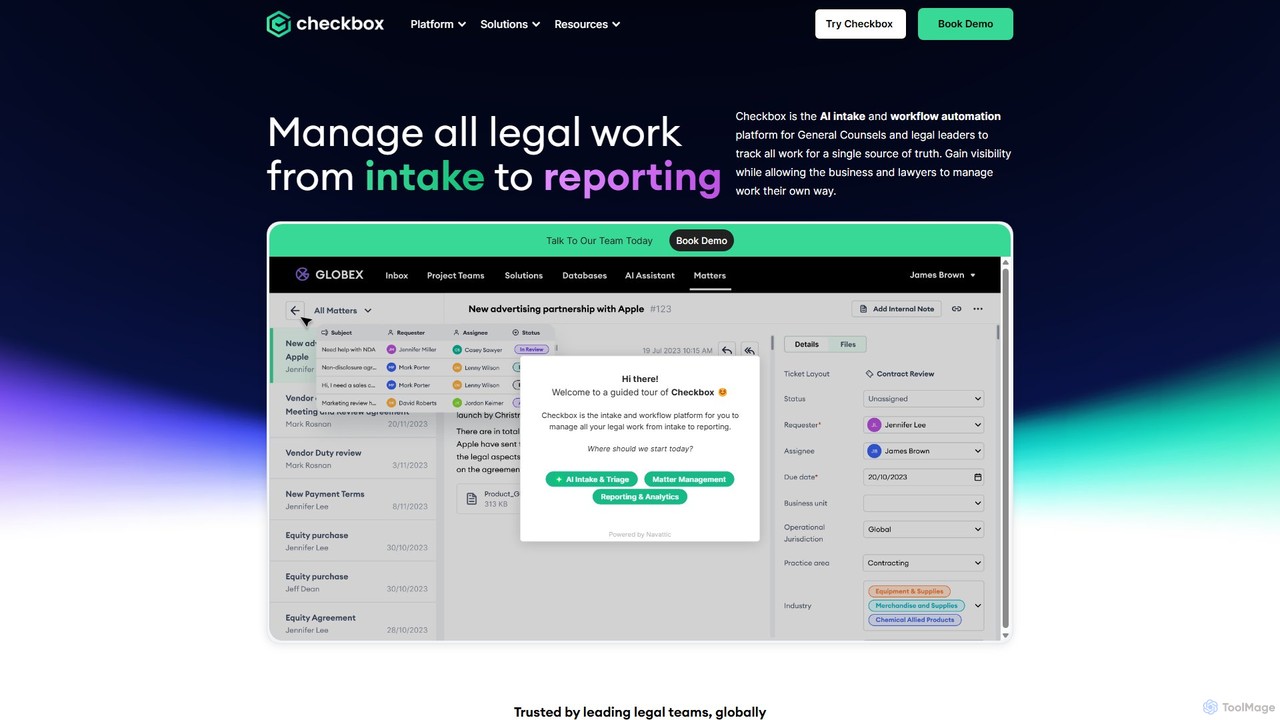
Checkbox is an AI-powered, no-code platform designed for legal teams to automate intake, triage, and workflows. It centralizes all legal requests from channels like email, Slack, and Salesforce into a single service hub. By automating repetitive tasks and providing comprehensive matter management and reporting, Checkbox empowers legal departments to increase efficiency, gain full visibility over their work, and focus on high-impact strategic initiatives.
About Workflow Automation
Workflow Automation tools in the legal sector are AI-powered solutions designed to streamline and automate repetitive, rule-based tasks within legal operations. These platforms leverage artificial intelligence, including natural language processing and machine learning, to handle high-volume document processing, contract review, compliance checks, and case management. Their primary goal is to enhance efficiency, reduce human error, and free legal professionals from mundane administrative burdens, allowing them to focus on strategic legal analysis and client advisory. This automation significantly accelerates legal processes, from initial intake to final resolution, ensuring greater consistency and accuracy across all legal workflows.
Core Features
- Automated Document Review: AI scans and analyzes large volumes of legal documents, identifying key clauses, anomalies, and relevant information much faster than manual review.
- Contract Lifecycle Management: Tools automate the drafting, negotiation, approval, and execution of contracts, ensuring compliance and tracking obligations throughout their lifecycle.
- Legal Research & Discovery Assistance: AI-driven platforms assist in sifting through vast legal databases and e-discovery documents to find pertinent information and precedents efficiently.
- Compliance Monitoring: Automatically monitors regulatory changes and internal policies, flagging potential non-compliance issues in real-time to mitigate risks.
- Case Management Automation: Streamlines administrative tasks related to case progression, scheduling, deadline tracking, and client communication within legal cases.
Applicable Scenarios
Legal departments in corporations, law firms, and government agencies extensively utilize workflow automation to manage their daily operations. For instance, corporate legal teams automate the review of vendor contracts, internal policy compliance, and intellectual property filings. Law firms employ these tools for e-discovery in litigation, rapidly processing millions of documents, or for automating client intake and initial case assessment. Government legal offices can use them for regulatory analysis, public record management, and efficient handling of legal aid applications.
How to Choose
When selecting a legal workflow automation tool, consider its integration capabilities with existing legal tech stacks (e.g., DMS, CRM, billing systems), the specific legal tasks it automates (e.g., contract review vs. e-discovery), the accuracy and reliability of its AI algorithms, and its compliance with data security and privacy regulations like GDPR or CCPA. Scalability, user-friendliness, and the vendor's expertise in legal AI are also crucial factors to ensure a smooth implementation and long-term value for your legal operations.

Workflow AutomationUse Cases
Automating Contract Review and Risk Identification
Corporate legal teams can use AI workflow automation to rapidly review thousands of contracts. The tool automatically extracts key clauses, identifies potential risks, and highlights deviations from standard terms, significantly reducing manual review time and ensuring consistent compliance across all agreements.
Automating Contract Review and Analysis
Corporate legal departments often face a high volume of contracts requiring review for specific clauses, risks, and compliance. AI workflow automation tools can automatically ingest contracts, extract key data points like terms, conditions, and obligations, and flag discrepancies or non-standard language. This process significantly reduces the time spent on manual review, improves accuracy, and ensures consistent adherence to company policies, allowing legal counsel to focus on high-risk negotiations and strategic advice rather than repetitive document scrutiny.
Streamlining Legal Document Generation
Paralegals and lawyers can leverage these tools to automate the drafting of standard legal documents such as NDAs, wills, or pleadings. By inputting specific client data, the system populates pre-approved templates, ensuring accuracy, consistency, and drastically cutting down document preparation time.
Streamlining E-Discovery in Litigation
Law firms and litigation support teams spend countless hours on e-discovery, sifting through vast amounts of electronic data to find relevant evidence. AI-powered workflow automation tools can rapidly process and categorize documents, emails, and other digital files, identifying privileged information, key facts, and patterns. This automation drastically reduces the time and cost associated with discovery, enhances the accuracy of document review, and allows legal teams to build stronger cases by quickly accessing critical information, thereby accelerating the entire litigation process.
Enhancing Regulatory Compliance Monitoring
Compliance officers in financial or healthcare legal departments can deploy AI workflow automation to continuously monitor evolving regulatory landscapes. The system automatically scans internal policies and external legal updates, flagging potential non-compliance issues and generating alerts for necessary adjustments.
Enhancing Regulatory Compliance Monitoring
Compliance officers and legal teams in regulated industries must continuously monitor a complex and evolving landscape of laws and regulations. AI workflow automation tools can track regulatory updates, analyze their impact on internal policies, and automatically flag potential areas of non-compliance in contracts or operational procedures. This proactive monitoring helps organizations stay ahead of regulatory changes, reduces the risk of penalties, and ensures that all legal documents and business practices adhere to the latest legal requirements, fostering a culture of continuous compliance.
Optimizing E-discovery Processes in Litigation
Litigation support teams can utilize these tools to automate the identification, collection, and review of relevant electronic information for legal cases. AI can quickly sift through vast datasets, categorize documents, and identify privileged or sensitive information, making the e-discovery process faster and more cost-effective.
Automating Client Intake and Onboarding
For law firms and legal service providers, the initial client intake and onboarding process can be time-consuming and prone to manual errors. Workflow automation tools can automate the collection of client information, conflict checks, creation of initial case files, and generation of engagement letters. This streamlines the client journey from prospect to active client, improves data accuracy, ensures compliance with ethical obligations, and allows legal professionals to engage with clients more efficiently from the very first interaction, enhancing the overall client experience.
Managing and Tracking Legal Case Workflows
Law firm administrators can implement workflow automation to manage the lifecycle of legal cases. The system automates task assignments, sets reminders for court deadlines, tracks document submissions, and facilitates communication between team members, ensuring no critical step is missed and improving overall case management efficiency.
Managing Intellectual Property Portfolio
Legal teams specializing in intellectual property (IP) often manage extensive portfolios of patents, trademarks, and copyrights, requiring meticulous tracking of deadlines, renewals, and compliance. AI workflow automation tools can automate the monitoring of IP application statuses, renewal dates, and potential infringements. They can also assist in generating necessary filings and reports, ensuring that IP assets are protected and managed efficiently. This reduces administrative overhead, minimizes the risk of missing critical deadlines, and provides a comprehensive overview of the entire IP portfolio, safeguarding valuable assets.
Automating Client Intake and Onboarding
Law firms can streamline their client intake process by automating data collection, conflict checks, and initial document preparation. AI-powered forms guide new clients through necessary information submission, automatically populate client profiles, and initiate conflict searches, providing a seamless and efficient onboarding experience.
Automating Legal Research and Due Diligence
Legal professionals, particularly in M&A or complex litigation, require extensive legal research and due diligence. AI workflow automation tools can rapidly search and synthesize information from vast legal databases, case law, statutes, and public records. They can identify relevant precedents, highlight potential risks in target companies during due diligence, and summarize complex legal texts. This significantly accelerates the research process, improves the depth and breadth of analysis, and enables legal teams to make more informed decisions by quickly accessing and understanding critical legal information.