
dilseheal
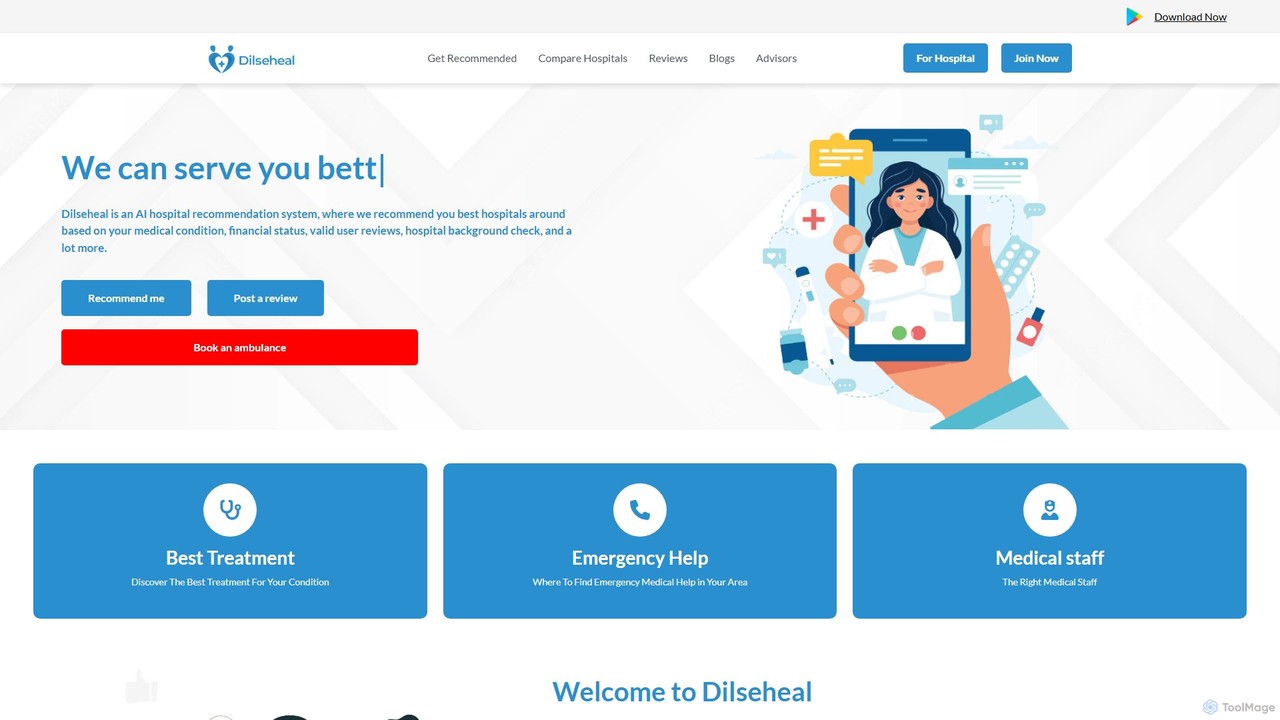
dilseheal is an AI-powered hospital recommendation system designed to help users find the best medical care, especially in …
dilseheal is an AI-powered hospital recommendation system designed to help users find the best medical care, especially in emergencies. By analyzing factors like medical condition, financial status, verified user reviews, and hospital background, it provides personalized and reliable hospital suggestions. The platform also offers 24/7 emergency assistance and a service to locate nearby emergency facilities, ensuring users receive prompt and expert care when it's needed most.
About Emergency Services
Emergency Services AI tools are specialized artificial intelligence applications designed to enhance the efficiency and effectiveness of crisis response and public safety operations. Within the broader 'Life' category, these tools leverage advanced data analytics, machine learning, and automation to provide real-time insights, optimize resource deployment, and improve communication during critical incidents, ultimately safeguarding communities.
Core Features
- Real-time Threat Detection: Analyzes vast data streams (social media, sensor data, news) to identify emerging threats and potential emergencies.
- Predictive Analytics for Resource Allocation: Forecasts incident likelihood and severity to strategically pre-position emergency personnel and equipment.
- Automated Crisis Communication: Generates and disseminates critical alerts, updates, and instructions to the public and response teams via multiple channels.
- Intelligent Incident Management: Provides a unified operational picture, tracks resources, and recommends optimal response strategies during an ongoing event.
- Post-incident Analysis & Reporting: Evaluates response effectiveness, identifies areas for improvement, and generates compliance reports.
Applicable Scenarios
Emergency Services AI tools are crucial for various public safety and disaster management entities. Police departments use them for predictive policing and real-time crime analysis. Fire and rescue services deploy AI for wildfire spread prediction and optimal evacuation route planning. Emergency medical services (EMS) utilize AI for dynamic ambulance dispatch and patient triage optimization during mass casualty incidents.
How to Choose
When selecting Emergency Services AI tools, prioritize solutions with robust data integration capabilities to unify disparate information sources. Evaluate the accuracy and reliability of their predictive models, as precision is paramount in critical situations. Consider the scalability and interoperability with existing emergency management systems, along with compliance with relevant data privacy and security regulations. User-friendliness for first responders and command center personnel is also key.
Emergency ServicesUse Cases
Predictive Wildfire Spread Modeling
Forestry and fire department analysts use AI tools to predict wildfire propagation paths and speeds based on real-time weather, terrain, and vegetation data. This enables proactive deployment of firefighting resources, establishment of containment lines, and timely evacuation orders, significantly reducing property damage and saving lives by anticipating fire behavior.
Optimizing Ambulance Dispatch & Routing
Emergency Medical Services (EMS) dispatchers utilize AI algorithms to analyze incoming emergency calls, current ambulance locations, traffic conditions, and hospital capacities. The AI recommends the fastest route and closest available unit, minimizing response times and ensuring critical patients receive care more quickly, potentially improving survival rates.
Real-time Public Safety Threat Assessment
Law enforcement agencies employ AI to monitor public social media feeds, surveillance camera footage, and sensor data for unusual patterns or keywords indicating potential threats like active shooters or large-scale disturbances. This allows for rapid identification of emerging dangers and immediate deployment of officers to mitigate risks before they escalate.
Automated Mass Casualty Incident Triage
During large-scale incidents, AI-powered systems assist medical personnel by rapidly processing patient data from wearables or initial assessments. The AI helps categorize patients based on injury severity and likelihood of survival, guiding responders to prioritize care and allocate limited medical resources effectively, streamlining the triage process.
Disaster Impact Assessment via Satellite Imagery
Disaster relief organizations and government agencies use AI to analyze satellite and drone imagery post-disaster (e.g., hurricanes, earthquakes). The AI quickly identifies damaged infrastructure, flooded areas, and isolated communities, providing a comprehensive overview of the affected region to guide search and rescue efforts and humanitarian aid distribution.
Intelligent Emergency Communication & Alerting
Public safety communication centers leverage AI to manage and disseminate critical information during emergencies. The AI can draft multi-channel alerts (SMS, social media, broadcast) tailored to specific affected populations, answer common public inquiries via chatbots, and translate messages into multiple languages, ensuring clear and timely communication.