Machine Learning Best in category 1 results Model Discovery AI Tool

Popular AI tools in the Model Discovery field of Machine Learning include MCP Showcase, etc., helping you quickly improve efficiency.

MCP Showcase

MCP Showcase

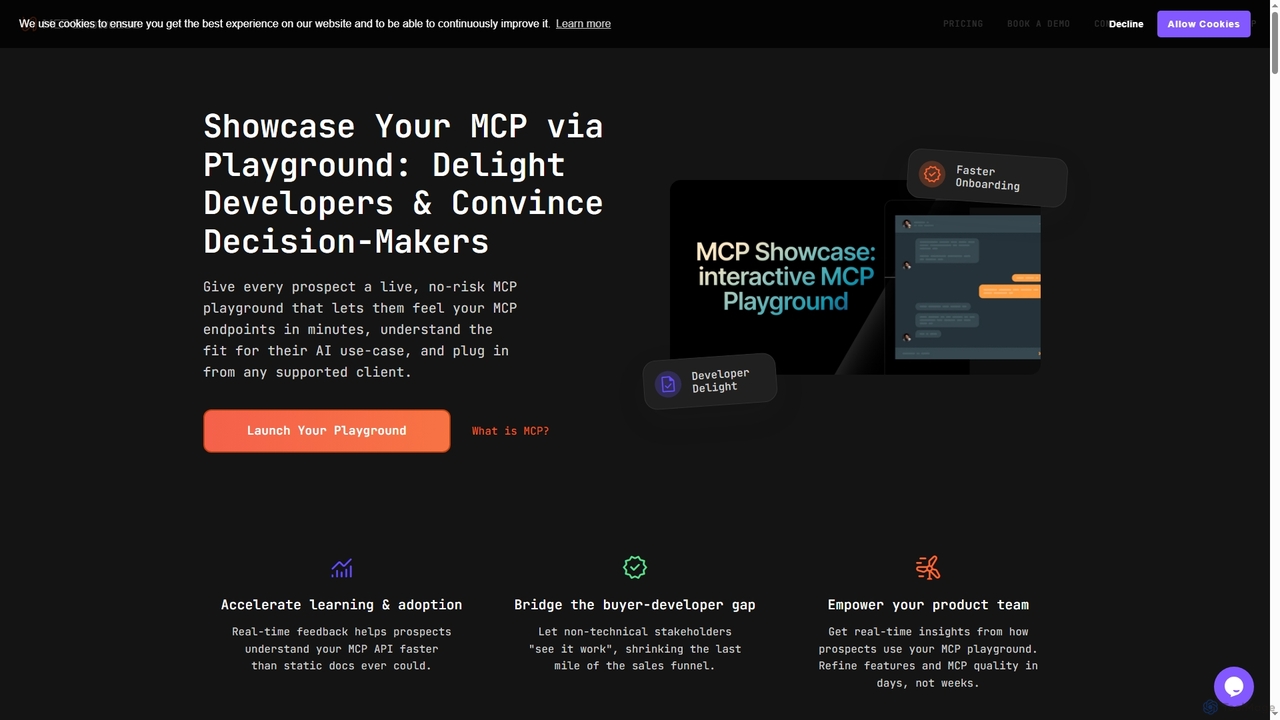
MCP Showcase is a pioneering platform demonstrating the Model Context Protocol (MCP), an open standard enabling AI assistants …

3.2K

About Model Discovery

Model Discovery tools are platforms designed to help users search, evaluate, and access pre-trained machine learning models. These tools function as extensive libraries or marketplaces, cataloging a vast array of models for tasks like natural language processing, computer vision, and audio generation. They enable developers and researchers to rapidly integrate advanced AI capabilities into applications without the immense cost and time of training models from scratch. Many platforms also provide performance benchmarks, documentation, and APIs for seamless implementation, accelerating the entire development lifecycle.

Core Features

  • Centralized Model Repository: A comprehensive, searchable library of pre-trained models for various tasks and domains.
  • Advanced Filtering and Search: Functionality to filter models by framework (e.g., TensorFlow, PyTorch), task, dataset, or license type.
  • Performance Benchmarks: Comparative data on model accuracy, inference speed, size, and other key metrics.
  • API Access and Integration: Tools and code snippets for easily downloading, deploying, or calling models programmatically.
  • Community and Documentation: Access to user ratings, tutorials, research papers, and detailed usage examples.

Use Cases

These tools are essential for developers building AI-powered applications, researchers comparing different model architectures, and businesses seeking to quickly prototype new AI features. For instance, a mobile app developer can find an optimized object detection model for on-device use, while a data scientist can compare several text summarization models to find the most accurate one for their specific dataset.

How to Choose

When selecting a Model Discovery tool, consider the breadth and quality of its model collection. Evaluate the supported machine learning frameworks and ensure they align with your tech stack. Pay close attention to the licensing terms of the models, especially for commercial projects. Finally, assess the quality of the documentation, community support, and ease of integration provided by the platform.

Model DiscoveryUse Cases

1

Rapid Prototyping of an AI Feature

A product manager at a tech startup wants to validate a new feature idea: automatically tagging user-uploaded images. Instead of tasking the engineering team with a multi-month project to build a custom model, they use a Model Discovery platform. They filter for high-accuracy, commercially-licensed image classification models compatible with PyTorch. Within an hour, they find a suitable ResNet variant, deploy it on a test server using the platform's API, and build a working prototype. This allows them to gather user feedback in days instead of months, significantly reducing development risk and cost.

2

Academic Research and Model Benchmarking

A university researcher is studying the trade-offs between speed and accuracy in object detection models for autonomous drones. Using a Model Discovery hub, they can access a curated list of relevant models like YOLO, SSD, and Faster R-CNN. The platform provides direct download links, links to the original research papers, and standardized performance metrics. This saves the researcher weeks of work searching for and implementing different models, allowing them to focus directly on their core research: running comparative experiments and analyzing the results for their specific use case.

3

Fine-tuning a Language Model for a Specific Domain

A legal tech company needs a chatbot that understands complex legal terminology. Training a large language model (LLM) from scratch is prohibitively expensive. Instead, their machine learning engineer uses a Model Discovery platform to find a powerful, open-source base model like Llama or Mistral. They download the model and then fine-tune it on their proprietary dataset of legal documents. This approach combines the general knowledge of the pre-trained model with the domain-specific expertise from their data, resulting in a highly accurate, specialized chatbot at a fraction of the cost of full training.

4

Selecting a Text-to-Speech Model for an Application

A developer is building an audiobook application and needs a high-quality, natural-sounding text-to-speech (TTS) voice. They use a Model Discovery platform that specializes in audio models. The platform allows them to filter models by language, gender, and voice style (e.g., narrative, conversational). Crucially, it provides interactive demos where they can input custom text and listen to the generated audio output for each model. By directly comparing the audio samples, they can quickly select the model with the best voice quality and emotional tone for their application, avoiding a lengthy and subjective evaluation process.

5

Ensuring Model Licensing Compliance for Commercial Use

A large enterprise is developing a commercial product that incorporates several open-source AI models. Their legal team needs to ensure that all models comply with company policy and are licensed for commercial use. They use a Model Discovery platform that provides detailed licensing information for each model. The legal team can filter the entire repository by license type (e.g., Apache 2.0, MIT) and generate a report of all models used by their development teams. This streamlines the compliance process, prevents potential legal issues, and allows developers to confidently use pre-trained models in commercial products.

6

Enhancing E-commerce Search with Image Similarity

An e-commerce platform wants to implement a "visual search" feature, allowing users to find similar products by uploading an image. An ML engineer on the team uses a Model Discovery platform to find a suitable image embedding model, such as CLIP. These models convert images into numerical vectors where similar images have vectors that are close together. By integrating this pre-trained model, the engineer can quickly build a system that indexes all product images as vectors. When a user uploads an image, it's converted to a vector, and the system finds the closest matching product vectors, providing highly relevant visual search results without needing to train a complex model internally.

Model DiscoveryFrequently Asked Questions