Neural Designer
Neural Designer is a user-friendly, no-code machine learning platform specializing in neural networks. It enables users to build, …
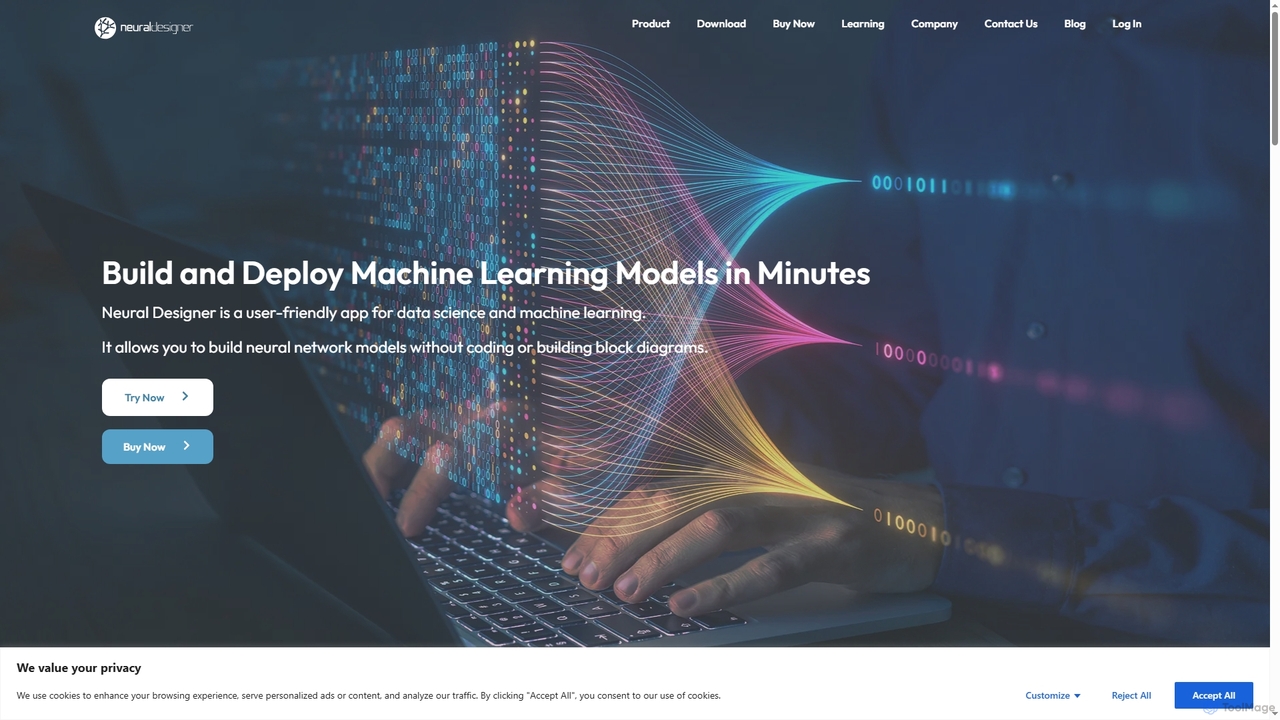
Neural Designer is a user-friendly, no-code machine learning platform specializing in neural networks. It enables users to build, train, and deploy advanced AI models for approximation, classification, and forecasting without writing any code or complex block diagrams. Designed for data scientists and organizations, it offers high performance, energy efficiency, and superior accuracy across various industries.
About Neural Networks
Neural Networks are a class of artificial intelligence models inspired by the human brain's structure, designed to learn and recognize complex patterns from data. These powerful algorithms process information through interconnected layers of nodes, adjusting weights and biases to identify intricate relationships. They excel at tasks requiring sophisticated pattern recognition, prediction, and classification, forming a cornerstone of modern machine learning and deep learning applications.
Core Features
- Pattern Recognition: Automatically identifies intricate and non-obvious patterns within large datasets.
- Adaptive Learning: Continuously improves performance by learning from new data without explicit programming.
- Feature Extraction: Automatically discovers and extracts relevant features from raw input data, reducing manual effort.
- Non-linear Modeling: Capable of modeling complex, non-linear relationships in data, surpassing traditional linear methods.
- Scalability: Can be scaled to handle massive datasets and highly complex problems, especially in deep learning architectures.
Use Cases
Neural Networks are widely applied across various domains, from automating complex data analysis to powering intelligent systems. They are crucial in fields like computer vision for object detection, natural language processing for sentiment analysis, and predictive analytics in finance for market forecasting.
How to Choose
Selecting the right Neural Network approach involves considering the problem's complexity, the volume and nature of available data, and computational resources. Evaluate factors such as the required model interpretability, the specific task (e.g., classification, regression, generation), and compatibility with existing machine learning frameworks like TensorFlow or PyTorch.

Neural NetworksUse Cases
Image Classification for Medical Diagnosis
Radiologists and medical researchers utilize Convolutional Neural Networks (CNNs) to analyze medical images like X-rays, MRIs, and CT scans. By training on vast datasets of labeled images, these networks can accurately detect anomalies such as tumors, fractures, or disease indicators, assisting in early diagnosis and improving diagnostic efficiency and consistency.
Natural Language Understanding in Customer Service
Companies deploy advanced Neural Networks, particularly Transformer models, in AI-powered chatbots and virtual assistants. These networks enable the systems to understand complex customer queries, extract intent, and provide relevant, context-aware responses, significantly enhancing customer support experience and reducing response times.
Fraud Detection in Financial Transactions
Financial institutions employ Artificial Neural Networks (ANNs) to monitor and analyze vast streams of transaction data in real-time. By identifying subtle, unusual patterns that deviate from normal behavior, these networks can flag potentially fraudulent activities, protecting customers and minimizing financial losses with high accuracy.
Personalized Content Recommendation
Streaming services, e-commerce platforms, and social media sites leverage deep Neural Networks to power their recommendation engines. These networks analyze user preferences, viewing history, and interactions to suggest highly personalized movies, products, or content, significantly improving user engagement and satisfaction.
Autonomous Vehicle Perception and Navigation
Neural Networks are fundamental to autonomous driving systems, processing real-time data from cameras, lidar, and radar sensors. They perform critical tasks like object detection (pedestrians, vehicles, traffic signs), lane keeping, and scene segmentation, enabling vehicles to understand their environment and navigate safely.
Speech Recognition for Voice Assistants
Voice assistants like Siri, Alexa, and Google Assistant rely heavily on Recurrent Neural Networks (RNNs) or Transformer-based models for accurate speech-to-text transcription. These networks learn to map audio signals to text, enabling seamless voice command processing and natural language interaction, making technology more accessible.