Machine Learning Best in category 1 results Dataset Tools AI Tool

Popular AI tools in the Dataset Tools field of Machine Learning include RoryPlans, etc., helping you quickly improve efficiency.

RoryPlans

RoryPlans

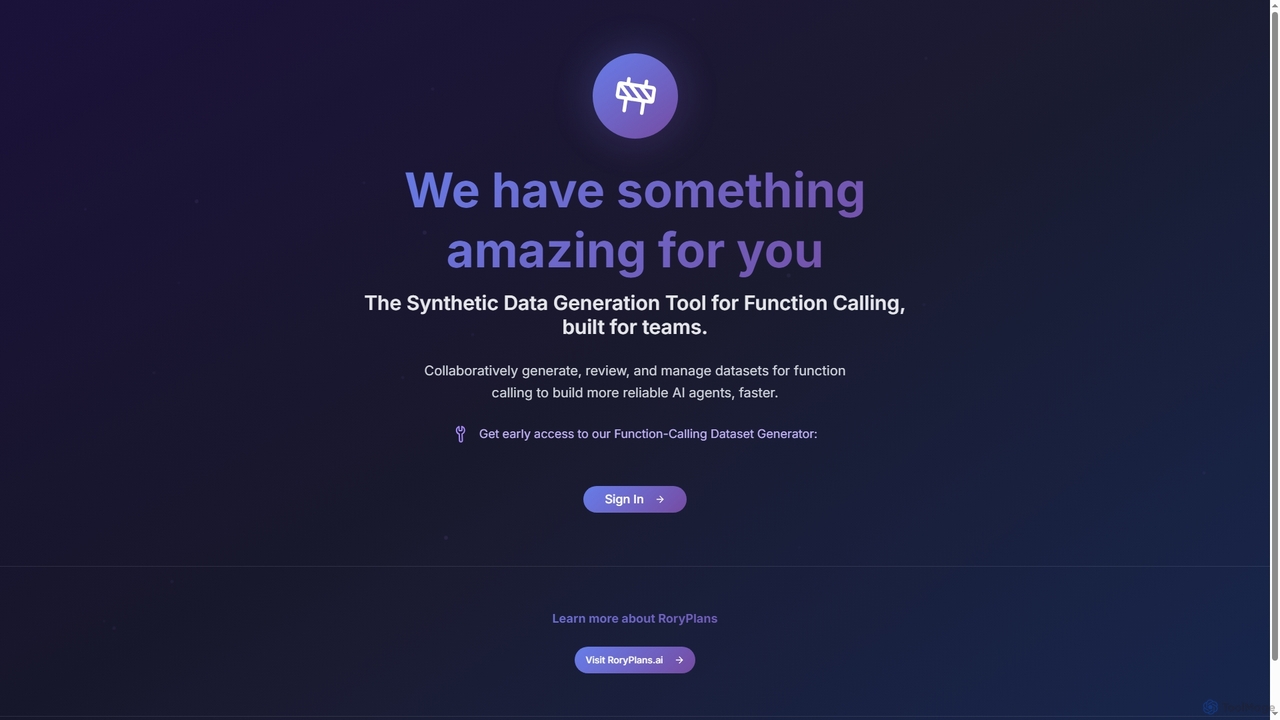
RoryPlans is a specialized AI tool designed for teams to collaboratively generate, review, and manage synthetic datasets for …

2.3K

About Dataset Tools

Dataset Tools are specialized AI-powered applications designed to create, process, manage, and enhance the datasets essential for training machine learning models. These tools streamline the crucial data preparation phase, ensuring high-quality, well-structured, and diverse data inputs. They enable data scientists and ML engineers to build more accurate, robust, and unbiased AI systems by providing efficient methods for data handling and refinement.

Core Features

  • Data Annotation & Labeling: Facilitates the tagging and categorization of raw data (images, text, audio) for supervised learning.
  • Data Augmentation: Generates modified versions of existing data to expand dataset size and diversity, improving model generalization.
  • Data Cleaning & Preprocessing: Identifies and corrects errors, removes inconsistencies, and transforms raw data into a suitable format for model training.
  • Synthetic Data Generation: Creates artificial data that mimics real-world data characteristics, useful for privacy, rare cases, or data scarcity.
  • Dataset Versioning & Management: Tracks changes, organizes, and stores different iterations of datasets, ensuring reproducibility and collaboration.

Applicable Scenarios

Dataset Tools are indispensable for machine learning projects across various industries. Data scientists use them to prepare vast amounts of data for training computer vision models, natural language processing systems, and predictive analytics. Researchers leverage these tools to experiment with different data representations and improve model robustness, while businesses employ them to ensure data quality and compliance for AI-driven applications.

How to Choose

When selecting Dataset Tools, consider the types of data you work with (image, text, audio, tabular) and the specific annotation or augmentation needs. Evaluate scalability for large datasets, integration capabilities with existing ML pipelines, and the level of automation offered. User-friendliness, collaboration features, pricing models, and compliance with data privacy regulations are also critical factors for making an informed decision.

Dataset ToolsUse Cases

1

Image Annotation for Autonomous Driving

Autonomous vehicle developers utilize dataset tools to precisely annotate millions of images and video frames with bounding boxes, semantic segmentation, and keypoints. This detailed labeling helps train computer vision models to accurately detect pedestrians, vehicles, traffic signs, and road conditions, ensuring the safety and reliability of self-driving systems.

2

Text Labeling for Sentiment Analysis Models

NLP engineers employ dataset tools to label large volumes of customer reviews, social media posts, or support tickets with sentiment (positive, negative, neutral) or specific entities. This labeled text data is then used to train sentiment analysis models, enabling businesses to automatically understand customer feedback and improve service or product offerings.

3

Data Augmentation for Medical Imaging

Medical researchers and AI developers use data augmentation tools to generate diverse variations of limited medical image datasets (e.g., X-rays, MRIs). By applying transformations like rotation, scaling, and brightness adjustments, they can expand the dataset, helping train more robust and accurate diagnostic AI models, especially for rare disease detection.

4

Synthetic Data Generation for Financial Fraud Detection

Financial institutions leverage synthetic data generation tools to create artificial transaction datasets that mimic real-world fraud patterns without exposing sensitive customer information. This allows them to train and test fraud detection AI models more securely and effectively, particularly for rare fraud events where real data is scarce.

5

Audio Transcription and Labeling for Voice Assistants

Developers of voice assistants and speech recognition systems use dataset tools to transcribe and label audio recordings with spoken words, speaker identification, and emotional cues. This meticulously prepared audio data is crucial for training AI models to accurately understand and respond to human speech, enhancing the user experience.

6

Dataset Cleaning for Predictive Maintenance

Industrial engineers and data scientists apply dataset cleaning tools to refine sensor data collected from machinery for predictive maintenance models. By identifying and correcting anomalies, missing values, or inconsistent readings, they ensure the training data is high-quality, leading to more accurate predictions of equipment failures and optimized maintenance schedules.

Dataset ToolsFrequently Asked Questions