ToolMage
Sign in

Best 1 Data Generation AI tools for Ai Development

Popular Data Generation AI tools in Ai Development include RoryPlans, helping you work more efficiently.

RoryPlans

RoryPlans

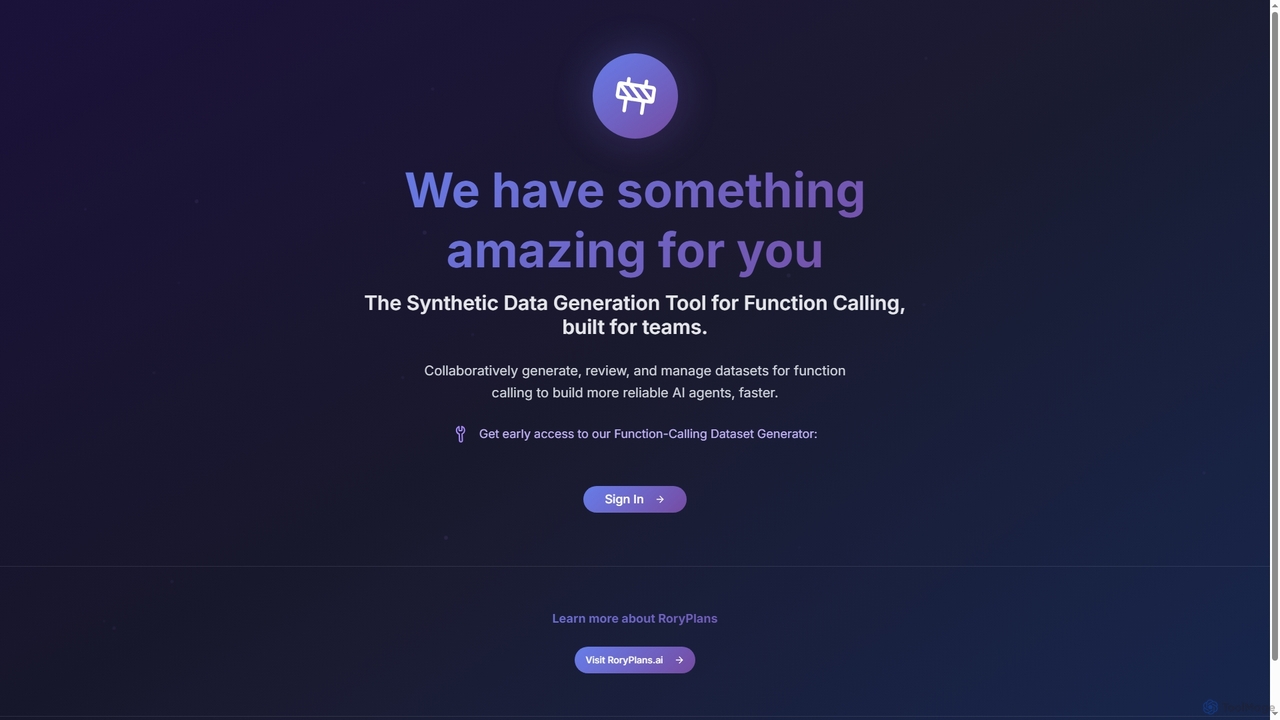
RoryPlans is a specialized AI tool designed for teams to collaboratively generate, review, and manage synthetic datasets for function calling. It aims to accelerate the development of more reliable AI agents by providing high-quality, structured data.

Data Generation
Visits 7.4KFavorites 133Likes 134

About Data Generation

Data Generation tools are AI-powered solutions designed to automatically create synthetic datasets that mimic the characteristics and patterns of real-world data. Leveraging advanced generative models, these tools can produce diverse forms of data, including text, images, audio, video, and tabular information, without relying on actual collected data. They are invaluable for overcoming data scarcity, enhancing privacy, and accelerating the development and testing of AI models across various industries.

Core Features

  • Synthetic Data Creation: Generates new data points that statistically resemble real data, preserving privacy and reducing bias.
  • Data Augmentation: Expands existing datasets by creating variations or new samples, improving model robustness and performance.
  • Privacy Preservation: Produces data that shares statistical properties with sensitive real data but contains no identifiable original information.
  • Customizable Data Parameters: Allows users to define specific attributes, distributions, or scenarios for the generated data.

Applicable Scenarios

Data Generation tools are widely used in scenarios where real data is scarce, sensitive, or expensive to acquire. This includes training machine learning models in healthcare with anonymized patient records, developing autonomous driving systems with simulated sensor data, and creating diverse content for marketing campaigns without extensive photoshoots.

How to Choose

When selecting a Data Generation tool, consider the type of data you need to generate (e.g., tabular, image, text), the required level of data realism and fidelity, and the tool's ability to integrate with your existing data pipelines. Evaluate its privacy features, scalability for large datasets, and the ease of customizing generation parameters to meet specific project requirements.

Data Generation use cases

1

Training AI Models with Privacy-Sensitive Data

Healthcare researchers and financial institutions often deal with highly sensitive patient or customer data. Data Generation tools allow them to create synthetic versions of this data, preserving the statistical properties necessary for training robust machine learning models while ensuring compliance with strict privacy regulations like GDPR or HIPAA, avoiding the use of real, identifiable information.

2

Augmenting Limited Datasets for Machine Learning

For startups or niche applications, acquiring large, diverse datasets can be challenging and costly. AI developers use Data Generation tools to expand small, real datasets by creating numerous synthetic variations. This significantly increases the volume and diversity of training data, helping to prevent overfitting and improve the generalization capabilities of their machine learning models, leading to better performance.

3

Developing and Testing Autonomous Systems

Engineers building autonomous vehicles or robotics require vast amounts of diverse sensor data (e.g., lidar, radar, camera feeds) for training and testing. Data Generation tools can simulate complex real-world scenarios, generating synthetic sensor data under various weather conditions, lighting, and traffic situations. This enables thorough testing of perception and decision-making algorithms in a safe, controlled, and scalable environment.

4

Creating Realistic Test Data for Software Development

Software testers and developers frequently need realistic yet non-sensitive data to test applications, especially those handling personal information. Data Generation tools can produce large volumes of synthetic user profiles, transaction records, or system logs that mirror real data structures and distributions. This ensures comprehensive testing of application logic, performance, and security without compromising actual user privacy.

5

Generating Diverse Content for Marketing and Design

Marketing teams and graphic designers often need a wide array of visual or textual content for campaigns, product mockups, or website development. Data Generation tools can create synthetic images of products in different settings, generate varied ad copy, or even produce unique design elements. This accelerates content creation, offers more creative options, and reduces the need for expensive photoshoots or manual content production.

6

Simulating Financial Market Scenarios for Risk Analysis

Financial analysts and risk managers need to test models against various market conditions, including rare or extreme events. Data Generation tools can simulate complex financial time series data, generating hypothetical market movements, stock prices, or economic indicators. This allows for robust stress testing of investment portfolios and risk management strategies, helping to identify vulnerabilities before they occur in real markets.

Data Generation FAQ

What are Data Generation tools?

Data Generation tools are AI-powered software solutions that create artificial, synthetic data designed to mimic the statistical properties and patterns of real-world data. They are crucial for scenarios where real data is scarce, sensitive, or expensive to obtain, enabling the development and testing of AI models and software applications without compromising privacy.

How do Data Generation tools differ from Data Augmentation?

While both expand datasets, Data Generation creates entirely new, synthetic data points from scratch, often based on learned distributions of real data. Data Augmentation, on the other hand, typically applies transformations (e.g., rotations, cropping, color changes for images; synonyms for text) to existing real data to create variations. Data Generation aims for novel data, while augmentation modifies existing samples.

What types of data can AI Data Generation tools create?

AI Data Generation tools are highly versatile and can create a wide array of data types. This includes tabular data (e.g., customer records, financial transactions), images (e.g., faces, objects, scenes), text (e.g., articles, reviews, code), audio (e.g., speech, music), and video. The specific capabilities depend on the underlying generative AI models used by the tool.

What are the main benefits of using Data Generation tools?

The primary benefits include enhanced data privacy by using synthetic data instead of sensitive real data, overcoming data scarcity for training robust AI models, reducing the cost and time associated with real data collection, and enabling the creation of diverse test scenarios for software and autonomous systems. They accelerate development cycles and improve model generalization.

How realistic is the data generated by these tools?

The realism of generated data varies significantly depending on the sophistication of the AI model and the quality of the real data used for training the generator. Modern generative models (like GANs or diffusion models) can produce highly realistic and statistically accurate synthetic data that is often indistinguishable from real data, especially for specific domains. However, achieving perfect realism across all dimensions remains an ongoing research area.