
ToolMage
Sign in

Best 1 Agentic Ai AI tools for Ai Development

Popular Agentic Ai AI tools in Ai Development include Metorial, helping you work more efficiently.

Metorial
Freemium

Metorial

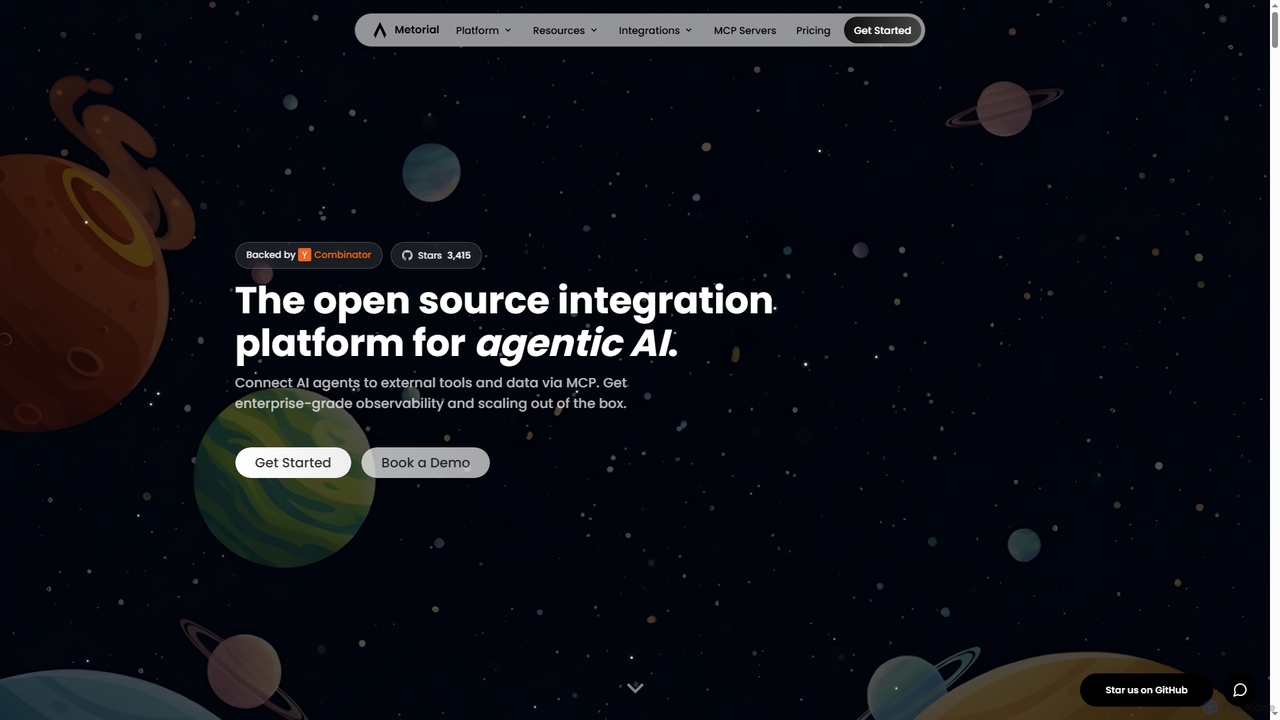
Metorial is an integration platform for AI agents, enabling developers to quickly build, deploy, and monitor powerful agentic AI applications. It provides seamless connections to hundreds of tools, data sources, and APIs via its serverless Model Context Protocol (MCP) platform, offering robust SDKs, observability, and enterprise-grade security for scalable AI solutions.

Agentic Ai
Visits 11.8KFavorites 120Likes 121

About Agentic Ai

Agentic AI refers to advanced AI systems capable of autonomous goal-setting, planning, and execution in complex environments. These tools leverage large language models and other AI techniques to break down high-level objectives into actionable sub-tasks, often utilizing external tools and APIs. They offer significant value by automating multi-step processes, enabling proactive problem-solving, and adapting to dynamic situations without constant human intervention. This category represents a significant leap towards more intelligent and self-sufficient AI applications within AI Development.

Core Features

  • Autonomous Planning: AI agents can define steps and strategies to achieve a given goal.
  • Tool Utilization: Ability to integrate and use external tools, APIs, and databases to perform tasks.
  • Self-Correction & Reflection: Agents can evaluate their progress, identify errors, and adjust their plans.
  • Memory Management: Maintain context and learn from past interactions to improve future performance.
  • Multi-step Task Execution: Orchestrate a series of actions to complete complex, multi-faceted objectives.

Applicable Scenarios

Agentic AI tools are invaluable for automating intricate workflows in various sectors. They are particularly useful for researchers needing to synthesize information from multiple sources, developers automating code generation and testing pipelines, and marketers orchestrating complex campaign strategies across different platforms. These systems excel where tasks require dynamic decision-making and interaction with diverse digital environments.

How to Choose

When selecting an Agentic AI tool, consider its level of autonomy and the complexity of tasks it can handle. Evaluate its integration capabilities with your existing tools and data sources, as well as the robustness of its safety protocols and guardrails. Assess the interpretability of its decision-making process and its scalability to meet future demands, alongside the overall cost-effectiveness for your specific use cases.

Featured tool rankings

Agentic Ai use cases

1

Automated Market Research & Report Generation

A marketing analyst can deploy an Agentic AI to autonomously scour the internet, analyze competitor strategies, identify emerging trends, and synthesize this data into comprehensive market research reports. The AI can access various data sources, process natural language content, and structure findings, significantly reducing manual research time and providing actionable insights for strategic planning.

2

Personalized Learning Path Creation

Educational platforms can utilize Agentic AI to create highly personalized learning paths for students. The AI assesses a student's current knowledge, learning style, and goals, then dynamically curates resources, suggests exercises, and adapts the curriculum in real-time. This ensures an optimized learning experience, addressing individual needs and accelerating skill acquisition across various subjects.

3

Complex Software Development Task Orchestration

Software development teams can leverage Agentic AI to automate and manage complex coding tasks. An AI agent can receive a high-level feature request, break it down into smaller coding modules, write code, run tests, debug, and even integrate the changes into a version control system. This significantly streamlines the development lifecycle, allowing human developers to focus on architectural design and complex problem-solving.

4

Proactive Customer Support & Issue Resolution

Customer service departments can deploy Agentic AI to provide proactive support. Instead of merely responding to queries, the AI can monitor customer interactions, identify potential issues before they escalate, gather relevant information from internal knowledge bases, and even initiate resolution steps or suggest solutions to human agents. This enhances customer satisfaction and reduces response times for complex problems.

5

Data-driven Investment Strategy Formulation

Financial analysts can utilize Agentic AI to develop sophisticated, data-driven investment strategies. The AI can continuously monitor market data, news feeds, economic indicators, and company reports, then autonomously identify investment opportunities, assess risks, and even propose portfolio adjustments based on predefined objectives and risk tolerance. This enables more dynamic and responsive financial decision-making.

6

Multi-platform Content Distribution & Optimization

Content creators and digital marketers can deploy Agentic AI to manage and optimize content distribution across various platforms. The AI can analyze audience engagement metrics, identify optimal posting times for different channels (e.g., social media, blogs, email), tailor content formats for each platform, and even suggest modifications to improve reach and impact. This automates complex content strategies and maximizes audience interaction.

Agentic Ai FAQ

What is Agentic AI?

Agentic AI refers to AI systems designed to operate autonomously, setting their own goals, planning actions, and executing tasks in dynamic environments. They typically feature the ability to break down complex problems, utilize external tools or APIs, and self-correct based on feedback. Common use cases include automated research, complex workflow orchestration, and proactive problem-solving, representing a significant evolution in AI capabilities.

How does Agentic AI differ from traditional AI models?

Traditional AI models often perform specific, pre-defined tasks, such as image recognition or natural language generation, in a reactive manner. Agentic AI, however, goes beyond this by exhibiting autonomy, goal-setting, and multi-step planning. It can dynamically adapt to new information, utilize various tools to achieve its objectives, and engage in self-reflection to improve its performance, making it more akin to a digital assistant capable of complex problem-solving.

What are the key benefits of using Agentic AI tools?

The primary benefits of Agentic AI tools include significant automation of complex, multi-step workflows, leading to increased efficiency and reduced manual effort. They enable proactive problem-solving and decision-making, as the AI can identify issues and act without constant human oversight. Furthermore, Agentic AI can adapt and learn from dynamic environments, providing more flexible and resilient solutions compared to static automation scripts, ultimately freeing up human resources for higher-value tasks.

What are the challenges and limitations of Agentic AI?

Despite their potential, Agentic AI tools face challenges such as ensuring safety and preventing unintended actions, especially in critical applications. Their decision-making processes can sometimes lack transparency, making it difficult to debug or understand failures. Scalability and computational costs for highly autonomous agents can also be significant. Furthermore, the need for robust guardrails and human oversight remains crucial to mitigate risks and ensure ethical deployment, particularly as their autonomy increases.

How can Agentic AI be integrated into existing workflows?

Integrating Agentic AI into existing workflows typically involves identifying repetitive, multi-step tasks that require dynamic decision-making. These tools can be connected via APIs to existing software, databases, and communication channels. Initial deployment often includes defining clear objectives, setting up guardrails, and establishing human-in-the-loop review processes. Gradual integration, starting with less critical tasks, allows teams to build trust and refine the AI's performance before scaling to more complex operations, ensuring a smooth transition and maximum benefit.