ToolMage
Sign in

Best 1 Context Management AI tools for Ai Development

Popular Context Management AI tools in Ai Development include Twigg, helping you work more efficiently.

Twigg
Freemium

Twigg

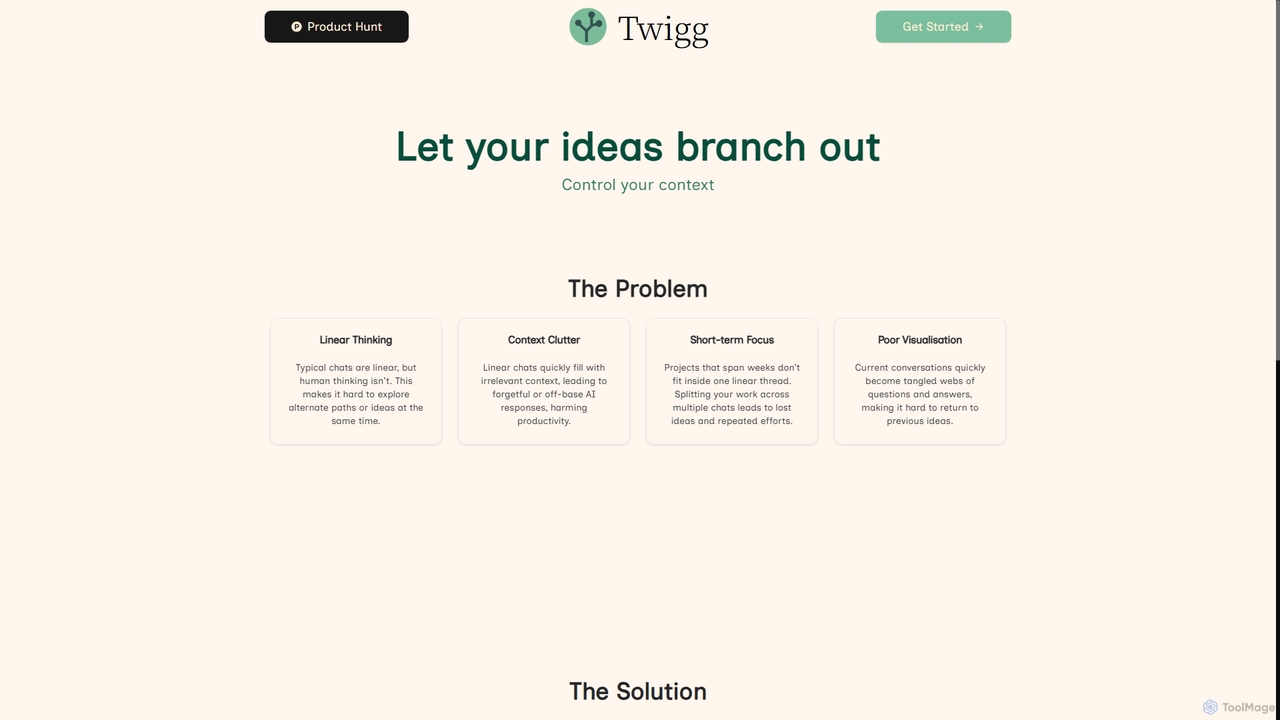
Twigg is an innovative AI chat interface that transforms linear conversations into interactive, branching idea trees. It helps users manage context, explore tangents, and visualize complex projects, making long-term collaboration with LLMs more efficient and intuitive.

Context Management
Visits 5.7KFavorites 170Likes 163

About Context Management

Context Management tools are AI-powered solutions designed to maintain and utilize relevant information throughout interactions, particularly within large language models (LLMs). These tools enable AI systems to remember past conversational turns, user preferences, and specific domain knowledge, ensuring coherent and contextually appropriate responses. By effectively managing the "memory" of an AI, they significantly enhance the naturalness and effectiveness of AI applications, moving beyond single-turn interactions.

Core Features

  • Context Window Management: Dynamically adjusts and optimizes the input context length for LLMs, ensuring relevant information is prioritized.
  • Session State Tracking: Maintains user-specific data and interaction history across multiple turns or sessions for personalized experiences.
  • Long-Term Memory Integration: Connects AI models with external knowledge bases or vector databases to retrieve and inject relevant historical data.
  • Contextual Filtering & Summarization: Identifies and extracts the most critical information from extensive dialogue history or documents to fit within context limits.
  • Prompt Engineering Support: Facilitates the dynamic construction and optimization of prompts by injecting relevant context for improved AI outputs.

Applicable Scenarios

Developers use these tools to build chatbots and virtual assistants that can hold extended, coherent conversations, remembering user preferences and past interactions. Content platforms leverage context management to tailor recommendations or generate articles that align with a user's historical interests and engagement patterns. Enterprises apply these tools to automate multi-step processes where AI needs to maintain state and refer back to previous actions or data points, such as in customer support workflows.

How to Choose

Assess compatibility with existing AI frameworks (e.g., LangChain, LlamaIndex) and data storage solutions. Evaluate how well the tool handles increasing volumes of context data and concurrent user sessions without performance degradation. Look for features that intelligently manage token limits, such as summarization, compression, or retrieval-augmented generation (RAG) capabilities. Consider the developer experience, documentation quality, and the simplicity of integrating context management into your AI applications.

Featured tool rankings

Context Management use cases

1

Building Stateful Chatbots

AI developers use context management tools to create chatbots that remember previous questions and answers, allowing for natural follow-up conversations and personalized support. For instance, a customer service bot can recall a user's past order details to provide relevant assistance without repeated inquiries, significantly improving user satisfaction and reducing interaction time.

2

Personalizing E-commerce Recommendations

E-commerce platforms employ context management to track user browsing history, purchase patterns, and explicit preferences. This allows AI recommendation engines to suggest highly relevant products or content, dynamically adjusting offers based on real-time interaction and historical data, leading to increased conversion rates and a more tailored shopping experience.

3

Automating Multi-Turn Customer Support

Customer support teams utilize these tools to power AI agents capable of handling complex, multi-step inquiries. The AI can maintain the full context of a customer's issue across several interactions, escalating to human agents with a complete history if needed, ensuring seamless transitions and consistent problem resolution.

4

Enhancing Code Generation with Project Context

Software engineers integrate context management into AI code assistants to provide the AI with an understanding of the entire codebase, project structure, and coding conventions. This enables the AI to generate more accurate, consistent, and contextually relevant code snippets, functions, or documentation, accelerating development cycles and reducing errors.

5

Creating Adaptive Educational Tutors

Educational technology companies use context management to develop AI tutors that track a student's learning progress, strengths, and weaknesses. The AI can then adapt its teaching methods, provide personalized explanations, and suggest relevant exercises based on the student's unique learning journey, fostering more effective and engaging educational experiences.

6

Optimizing Legal Document Review

Legal professionals leverage context management tools to help AI systems understand the nuances of complex legal documents and case histories. By maintaining the context of specific clauses, precedents, and related documents, the AI can more accurately identify relevant information, summarize key points, and assist in drafting new documents, significantly speeding up review processes.

Context Management FAQ

What are AI Context Management tools?

AI Context Management tools are specialized solutions within AI development that enable AI systems, especially large language models (LLMs), to maintain and utilize relevant information across interactions. They ensure that AI remembers conversational history, user preferences, or specific domain knowledge to generate coherent, personalized, and contextually appropriate responses, moving beyond single-turn interactions.

Why is Context Management important for LLMs?

Context Management is crucial for LLMs because it addresses their inherent limitation of having a finite "context window." Without it, LLMs would forget previous parts of a conversation or relevant background information, leading to disjointed and less useful outputs. Effective context management allows LLMs to simulate long-term memory, understand complex dialogues, and provide more accurate, personalized, and human-like interactions.

How do Context Management tools differ from basic prompt engineering?

While basic prompt engineering focuses on crafting a single, effective input for an LLM, Context Management tools go further by dynamically building and managing that input over time. They handle the complexities of retrieving, summarizing, and injecting relevant historical data or external knowledge into the prompt, ensuring the LLM always receives the most pertinent context, which is beyond manual prompt engineering for multi-turn or knowledge-intensive tasks.

What are the key challenges in AI Context Management?

Key challenges include managing the "context window" size limitations of LLMs, ensuring the relevance and accuracy of retrieved information, balancing performance with the complexity of context processing, and handling privacy and security of sensitive user data. Additionally, maintaining long-term memory across diverse and evolving user interactions presents significant technical hurdles.

Who benefits most from using Context Management tools?

Developers building advanced conversational AI applications, such as intelligent chatbots, virtual assistants, and personalized recommendation systems, benefit significantly. Businesses aiming to automate complex, multi-step customer service workflows, content creators seeking to generate highly personalized content, and enterprises integrating AI into knowledge-intensive operations also gain immense value from these tools.