
Flutch
Flutch is a comprehensive platform for developing, deploying, and managing custom AI agents with a strong focus on …
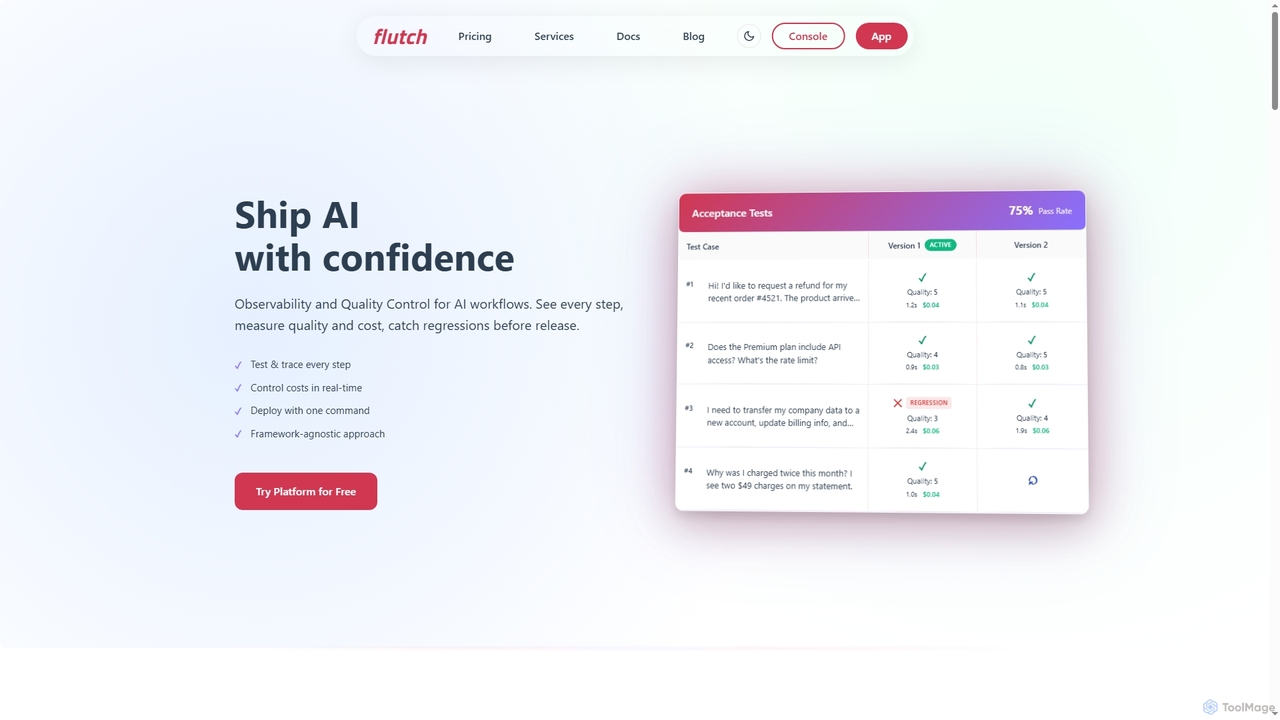
Flutch is a comprehensive platform for developing, deploying, and managing custom AI agents with a strong focus on observability, quality control, and cost management. It empowers developers to build reliable AI workflows, test agents rigorously, monitor performance in real-time, and integrate seamlessly into existing systems, ensuring AI solutions are shipped with confidence and operate efficiently.
About Agent Management
Agent Management tools are specialized AI platforms designed to orchestrate, monitor, and control autonomous AI agents. These tools provide comprehensive frameworks for deploying, configuring, and supervising agents as they perform tasks and make decisions. They are essential for operationalizing and scaling complex AI applications, ensuring agents operate efficiently, reliably, and in alignment with business objectives within dynamic environments.
Core Features
- Agent Orchestration: Design and manage workflows for multiple agents, coordinating their interactions and task assignments.
- Performance Monitoring: Track agent activity, resource usage, and task completion rates to ensure optimal operation.
- Safety & Control: Implement guardrails, ethical guidelines, and termination protocols to manage agent behavior and prevent unintended actions.
- Task Delegation: Automatically assign specific tasks to agents based on their capabilities and current operational context.
- Lifecycle Management: Handle the deployment, updating, scaling, and retirement of AI agents throughout their operational lifespan.
Use Cases
These tools are used in scenarios ranging from automating complex business processes and managing intelligent robotic fleets to orchestrating AI-driven customer service operations and developing advanced simulation environments.
How to Choose
When selecting Agent Management tools, consider the complexity of agent interactions, the need for real-time monitoring, integration capabilities with existing AI models and systems, and the robustness of safety and control features. Scalability, ease of deployment, and support for various agent architectures are also critical factors.
Agent ManagementUse Cases
Automating Multi-Step Business Workflows
For enterprise operations teams, Agent Management tools enable the creation of autonomous workflows where different AI agents handle sequential or parallel tasks. For example, one agent might extract data from invoices, another validates it against a database, and a third initiates payment, all orchestrated and monitored by the management system, significantly reducing manual intervention and processing time.
Orchestrating AI-Driven Customer Support
Customer service departments use Agent Management to deploy and coordinate specialized AI agents for various support functions. A primary agent might triage incoming queries, routing complex issues to a knowledge-base agent, while another handles routine FAQs, and a third escalates critical cases to human agents, ensuring efficient and consistent customer interactions.
Managing Autonomous Robotic Fleets
In manufacturing or logistics, Agent Management systems oversee fleets of autonomous robots or drones. These tools assign tasks like inventory management or delivery routes, monitor their operational status, battery levels, and location, and intervene if anomalies occur, optimizing fleet efficiency and safety in dynamic physical environments.
Developing and Testing Complex AI Systems
AI developers leverage Agent Management to design, simulate, and test multi-agent systems before deployment. This involves defining agent roles, interactions, and environmental parameters, then running simulations to observe emergent behaviors, identify potential conflicts, and refine agent policies, accelerating development cycles and improving system robustness.
Ensuring AI Agent Alignment and Safety
For organizations deploying critical AI agents, these tools provide essential guardrails and monitoring for ethical AI use. They allow for the definition of behavioral constraints, real-time anomaly detection, and the ability to pause or terminate agents that deviate from expected norms or ethical guidelines, ensuring responsible AI operation.
Personalized Content Generation and Distribution
Marketing and content teams can use Agent Management to coordinate AI agents for personalized content creation and distribution. One agent might analyze user preferences, another generates tailored content variations (e.g., ad copy, email subject lines), and a third schedules and distributes this content across various platforms, optimizing engagement and reach.