Caywork
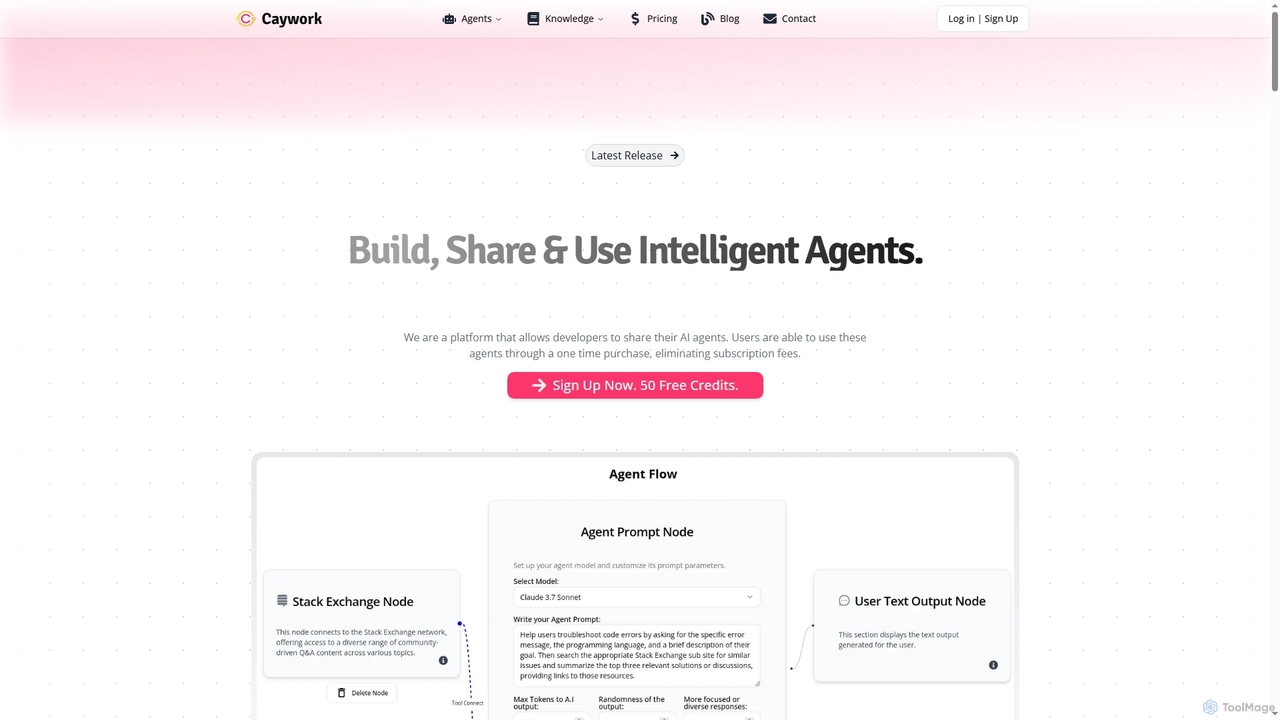
Caywork is a platform for building, sharing, and using intelligent AI agents. It offers developers a streamlined way …
Caywork is a platform for building, sharing, and using intelligent AI agents. It offers developers a streamlined way to publish task-specific agents without upfront costs, handling integrations and hosting. Users benefit from a pay-per-use credit system, eliminating subscriptions and providing quick access to a diverse marketplace of agents.
About Agent Platforms
Agent Platforms are specialized AI-powered tools designed to build, deploy, and manage autonomous AI agents. These platforms provide the foundational infrastructure for creating intelligent entities capable of understanding complex goals, making independent decisions, and executing multi-step tasks by orchestrating various AI models and external tools. They empower developers and businesses to move beyond single-purpose AI models towards more sophisticated, goal-oriented, and adaptive AI systems within the broader AI Development landscape.
Core Features
- Task Orchestration: Enables agents to break down complex goals into sub-tasks and execute them sequentially or in parallel.
- Tool Integration: Allows agents to connect with and utilize external APIs, databases, and other AI models to expand their capabilities.
- Memory Management: Provides mechanisms for agents to store, retrieve, and learn from past interactions and observations.
- Decision Making & Planning: Equips agents with reasoning capabilities to plan actions and adapt behavior based on real-time data.
- Human-in-the-Loop (HITL): Facilitates human oversight, intervention, and feedback to guide or refine agent operations.
Applicable Scenarios
Agent Platforms are invaluable for scenarios requiring intelligent automation and complex problem-solving. They are used by software developers to automate coding and testing, by researchers for autonomous data collection and analysis, and by enterprises to build adaptive customer service solutions that go beyond simple chatbots, handling multi-turn conversations and complex requests.
How to Choose
When selecting an Agent Platform, consider its integration capabilities with existing tools and models, the flexibility of its task orchestration engine, its memory and learning mechanisms, and the level of human oversight it allows. Evaluate the platform's scalability, developer-friendliness, and the robustness of its security features to ensure it meets your project's specific requirements and future growth.

Agent PlatformsUse Cases
Automated Research & Report Generation
Researchers and analysts can leverage Agent Platforms to deploy AI agents that autonomously gather information from diverse online sources, synthesize findings, and generate comprehensive reports on specific topics. This significantly reduces manual data collection and analysis time, providing quick insights for decision-making.
Intelligent Customer Service Automation
Businesses can create sophisticated AI agents capable of handling complex customer inquiries, accessing CRM data, providing personalized support, and even proactively resolving issues. These agents can manage multi-turn conversations and escalate to human agents only when truly necessary, enhancing customer satisfaction and operational efficiency.
Autonomous Software Development Assistant
Software development teams can utilize Agent Platforms to build agents that interpret high-level requirements, generate code snippets, perform unit tests, identify bugs, and suggest fixes. This accelerates the development lifecycle, reduces repetitive coding tasks, and allows human developers to focus on more complex architectural challenges.
Dynamic Marketing Campaign Optimization
Marketing professionals can deploy agents to monitor market trends, analyze competitor strategies, generate personalized ad copy and visuals, and optimize campaign performance in real-time across various channels. The agents can adapt messaging and targeting based on audience engagement and conversion data.
Proactive IT Operations Management
IT departments can use Agent Platforms to create agents that continuously monitor system health, predict potential outages, automatically diagnose issues, and even initiate remediation steps. This minimizes downtime, improves system reliability, and frees up IT staff from routine maintenance tasks.
Personalized Learning & Tutoring Systems
Educators and e-learning platforms can develop AI agents that adapt to individual student learning styles, provide customized explanations, generate practice problems, and offer targeted feedback. These agents can guide students through complex subjects, making learning more engaging and effective.