StoryMint
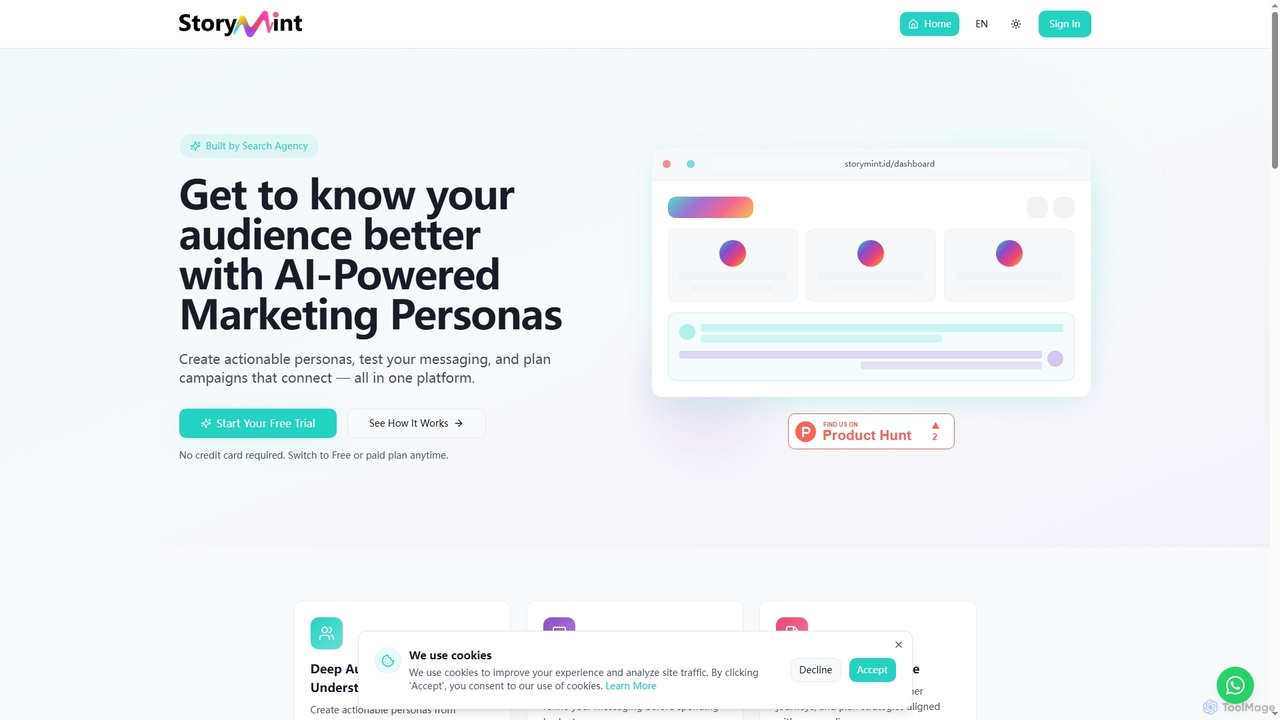
StoryMint is an AI-powered platform designed for marketers to create, validate, and utilize detailed marketing personas. It helps …
StoryMint is an AI-powered platform designed for marketers to create, validate, and utilize detailed marketing personas. It helps deeply understand audiences, test messaging, and plan effective campaigns, transforming static target audience descriptions into living, actionable insights for better campaign performance.
PersonaGen
PersonaGen is an AI-powered tool designed to create detailed and realistic user personas in minutes. It helps marketers, …
PersonaGen is an AI-powered tool designed to create detailed and realistic user personas in minutes. It helps marketers, designers, and product managers gain a deep understanding of their target audience, enabling them to build more effective products and campaigns. Simply input basic data, and let the AI generate comprehensive persona profiles.
About Persona Generation
Persona Generation tools are AI-powered platforms that automatically create detailed, data-driven user or customer profiles. These tools analyze qualitative and quantitative data, such as interviews, surveys, or analytics, to synthesize fictional characters that represent key audience segments. This process enables marketing, product, and design teams to gain a deep, empathetic understanding of their target users' motivations, goals, and pain points. By automating this foundational marketing task, businesses can develop more effective strategies and user-centric products with greater speed and accuracy.
Core Features
- Data Synthesis: Automatically analyzes and clusters raw data from various sources like surveys, interviews, and analytics to identify key patterns.
- Psychographic Profiling: Generates insights beyond demographics, including a persona's values, interests, lifestyle, and personality traits.
- Pain Point & Goal Identification: Extracts and clearly articulates the primary challenges and motivations of each user segment.
- Narrative Creation: Crafts a compelling backstory, a 'day-in-the-life' scenario, or a summary that brings the persona to life.
- Multi-Persona Output: Creates a set of distinct personas from a single dataset, representing the diversity of a target market.
Use Cases
These tools are invaluable for product managers defining feature roadmaps, UX/UI designers creating user-centered interfaces, and content marketers tailoring messaging. Startups also use them to validate their ideal customer profile (ICP) and guide go-to-market strategies. Essentially, any role that relies on a deep understanding of the customer benefits from this technology.
How to Choose
When selecting a Persona Generation tool, consider the types of data it can import (e.g., text, CSV, analytics APIs). Evaluate the depth of the generated personas—does it provide rich psychographic details or just basic demographics? Also, check for customization options to refine the AI's output and integration capabilities with other tools like CRMs or design software.
Persona GenerationUse Cases
Kickstart Product Development with User Personas
A product manager for a new productivity app needs to align the development team on who they are building for. They upload 50 user interview transcripts into an AI Persona Generation tool. The AI processes the qualitative data, identifying three distinct user segments: the 'Busy Professional', the 'Creative Freelancer', and the 'Student Organizer'. For each, it generates a detailed persona with a name, photo, goals (e.g., 'manage multiple projects seamlessly'), and frustrations (e.g., 'too many scattered tools'). This output provides a clear, shared vision, enabling the team to prioritize features that directly address the core needs of their target users, significantly reducing guesswork in early development stages.
Refine Content Marketing Strategy
A content marketing manager for a B2B SaaS company wants to create more resonant blog posts and social media content. They connect their website's Google Analytics and customer survey data (exported as a CSV) to a persona generator. The tool analyzes user behavior, demographics, and survey responses to generate two key buyer personas: 'Data-Driven Dana', a marketing analyst, and 'Strategic Steve', a marketing director. The personas include preferred content formats, communication channels, and key topics of interest. Armed with this insight, the manager tailors their content calendar, creating technical deep-dives for Dana and high-level strategy guides for Steve, leading to a 30% increase in engagement.
Enhance UX/UI Design with Empathy
A UX design team is redesigning an e-commerce mobile app. To ensure their decisions are user-centric, they feed raw notes from user testing sessions and customer support tickets into a persona generator. The AI synthesizes this feedback into a primary persona, 'Chloe the Casual Shopper'. The persona highlights her main goal ('find deals quickly') and a major pain point ('confusing checkout process'). The design team prints this persona and keeps it visible in their workspace. During design sprints, they constantly refer to Chloe, asking 'Would Chloe understand this icon?' or 'How can we make this easier for Chloe?'. This practice fosters empathy and leads to a redesigned checkout flow that reduces cart abandonment by 15%.
Validate a Startup's Ideal Customer Profile (ICP)
An early-stage startup founder has a hypothesis about their target market but needs data to back it up for an investor pitch. They conduct 20 interviews with potential customers and feed the transcripts into a persona generator. The tool synthesizes the conversations and generates a primary Ideal Customer Profile (ICP) that is much more specific than their initial guess. It details the ICP's job title, company size, daily challenges, and software budget. This data-driven persona becomes a cornerstone of their pitch deck, demonstrating a deep market understanding and providing clear evidence of product-market fit, which helps them secure seed funding.
Enable Sales Teams with Buyer Personas
A sales manager notices inconsistent messaging across their team. To standardize their approach, they use a persona generator connected to their CRM data and recordings of successful sales calls. The AI identifies two primary buyer personas: 'Pragmatic Paul', who is budget-conscious and focuses on ROI, and 'Innovative Ingrid', who is interested in cutting-edge features and competitive advantages. The generated personas include common objections, key selling points, and preferred communication styles for each type. The manager uses these detailed profiles to create tailored sales scripts and training materials, resulting in a more confident sales team and a 10% increase in conversion rates.
Synthesize Academic Research Findings
A sociologist has conducted 100 in-depth interviews for a study on remote work habits. Manually analyzing and theming this volume of text is a daunting task. They use an AI persona generator to process all the interview transcripts. The tool identifies and groups participants into four distinct archetypes based on their work styles, motivations, and challenges, such as 'The Boundary-Setter' and 'The Always-On Professional'. Each archetype is presented with supporting quotes and behavioral patterns. This allows the researcher to quickly structure their findings and present the complex qualitative data in a clear, digestible, and humanized format in their final paper, saving weeks of manual analysis.