Leadlister
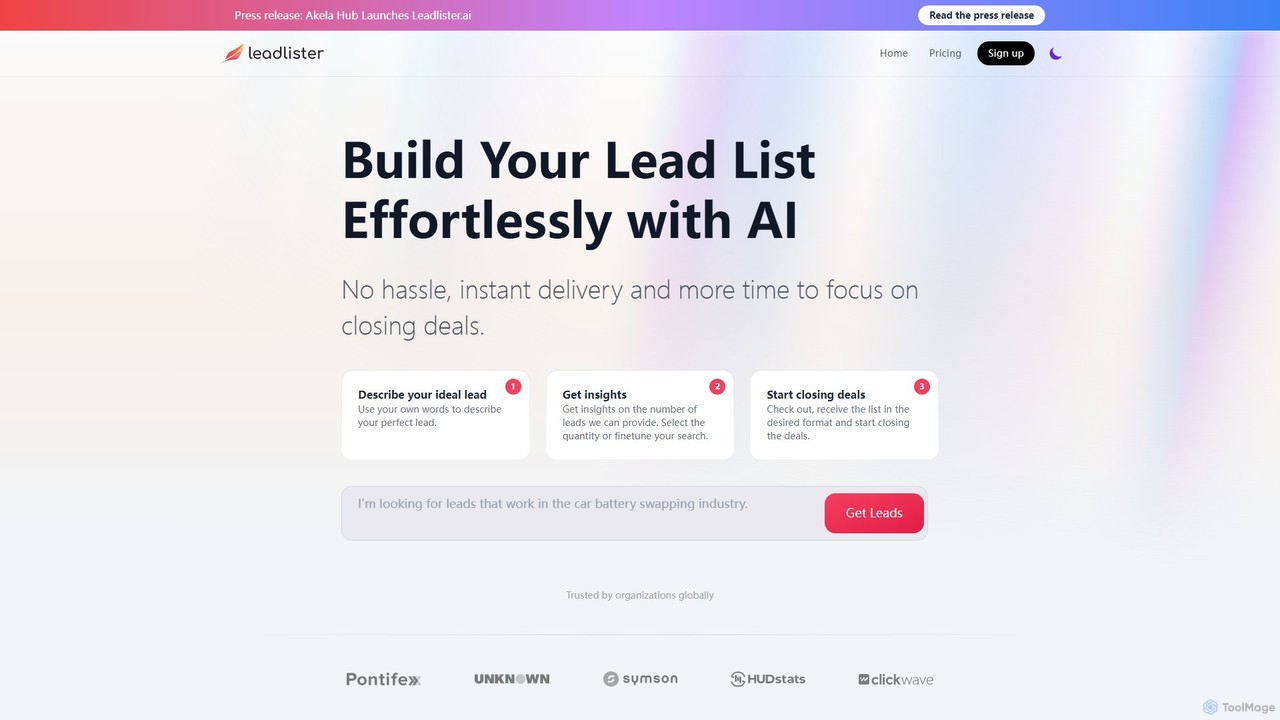
Leadlister is an AI-powered platform that effortlessly builds targeted B2B lead lists. Simply describe your ideal customer profile …
Leadlister is an AI-powered platform that effortlessly builds targeted B2B lead lists. Simply describe your ideal customer profile (ICP) in natural language, and the AI will scan a database of over 400 million professionals to deliver a qualified list instantly. It offers a flexible pay-per-use model, eliminating the need for long-term subscriptions and allowing you to focus on closing deals rather than searching for leads.
NeuraLead
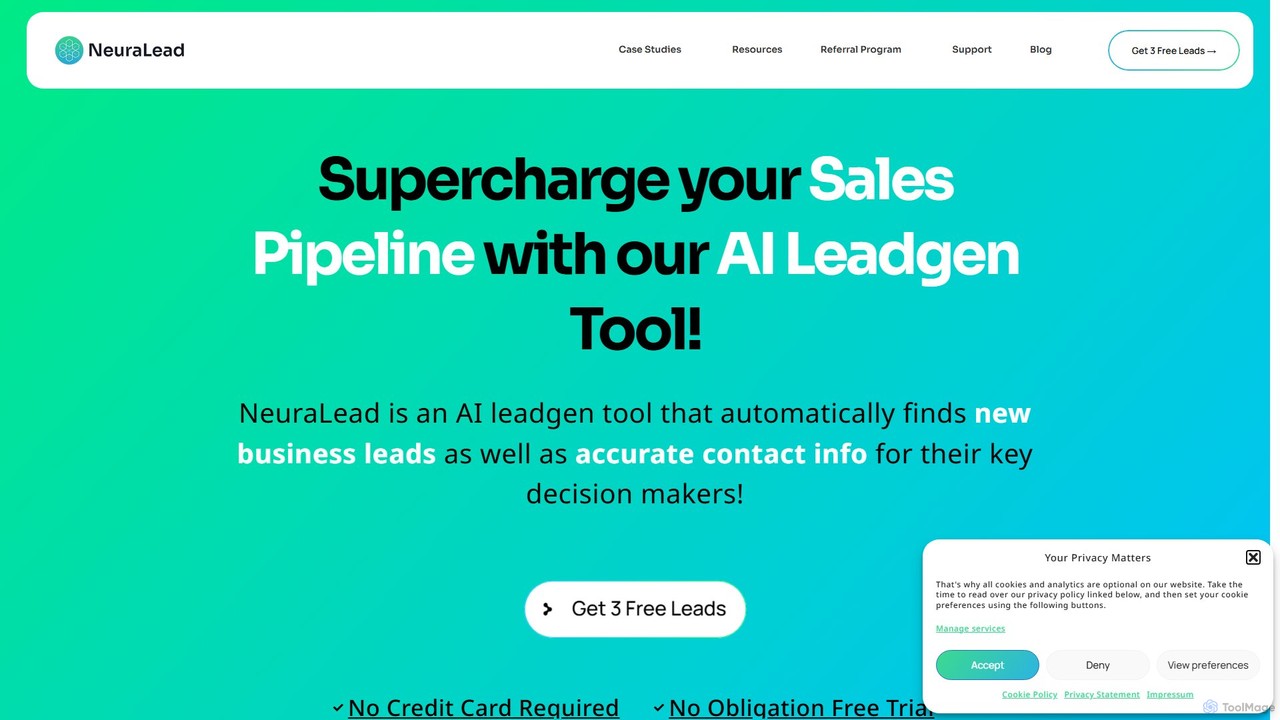
NeuraLead is an AI-powered lead generation tool that automates finding new B2B leads. By analyzing a reference company, …
NeuraLead is an AI-powered lead generation tool that automates finding new B2B leads. By analyzing a reference company, it discovers similar businesses and provides accurate contact information for key decision-makers. It saves time, enhances sales pipelines with high-quality prospects, and offers sales intelligence capabilities to supercharge your sales efforts.
SalesMirror
SalesMirror is a real-time B2B prospecting and lead generation platform. It helps sales and marketing teams find and …
SalesMirror is a real-time B2B prospecting and lead generation platform. It helps sales and marketing teams find and verify contact information for startups, local businesses, and SaaS companies. The tool features an email/phone finder, technology stack identification, and an investor database, all powered by a real-time search engine with over 250 million data points.
About Prospecting
AI Prospecting tools are a specialized category of software designed to automate the identification and qualification of potential customers. These tools leverage artificial intelligence to analyze vast datasets from public sources, identifying individuals and companies that match a predefined Ideal Customer Profile (ICP). Their primary value lies in transforming the time-consuming manual process of lead generation into an efficient, data-driven operation. By delivering a steady stream of high-quality, relevant leads, they empower sales and marketing teams to focus on building relationships and closing deals.
Core Features
- Ideal Customer Profile (ICP) Analysis: Uses AI to identify and score leads that precisely match your most valuable customer characteristics.
- Contact Data Enrichment: Automatically finds and verifies contact information such as emails, phone numbers, and social media profiles for target leads.
- Buying Signal Detection: Monitors online activities and company news to detect signals that indicate a prospect is ready to buy, such as new funding or job postings.
- Automated Sequencing: Helps create and manage multi-touch outreach campaigns via email and social media to engage prospects at scale.
Use Cases
AI Prospecting tools are essential for B2B sales development representatives (SDRs), account executives, and marketing teams. They are widely used in industries like technology, SaaS, financial services, and professional consulting to build sales pipelines. Startups also use them to find early adopters and conduct market validation efficiently.
How to Choose
When selecting an AI Prospecting tool, evaluate the quality and breadth of its data sources. Check its integration capabilities with your existing CRM (e.g., Salesforce, HubSpot). Consider the tool's specialization—whether it focuses on company-level data (firmographics) or individual contact data. Finally, ensure it complies with data privacy regulations like GDPR and CCPA.
ProspectingUse Cases
Targeting High-Intent B2B Leads
A sales development representative (SDR) at a SaaS company needs to build a pipeline of qualified leads for their new cybersecurity product. They use an AI prospecting tool to set up alerts for 'buying signals,' such as companies that have recently posted jobs for a 'Chief Information Security Officer' or have been mentioned in news articles about data breaches. The tool automatically identifies these companies, finds the contact details of relevant decision-makers (like the Head of IT), and adds them to a personalized email outreach sequence. This data-driven approach results in a 30% higher meeting booking rate compared to traditional cold outreach methods.
Automating Lead List Building for Startups
A founder of a new FinTech startup needs to identify the first 500 potential customers for their beta program. With a limited budget and no sales team, manual research is not feasible. They use an AI prospecting tool to define their Ideal Customer Profile: small to medium-sized e-commerce businesses using a specific payment gateway. The AI scans thousands of websites and directories, generating a clean, verified list of 500 companies and their founders' contact information in under an hour. This process, which would have taken weeks manually, allows the founder to immediately start their outreach campaign.
Enriching Inbound Leads in a CRM
A marketing team at a consulting firm generates leads through webinars and whitepaper downloads. However, these inbound leads often have incomplete information (e.g., only a name and email). They integrate an AI prospecting tool with their HubSpot CRM. Whenever a new lead enters the CRM, the tool automatically enriches the contact record with data like job title, company size, industry, and a link to their LinkedIn profile. This provides the sales team with crucial context, allowing them to have more relevant and personalized conversations, which in turn improves the lead-to-opportunity conversion rate.
Identifying New Markets for Expansion
A product manager for a B2B software company is tasked with exploring expansion into the healthcare industry. They use an AI prospecting tool to conduct market research. By inputting criteria like 'private hospitals,' 'more than 500 employees,' and 'using legacy EMR systems,' the tool generates a comprehensive list of potential target accounts across different regions. It also identifies key personas within these organizations, such as 'Director of Health Informatics.' This data allows the product manager to quantify the total addressable market (TAM) and provides the sales team with an initial list of accounts to target for a pilot program.
Sourcing Passive Candidates for Recruitment
A corporate recruiter is struggling to fill a highly specialized 'Machine Learning Engineer' role. Instead of relying solely on job boards, they use an AI prospecting tool, typically used for sales, to find passive candidates. They search for professionals with specific skills listed on their public profiles, who work at competitor companies, and who have recently published research papers. The tool builds a list of qualified individuals who are not actively looking for a job. The recruiter then uses this information to initiate a personalized and discreet outreach, significantly increasing the pool of high-caliber applicants.
Finding Strategic Partnership Opportunities
A business development manager at a marketing automation company wants to find potential integration partners. Their ideal partners are CRM companies that do not have a built-in email marketing feature. Using an AI prospecting tool, they filter for companies in the 'CRM Software' industry, excluding those that list 'email automation' as a core feature on their website. The tool generates a targeted list of potential partners. The manager then uses the tool to identify the 'Head of Partnerships' or 'VP of Business Development' at each company, enabling a direct and relevant conversation about a potential technology partnership.