ToolMage
Sign in

Best 25 Strategy AI tools for Marketing

Popular Strategy AI tools in Marketing include LivePlan, Digital First AI, Trend Hunter AI, pestel, Briefly, Content Codex, Molo9, macky, Claude Code Ideas, and startnew, helping you work more efficiently.

AI Lean Canvas Generator
Free

AI Lean Canvas Generator

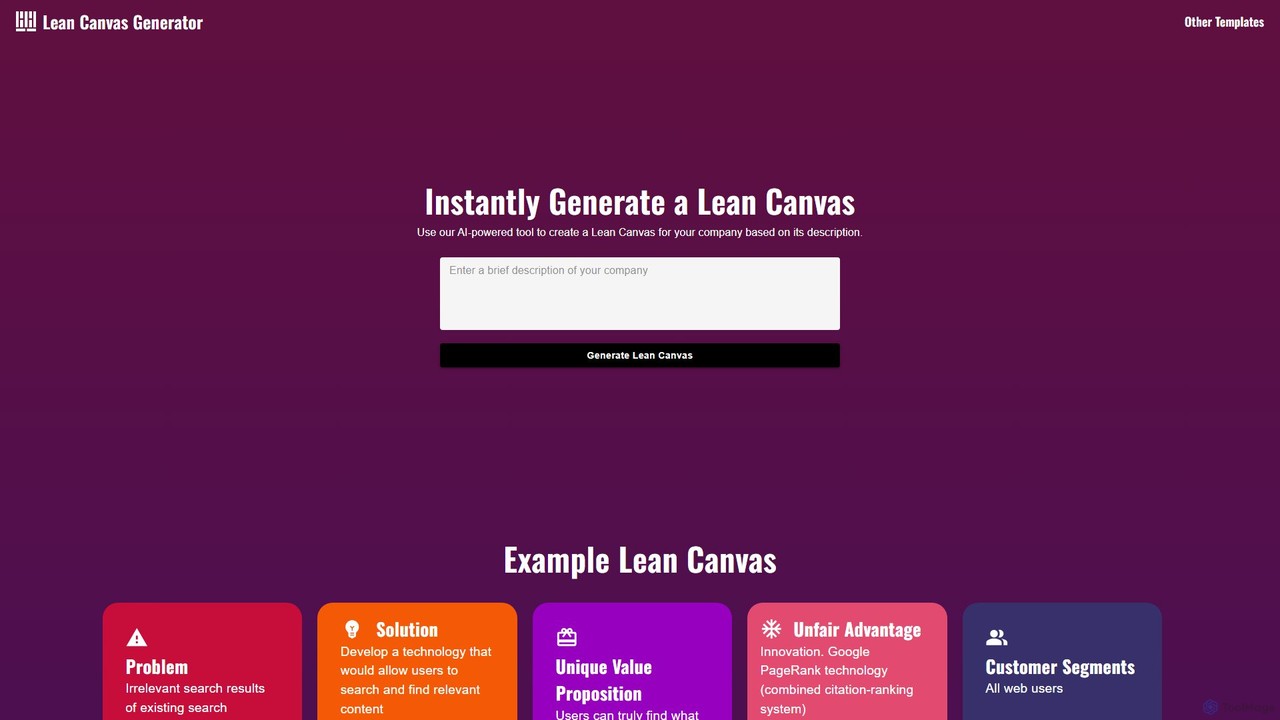
AI Lean Canvas Generator is an AI-powered tool that instantly creates a comprehensive Lean Canvas from a simple description of your business idea. It helps entrepreneurs, product managers, and startups quickly structure and validate their business models. By automatically populating key sections like Problem, Solution, and Unique Value Proposition, it streamlines strategic planning and accelerates the idea-to-validation process.

Startup Tools
Visits 5.9KFavorites 149Likes 140

About Strategy

Strategy AI tools are specialized platforms that leverage artificial intelligence to assist businesses in developing, analyzing, and optimizing their marketing strategies. These tools process vast amounts of market data, consumer behavior, and competitive intelligence to provide actionable insights. They empower decision-makers to formulate data-driven plans, identify emerging trends, and gain a significant competitive edge in the dynamic market landscape.

Core Features

  • Market Intelligence & Trend Forecasting: Analyze global and local market data to identify emerging trends and predict future shifts.
  • Competitor Analysis: Monitor competitor activities, strategies, pricing, and performance in real-time.
  • Audience Segmentation & Persona Development: Create detailed customer segments and data-backed personas for hyper-targeted messaging.
  • Strategic Planning & Optimization: Assist in campaign planning, resource allocation, and performance optimization based on predictive models.
  • Predictive Analytics: Forecast campaign outcomes, market demand, and potential risks to inform strategic decisions.

Use Cases

Marketing managers, business strategists, and product development teams utilize these tools for critical decision-making. They are essential for market entry strategies, designing impactful campaigns, and planning long-term growth initiatives by providing deep insights into market dynamics and consumer needs.

How to Choose

When selecting a Strategy AI tool, consider its data integration capabilities with existing systems like CRM and analytics platforms. Evaluate the depth of its analytical models and the clarity of its insight generation. Look for customization options to adapt to specific business needs and assess the user interface for ease of strategic decision-making and reporting.

Featured tool rankings

Strategy use cases

1

Identifying New Market Opportunities

Business development teams use Strategy AI tools to analyze vast global market data, consumer demographics, and technological advancements. This helps them pinpoint untapped niches, assess market viability, and identify optimal regions or segments for new product launches or service expansions, significantly reducing market entry risks.

2

Optimizing Marketing Budget Allocation

Marketing directors leverage AI to simulate various budget distribution scenarios across diverse channels like social media, search engines, and email marketing. By predicting the ROI for each scenario, these tools ensure that marketing spend is allocated most effectively, maximizing campaign impact and overall strategic efficiency.

3

Developing Hyper-Targeted Customer Personas

Product marketing managers utilize AI to synthesize customer data from CRM systems, social media interactions, and website analytics. This process generates highly detailed, data-backed customer personas, enabling the creation of more resonant messaging, tailored product features, and personalized marketing campaigns.

4

Forecasting Campaign Performance & Risks

Before launching a major campaign, managers input planned parameters into an AI strategy tool. The tool then predicts potential reach, conversion rates, and identifies unforeseen risks or challenges, such as market saturation or competitor responses, allowing for proactive adjustments and risk mitigation.

5

Conducting Real-time Competitor Strategy Analysis

Competitive intelligence analysts deploy AI to continuously monitor competitor activities, including pricing changes, new product launches, marketing messages, and shifts in customer sentiment. This provides instant strategic alerts and deep insights, enabling rapid adaptation and maintenance of a competitive edge.

6

Strategic Product Roadmap Planning

Product managers employ AI to analyze market demand, synthesize customer feedback, and evaluate technological feasibility. This data-driven approach helps prioritize features, identify critical development paths, and define a robust product roadmap that aligns with market needs and long-term business objectives.

Strategy FAQ

What are AI Strategy Tools in Marketing?

AI Strategy Tools in Marketing are advanced software solutions that use artificial intelligence to analyze complex market data, consumer behavior, and competitive landscapes. Their primary function is to provide actionable insights and recommendations, helping businesses formulate and optimize their marketing strategies for better decision-making and competitive advantage.

How do AI Strategy Tools differ from general Marketing Automation?

While both fall under Marketing, AI Strategy Tools focus on the planning and analytical aspects, providing insights for high-level decisions like market entry or budget allocation. Marketing Automation, conversely, focuses on executing repetitive tasks, such as sending emails or scheduling social posts, based on predefined rules or triggers. Strategy tools inform what to do, automation tools handle how to do it efficiently.

What are the key benefits of using AI for Marketing Strategy?

Using AI for marketing strategy offers several benefits: enhanced data-driven decision-making, faster identification of market trends and opportunities, more accurate competitor analysis, and optimized resource allocation. It also enables predictive forecasting of campaign performance and customer behavior, leading to more effective and efficient strategic planning.

What should I consider when selecting an AI Strategy Tool?

When choosing an AI Strategy Tool, evaluate its data integration capabilities with your existing systems (CRM, analytics). Assess the depth and accuracy of its analytical models, its ability to generate clear, actionable insights, and the level of customization it offers. User-friendliness, reporting features, and scalability for future growth are also crucial considerations.

Can AI Strategy Tools predict future market trends accurately?

AI Strategy Tools can predict future market trends with a high degree of accuracy by analyzing historical data, real-time market signals, and complex algorithms. While no prediction is 100% certain, these tools significantly improve forecasting capabilities by identifying patterns and correlations that human analysts might miss, providing valuable foresight for strategic planning.