ToolMage
Sign in

Best 1 International Payments AI tools for Payments

Popular International Payments AI tools in Payments include Kaisel, helping you work more efficiently.

Kaisel
Freemium

Kaisel

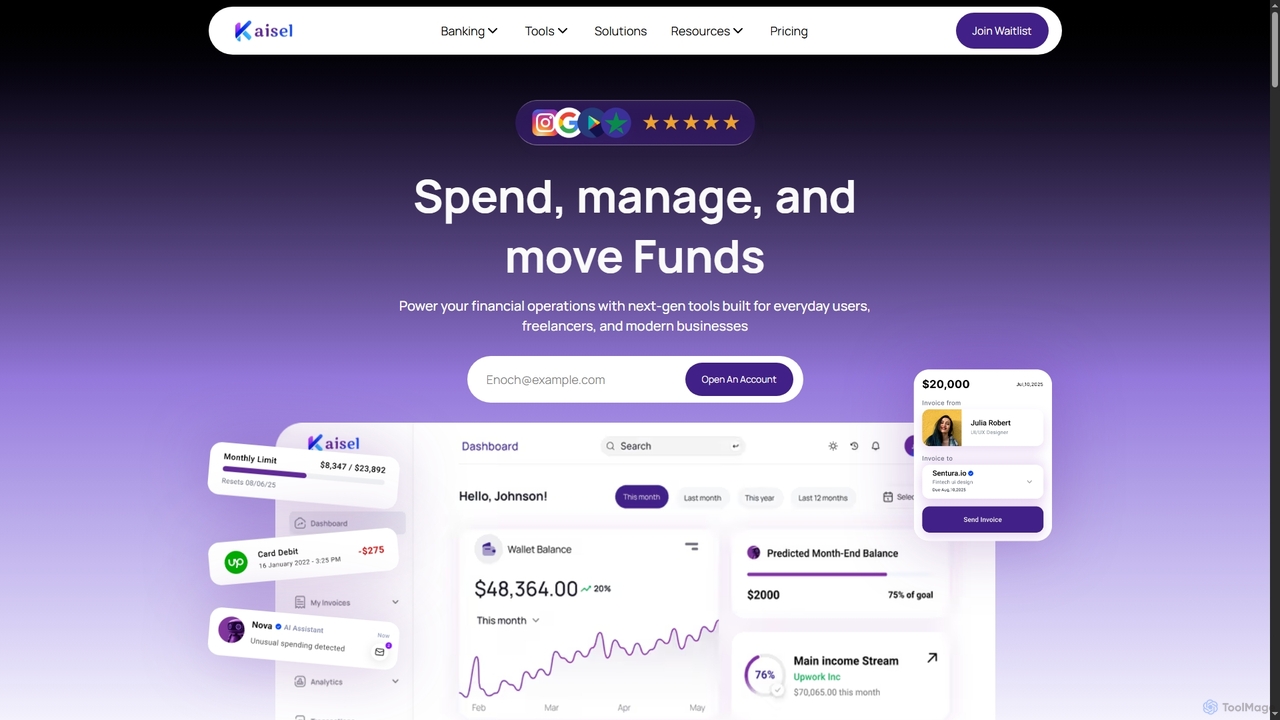
Kaisel is an AI-powered financial platform designed for everyday users, freelancers, and modern businesses to intelligently manage, spend, and move funds globally. It offers smart tools for international payments, virtual cards, expense tracking, invoicing, and AI-driven financial forecasting.

Financial Forecasting
Visits 5.9KFavorites 150Likes 135

About International Payments

International Payments tools are AI-powered platforms designed to facilitate seamless and secure cross-border financial transactions. Leveraging advanced algorithms, these tools automate currency exchange, manage regulatory compliance, and mitigate fraud risks, enabling individuals and businesses to send and receive money globally with unprecedented efficiency. They significantly reduce the complexities and costs associated with traditional international transfers, fostering global commerce and financial inclusion.

Core Features

  • Real-time Currency Conversion: Automatically converts funds between various currencies at competitive, often dynamic, exchange rates.
  • Global Compliance & KYC: Ensures adherence to international financial regulations and Know Your Customer (KYC) requirements across different jurisdictions.
  • Automated Fraud Detection: Utilizes AI to identify and prevent suspicious transactions, enhancing security for cross-border payments.
  • Multi-currency Accounts: Allows users to hold, send, and receive funds in multiple foreign currencies without constant conversion.
  • Cross-border Remittance: Facilitates fast and cost-effective transfer of funds to recipients in different countries.

Applicable Scenarios

These tools are indispensable for e-commerce businesses expanding into global markets, freelancers receiving payments from international clients, and multinational corporations managing global payroll. They streamline the process of paying overseas suppliers, collecting revenue from international customers, and handling remittances, making global financial operations more accessible and efficient.

How to Choose

When selecting an International Payments tool, consider its supported currencies and countries, transaction fees and exchange rates, and the speed of transfers. Evaluate its integration capabilities with existing accounting or e-commerce platforms, robust compliance and fraud prevention features, and the clarity of its fee structure. User experience and customer support are also crucial for managing complex international transactions.

International Payments use cases

1

Streamlining Global E-commerce Sales

An online retailer selling products worldwide uses an AI International Payments tool to automatically process transactions in various local currencies. The tool handles real-time currency conversion, manages international tax regulations, and ensures compliance with local payment methods. This allows the retailer to expand their customer base globally without the overhead of manual currency management or complex international banking setups, significantly reducing abandoned carts from overseas buyers.

2

Streamlining Cross-Border E-commerce Sales

An online retailer selling products globally uses international payment tools to accept payments from customers in various countries and currencies. The AI automatically handles currency conversion, local payment methods, and fraud screening, ensuring smooth transactions and reducing cart abandonment rates for international buyers. This allows the business to expand its market reach without complex manual payment processing.

3

Managing Global Freelancer & Contractor Payouts

A company with a distributed workforce hires freelancers and contractors worldwide. They utilize international payment platforms to efficiently process mass payouts in local currencies. The tool automates compliance checks, tax reporting, and ensures timely payments, significantly reducing administrative overhead and ensuring contractor satisfaction across different regions.

4

Efficient International Freelancer Payments

A freelance graphic designer working with clients across Europe and North America utilizes an International Payments platform to receive payments. The tool allows clients to pay in their local currency, while the designer receives funds in their preferred currency with minimal conversion fees. This eliminates the need for multiple bank accounts or dealing with slow, expensive wire transfers, ensuring faster access to earnings and simplified financial reconciliation.

5

Managing Global Employee Payroll

A growing tech startup with remote employees in five different countries employs an International Payments solution for payroll. The platform automates the monthly salary disbursement, converting funds into each employee's local currency and ensuring compliance with local labor laws and tax regulations. This reduces the administrative burden on the HR and finance teams, minimizes errors, and ensures timely, accurate payments to a diverse global workforce.

6

Optimizing Supplier Payments for Importers/Exporters

An import/export business regularly pays suppliers in multiple countries. International payment solutions help them manage these transactions by offering competitive exchange rates, transparent fee structures, and real-time tracking. This ensures suppliers are paid promptly, strengthens relationships, and provides better financial control over international trade operations.

7

Optimizing Supplier Payments for Importers

An import business regularly sources goods from manufacturers in Asia and Europe. They use an International Payments tool to pay their suppliers, benefiting from competitive exchange rates and lower transaction fees compared to traditional banks. The platform provides transparent tracking of payments, helps manage currency fluctuation risks, and ensures timely delivery of funds, strengthening supplier relationships and optimizing supply chain finance.

8

Facilitating International Subscription Services

A SaaS company offers subscription services to a global user base. They use international payment tools to manage recurring billing in various currencies, handle failed payments, and comply with regional payment regulations. This automation ensures a consistent revenue stream from international subscribers and reduces churn due to payment processing issues.

9

Securely Receiving Funds from Overseas Clients

A consulting firm provides services to international clients and needs a reliable way to receive payments. International payment platforms offer secure payment links, multi-currency accounts, and robust fraud protection. This ensures that funds are received safely and efficiently, often with lower fees compared to traditional bank transfers, improving cash flow management.

10

Facilitating Cross-border Subscription Billing

A SaaS company offering subscription services to a global user base leverages an International Payments tool for recurring billing. The tool automatically processes monthly or annual payments from customers in various countries, handling different payment methods and currencies. It also intelligently retries failed payments and provides detailed analytics on international revenue streams, ensuring consistent cash flow and reducing churn from international subscribers.

11

Secure Personal Remittances to Family Abroad

An individual regularly sends money to family members living in another country. They use an AI-powered International Payments app that offers competitive exchange rates, low fees, and robust security features. The app provides real-time tracking of the transfer and ensures funds are delivered quickly and safely to the recipient's local bank account or mobile wallet, offering peace of mind and convenience for personal financial support.

12

Automating Payroll for Remote International Teams

A tech startup with a fully remote team spread across continents uses international payment systems for monthly payroll. The system automates salary disbursements in local currencies, handles tax deductions according to regional laws, and provides detailed pay stubs. This simplifies complex international payroll, ensuring accuracy and compliance while saving significant HR time.

International Payments FAQ

What are AI International Payments tools?

AI International Payments tools are platforms that use artificial intelligence to streamline and optimize cross-border financial transactions. They go beyond traditional methods by automating complex processes like real-time currency conversion, dynamic exchange rate optimization, enhanced fraud detection, and ensuring compliance with diverse international regulations. Their primary goal is to make sending and receiving money across borders faster, cheaper, more secure, and more accessible for both individuals and businesses.

What are International Payments tools?

International Payments tools are AI-powered platforms designed to facilitate cross-border financial transactions for businesses and individuals. They streamline the process of sending and receiving money globally by automating currency exchange, fraud detection, and compliance checks, making international transfers faster, more secure, and cost-effective than traditional methods.

How do AI International Payments tools differ from traditional international transfers?

AI International Payments tools offer significant advantages over traditional bank transfers. Traditional methods are often slow, involve high fixed fees, and use less favorable exchange rates. AI tools, however, leverage algorithms for faster processing, often offer lower or transparent fees, and provide more competitive, real-time exchange rates. They also excel in automated compliance checks and advanced fraud prevention, offering greater security and efficiency compared to manual, human-intensive traditional processes.

How do AI-powered International Payments differ from traditional bank transfers?

AI-powered international payment tools offer significant advantages over traditional bank transfers. While banks rely on manual processes and correspondent networks, AI tools automate fraud detection, optimize currency exchange rates dynamically, and perform real-time compliance checks. This results in faster transaction speeds, lower fees, greater transparency, and enhanced security, especially for high-volume or complex cross-border operations.

What are the key benefits of using AI for International Payments?

The key benefits include enhanced security through AI-driven fraud detection, optimized currency exchange rates for cost savings, and automated compliance with global regulations (KYC/AML). Additionally, these tools offer faster transaction processing, real-time tracking, and simplified management of mass payouts, significantly reducing administrative burden and operational risks for global transactions.

What are the key benefits of using AI for international payments?

The key benefits include enhanced speed, reduced costs, improved security, and greater efficiency. AI automates complex tasks like currency conversion and regulatory checks, significantly speeding up transaction times. It helps minimize fees and optimize exchange rates, leading to cost savings. Advanced AI algorithms provide superior fraud detection, protecting against financial crime. Furthermore, these tools offer better scalability and integration capabilities, simplifying global financial management for businesses of all sizes.

What features should I look for in an International Payments platform?

When choosing an International Payments platform, prioritize features such as support for a wide range of currencies and countries, transparent and competitive fee structures, and favorable exchange rates. Look for robust security measures, including AI-powered fraud detection and compliance with international financial regulations (e.g., AML, KYC). Real-time transaction tracking, multi-currency account options, and seamless integration with your existing accounting or e-commerce systems are also crucial for efficient operation.

What should I consider when choosing an International Payments platform?

When selecting an international payments platform, consider its supported currencies and regions, ensuring it aligns with your global reach. Evaluate the fee structure, including exchange rates and hidden costs, for transparency. Prioritize robust security features like AI fraud detection and compliance with international financial regulations. Finally, check for seamless integration capabilities with your existing business software to ensure operational efficiency.

Who can benefit most from using International Payments tools?

International Payments tools are highly beneficial for e-commerce businesses with global customers, companies managing international freelancers or remote teams, and import/export businesses dealing with overseas suppliers. They also serve multinational corporations for intercompany transfers and individuals needing to send or receive money across borders efficiently and securely. Essentially, anyone involved in frequent cross-border financial transactions can benefit.

Who can benefit most from using AI International Payments tools?

A wide range of users can benefit. E-commerce businesses selling globally can streamline their international sales and reduce conversion costs. Freelancers and remote workers can receive payments from international clients faster and with lower fees. Multinational corporations can simplify global payroll and supplier payments. Individuals sending remittances to family abroad can also benefit from competitive rates and secure, fast transfers. Essentially, anyone involved in frequent cross-border financial transactions stands to gain.