ToolMage
Sign in

Best 1 Cognitive Assessment AI tools for Personal Development

Popular Cognitive Assessment AI tools in Personal Development include IQConnect, helping you work more efficiently.

IQConnect
Free

IQConnect

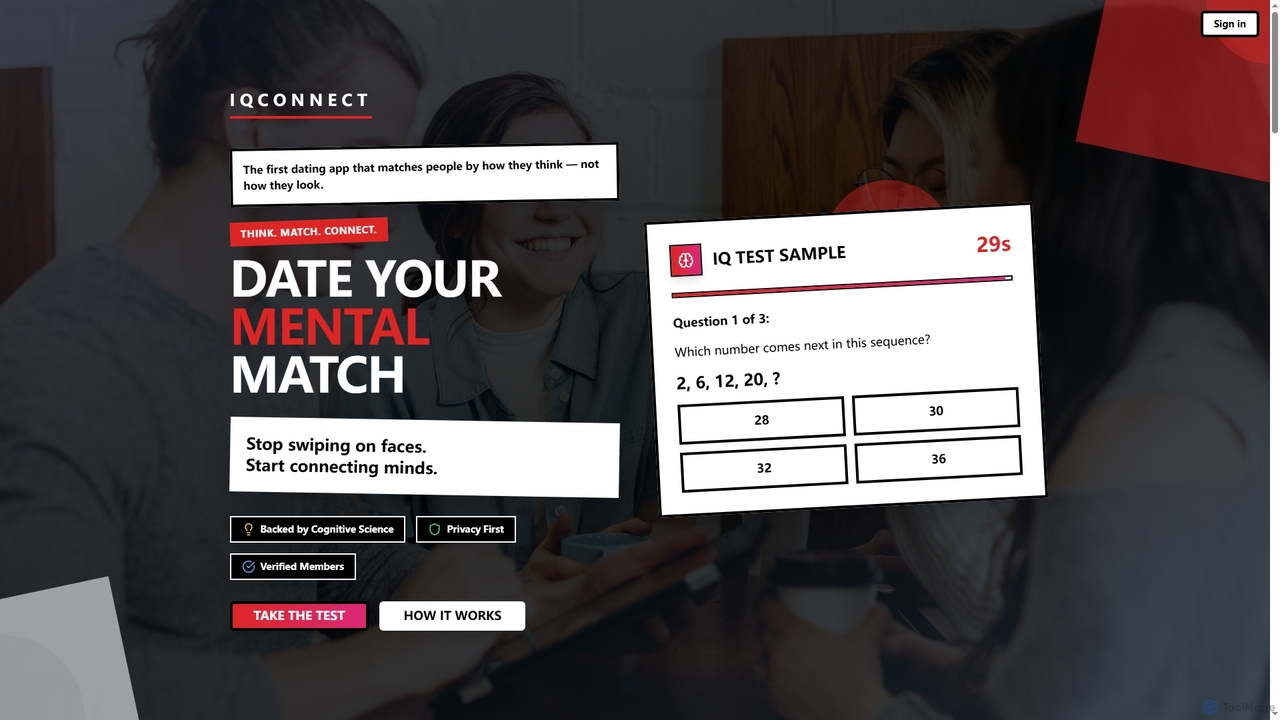
IQConnect is an innovative dating app that revolutionizes online connections by matching individuals based on cognitive compatibility rather than appearance. Utilizing a short, AI-powered IQ assessment, it connects users who think similarly, fostering deeper, more meaningful conversations. Designed for inclusivity, it welcomes all intelligence levels and prioritizes user privacy, offering a science-backed approach to finding your mental match.

Intelligence Matching
Visits 4.9KFavorites 95Likes 120

About Cognitive Assessment

Cognitive Assessment tools are AI-powered platforms designed to evaluate and measure various aspects of human cognitive function. Utilizing advanced algorithms and data analysis, these tools provide objective insights into areas like memory, attention, problem-solving, and executive functions. They serve as valuable resources within personal development, educational planning, and clinical screening, helping individuals understand their cognitive strengths and areas for improvement.

Core Features

  • Memory Analysis: Objectively measures different types of memory, including working, short-term, and long-term recall.
  • Attention & Focus Tracking: Assesses sustained attention, selective attention, and the ability to maintain focus over time.
  • Problem-Solving Evaluation: Analyzes logical reasoning, critical thinking, and strategic planning capabilities through interactive tasks.
  • Executive Function Assessment: Evaluates higher-level cognitive processes such as planning, decision-making, and cognitive flexibility.

Use Cases

These tools are utilized by individuals seeking self-improvement, educators tailoring learning plans, and professionals aiming to optimize performance. They provide data-driven insights for understanding cognitive profiles, identifying areas for growth, and tracking progress over time in a structured manner.

How to Choose

When selecting a Cognitive Assessment tool, consider its scientific validity and reliability, the specific cognitive domains it covers, and the clarity and actionability of its reports. Evaluate user-friendliness, data privacy policies, and whether it offers personalized recommendations or integrates with other personal development platforms.

Cognitive Assessment use cases

1

Identifying Cognitive Strengths for Career Development

A professional seeking career advancement uses a cognitive assessment tool to pinpoint their strongest cognitive abilities, such as logical reasoning or spatial awareness. The insights gained help them choose roles that leverage these strengths, leading to greater job satisfaction and performance. For instance, an individual discovering high analytical skills might pursue data science or research positions, optimizing their career path.

2

Personalized Learning Plan Creation

Students or lifelong learners utilize these tools to understand their learning styles and cognitive weaknesses, such as short-term memory or processing speed. Based on the assessment results, educators or individuals can develop tailored study strategies and learning materials that address specific challenges, optimizing the learning process and improving academic outcomes significantly.

3

Monitoring Cognitive Health in Seniors

Elderly individuals and their caregivers use AI cognitive assessment tools for regular, non-invasive monitoring of cognitive health. These tools can track subtle changes in memory, attention, and processing speed over time, providing early indicators of potential cognitive decline. This allows for timely intervention and adjustments to lifestyle or medical care, supporting proactive health management.

4

Enhancing Athletic Performance Through Cognitive Training

Athletes and coaches leverage cognitive assessment tools to identify and train specific cognitive skills crucial for sports, such as reaction time, decision-making under pressure, and spatial awareness. By understanding an athlete's cognitive profile, targeted training programs can be developed to improve mental agility, leading to enhanced on-field performance and strategic advantages in competitive environments.

5

Assessing Cognitive Readiness for High-Stakes Roles

Organizations in fields requiring high cognitive demands, such as aviation, finance, or emergency services, use these tools to assess candidates' cognitive readiness. This includes evaluating their ability to process complex information, make rapid decisions, and maintain focus under stress. The assessments help ensure that individuals possess the necessary cognitive resilience for critical roles, reducing risks and improving operational safety.

6

Supporting Research in Cognitive Science

Researchers in cognitive science and neuroscience employ AI cognitive assessment tools to collect standardized, large-scale data on human cognition. These tools facilitate the design of experiments, automate data collection, and provide robust analytical capabilities, accelerating discoveries in understanding brain function, cognitive disorders, and the effectiveness of various interventions. This streamlines the research process and enhances data quality.

Cognitive Assessment FAQ

What are AI Cognitive Assessment tools?

AI Cognitive Assessment tools are digital platforms that use artificial intelligence to objectively measure various cognitive functions like memory, attention, and reasoning. They leverage algorithms to analyze performance on standardized tasks, providing detailed reports on an individual's cognitive profile. These tools are distinct from general personal development apps by offering data-driven, scientific evaluations rather than subjective self-assessments.

How do AI Cognitive Assessment tools differ from traditional psychological tests?

AI Cognitive Assessment tools often offer greater accessibility, real-time feedback, and the ability to analyze vast datasets for more nuanced insights compared to traditional paper-and-pencil tests. While both aim to evaluate cognition, AI tools can adapt tests dynamically, provide immediate, data-driven reports, and often integrate gamification for higher user engagement, making the assessment process more efficient and engaging.

What cognitive functions do these tools typically assess?

These tools commonly assess a range of cognitive functions including memory (working, short-term, long-term), attention (sustained, selective), executive functions (planning, problem-solving, decision-making, cognitive flexibility), processing speed, and verbal/spatial reasoning. The specific functions covered can vary by tool, with some focusing on broad assessments and others on highly specialized domains relevant to particular needs or conditions.

Who can benefit from using AI Cognitive Assessment tools?

A wide range of individuals and professionals can benefit. This includes students aiming to optimize learning strategies, professionals seeking to enhance career performance, individuals interested in personal development and self-understanding, and older adults monitoring cognitive health. Additionally, researchers and clinicians use these tools for data collection and preliminary screening, making them versatile for various applications.

What should I consider when choosing an AI Cognitive Assessment tool?

When selecting an AI Cognitive Assessment tool, consider its scientific validity and reliability, ensuring it's backed by research. Evaluate the specific cognitive domains it covers and whether they align with your needs. Look for clear, actionable reports, user-friendliness, and robust data privacy policies. Additionally, assess if it offers personalized recommendations, integrates with other platforms, and fits your budget and technical requirements.