Me.bot
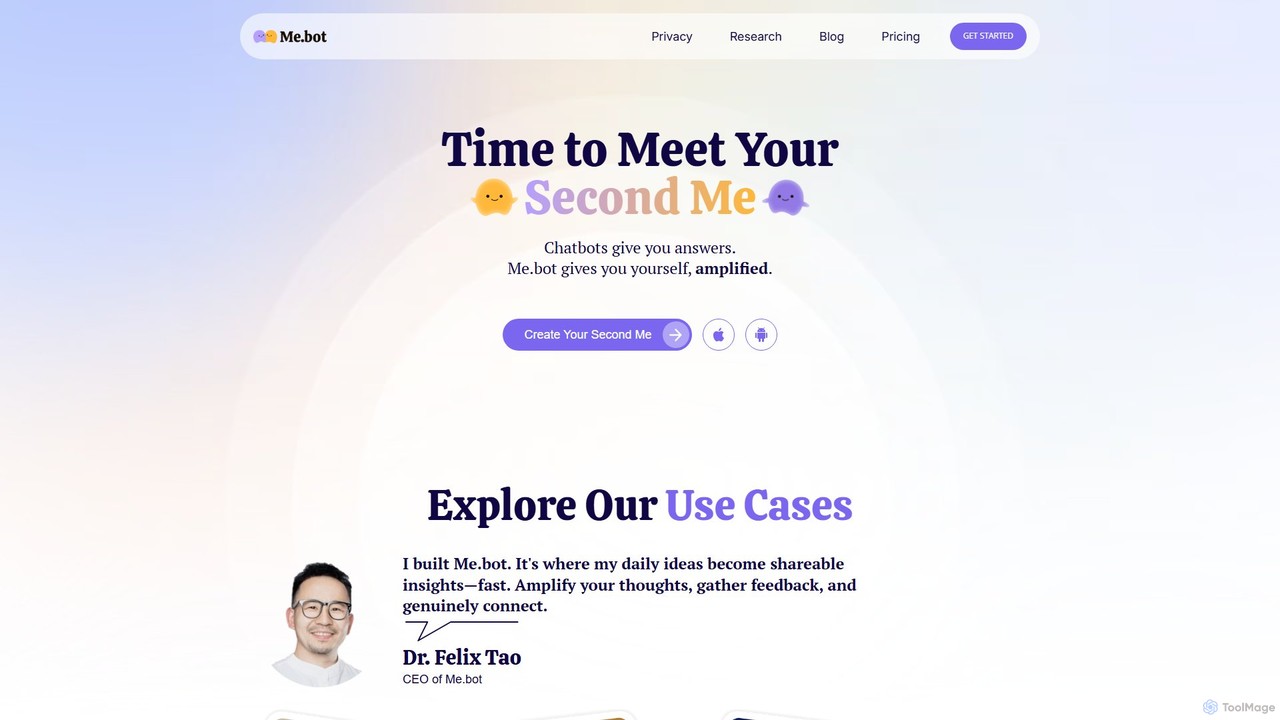
Me.bot is a personal AI that creates a digital version of you, your "Second Me." By learning from …
Me.bot is a personal AI that creates a digital version of you, your "Second Me." By learning from your notes, voice, and ideas, it helps you generate hyper-personalized content, interactive presentations, and communications that reflect your unique style and knowledge, amplifying your thoughts and saving you hours of work.
About Digital Identity
Digital Identity tools are a class of AI software for creating, managing, and deploying persistent, AI-powered representations of a person online. These tools leverage generative AI, including deep learning for visual synthesis and voice cloning, to build realistic digital avatars or agents. Their primary value lies in enabling scalable personal communication, creating automated brand personas, or preserving an individual's likeness and knowledge digitally. This allows a single person's presence and expertise to be replicated across multiple platforms simultaneously.
Core Features
- AI Avatar Generation: Create photorealistic or stylized 3D avatars from photos or text prompts.
- Voice Cloning: Replicate a human voice with high fidelity to generate speech from text, capturing tone and inflection.
- Personality Emulation: Train an AI agent on personal data (writings, interviews) to mimic a specific communication style and knowledge base.
- Interactive Agent Deployment: Integrate the digital identity into websites, apps, or virtual environments as an interactive chatbot or guide.
Use Cases
These tools are valuable for content creators, educators, business leaders, and marketers. For example, a CEO can create a digital twin to handle initial investor queries on a website, or an online course instructor can use an AI avatar to deliver personalized lessons 24/7. They are also widely used in marketing to create virtual influencers with consistent brand messaging and unlimited availability.
How to Choose
When selecting a Digital Identity tool, first consider the realism and customizability of the avatar. Evaluate the accuracy and emotional range of the voice cloning feature. Assess the ease of integration with your existing platforms (e.g., websites, social media APIs). Finally, carefully review the data privacy and security policies to understand how your personal biometric data is stored and used.

Digital IdentityUse Cases
Create a Virtual Influencer for Marketing
A marketing agency aims to launch a new campaign with a unique, controllable brand ambassador. Using a digital identity tool, they design a stylized 3D avatar that aligns with the brand's aesthetic. They then train an AI personality on brand guidelines and marketing copy to ensure all communications are on-message. This virtual influencer can be deployed across social media platforms 24/7, engaging with followers, appearing in promotional videos, and even hosting live events, providing a consistent and scalable marketing presence without the complexities of managing a human influencer.
Develop a Personalized AI E-learning Tutor
An expert educator wants to scale their teaching to a global audience without losing the personal touch. They use a digital identity tool to create a realistic avatar of themselves and clone their voice. The AI is then trained on their entire curriculum, lecture transcripts, and Q&A sessions. The resulting AI tutor can be embedded into an online learning platform. It can deliver lectures in the educator's own voice, answer student questions with nuanced, context-aware responses based on the course material, and provide personalized feedback, offering a scalable yet intimate learning experience for thousands of students.
Create a Digital Twin for a Business Leader
A busy CEO wants to maintain a personal connection with employees and clients but lacks the time. They create a digital twin using an AI identity tool. The process involves a 3D scan for the avatar and voice cloning from recordings of their speeches. The AI is trained on their emails, articles, and interviews to learn their communication style and core philosophies. This digital twin is then deployed on the company's internal portal to answer employee questions and on the main website to greet visitors, providing a consistent, personal, and scalable point of contact that embodies the leader's presence.
Automate Multilingual Content Dubbing
A content creator with a large international audience needs to dub their videos into multiple languages, a process that is typically expensive and time-consuming. By using a digital identity tool with advanced voice cloning, they can replicate their own voice with high fidelity. The tool then uses this voice clone to generate audio tracks in Spanish, French, and Japanese from the original English script. This allows the creator to release multilingual content simultaneously, maintaining their unique vocal identity across all versions and significantly reducing production costs and turnaround time compared to hiring voice actors.
Preserve a Digital Legacy Interactively
An individual wants to preserve their life stories, knowledge, and personality for future generations. They use a digital identity service to create an interactive legacy. Over several sessions, they record interviews, upload personal writings, and provide photos. The platform builds a realistic avatar, clones their voice, and trains a conversational AI on this data. After their passing, family members can interact with this digital persona, asking questions about their life, hearing stories in their own voice, and experiencing their personality in a dynamic way that goes far beyond static photos and videos.
Provide Scalable, Personalized Customer Onboarding
A SaaS company wants to improve its user onboarding process by making it more personal and interactive. They create a digital identity of their Head of Product, who is well-known to their user base. This AI avatar, featuring the product head's voice and likeness, is integrated into the application's onboarding flow. It guides new users through key features, offers tips based on user behavior, and answers common setup questions. This approach replaces generic video tutorials with a dynamic, conversational experience, increasing user engagement and reducing initial support tickets.