
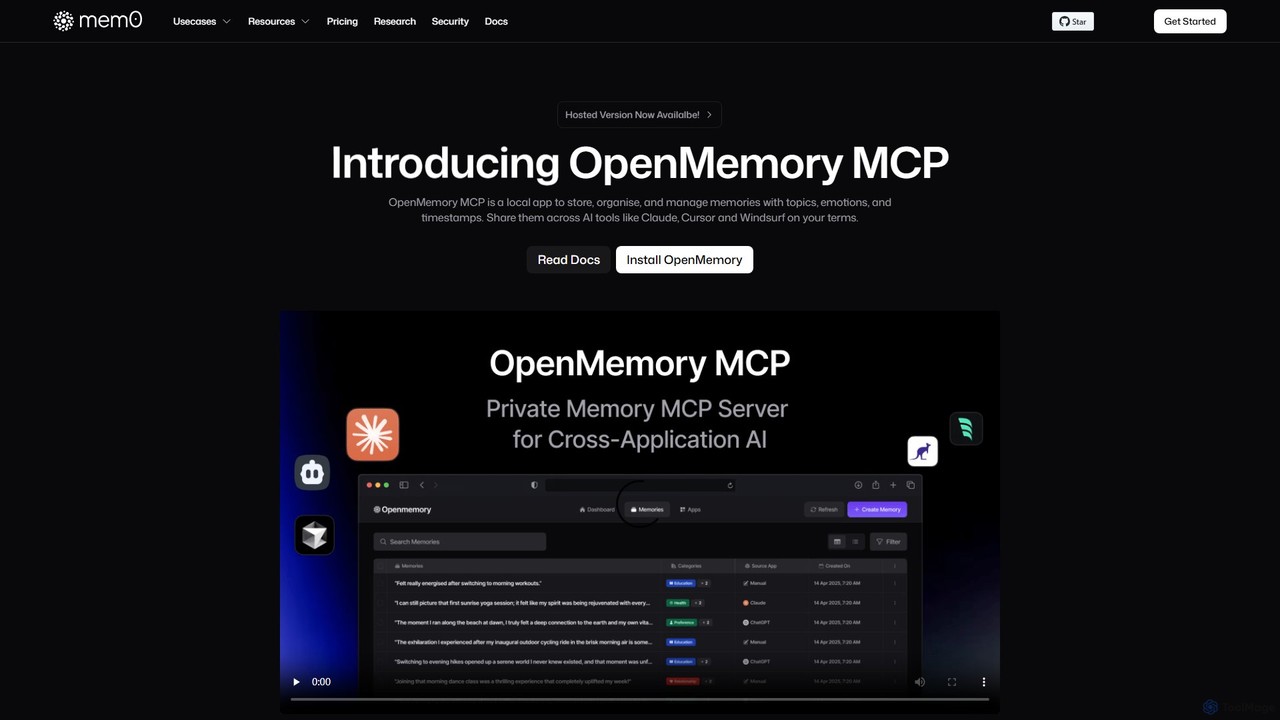
OpenMemory MCP
OpenMemory MCP is a local-first application that provides a persistent, private memory for your AI tools. It stores, …
OpenMemory MCP is a local-first application that provides a persistent, private memory for your AI tools. It stores, organizes, and manages your interactions, preferences, and context securely on your device, enabling personalized and continuous conversations across different AI platforms like Claude and Cursor.
About Data Control
Data Control tools are a specialized class of software for managing, governing, and securing the data used in and generated by AI systems. These tools apply granular policies and technical safeguards across the entire data lifecycle, from collection and processing to model training and inference. They are essential for ensuring AI applications comply with privacy regulations like GDPR and CCPA, building user trust, and mitigating risks associated with sensitive information. As a key component of Privacy & Security, they provide a proactive layer of data governance rather than just reactive threat defense.
Core Features
- Granular Access Control: Define and enforce precise permissions on who can access, view, or modify specific data sets, columns, or rows.
- Data Anonymization & Pseudonymization: Automatically identify and mask or replace personally identifiable information (PII) to protect privacy during analysis or model training.
- Consent Management: Track and manage user consent for data usage, ensuring that data is only used for purposes explicitly agreed upon.
- Data Lineage & Auditing: Provide a clear, auditable trail of how data is sourced, transformed, and used by AI models, simplifying compliance checks.
- Automated Policy Enforcement: Implement and automate data governance rules and compliance policies directly within data workflows.
Use Cases
Data Control tools are critical in regulated industries such as healthcare, finance, and insurance, where handling sensitive patient or customer data is standard. They are also vital for technology companies and e-commerce platforms that leverage user data for personalization, helping them adhere to global privacy laws. Any organization training AI models on proprietary or personal data uses these tools to maintain control and security.
How to Choose
When selecting a Data Control tool, evaluate its integration capabilities with your existing data stack (e.g., databases, data warehouses). Assess the scope of its policy engine and whether it supports the specific regulations you must comply with. Consider the ease of use for both technical and non-technical users in defining and managing policies. Finally, analyze its performance impact and scalability to ensure it can handle your data volume without creating bottlenecks.
Data ControlUse Cases
Ensuring HIPAA Compliance in AI Medical Research
A healthcare research institute needs to train a diagnostic AI model on thousands of patient records. To comply with HIPAA regulations, they use a Data Control tool to automatically scan and anonymize all 18 types of Personally Identifiable Information (PII), such as names and addresses, before the dataset is accessed by data scientists. The tool also enforces role-based access, ensuring that only authorized researchers can work with the de-identified data. This process allows them to accelerate medical innovation while rigorously protecting patient privacy and generating audit logs for compliance verification.
Managing GDPR Consent for Personalized Marketing
An e-commerce company operating in Europe uses a Data Control platform to manage customer consent in compliance with GDPR. When a user signs up, their consent preferences for marketing emails, analytics tracking, and data sharing are captured. The platform then automatically enforces these preferences across their marketing automation and CRM systems. If a user withdraws consent, the tool triggers a workflow to remove their data from relevant marketing lists immediately. This automated governance prevents costly compliance violations and builds customer trust by giving them transparent control over their data.
Securing Financial Data for AI Fraud Detection Models
A financial institution develops AI models to detect fraudulent transactions. To protect sensitive customer financial data, they implement a Data Control tool that applies dynamic data masking. When data scientists query the transaction database to build models, the tool automatically redacts or pseudonymizes fields like account numbers and names in real-time, based on the scientist's access level. This allows them to work with realistic data structures and patterns without ever being exposed to raw PII. The tool's audit logs also provide a complete record of data access for regulatory reporting.
Auditing Data Lineage for AI Model Explainability
A company in a regulated industry needs to explain the decisions of its AI credit scoring model to auditors. They use a Data Control tool with data lineage capabilities. The tool tracks every piece of data from its source, through all transformations and cleaning steps, to its final use in the model's training set. When an auditor questions a specific model outcome, the team can instantly generate a report showing the exact data and processing steps that influenced that decision. This transparency is crucial for demonstrating regulatory compliance and building trust in their AI systems.
Preventing Data Leakage in Collaborative AI Projects
Two different business units within a large corporation are collaborating on an AI project. One unit has sensitive customer data, while the other has operational data. To facilitate collaboration without risking data leakage, they use a Data Control platform. The platform creates a secure, virtual data environment where policies are enforced to prevent the customer data unit from accessing raw operational logs, and vice versa. It allows them to join and analyze the datasets in a controlled manner, ensuring that each team only sees the aggregated results necessary for the project, thereby protecting sensitive information from unauthorized internal access.
Automating Data Retention and Deletion Policies
A global SaaS company must comply with various data retention laws, which require deleting user data after a certain period of inactivity. They use a Data Control tool to automate this process. The IT team defines policies within the tool, such as "delete all PII for users inactive for more than two years." The tool continuously monitors the user database and, when the conditions are met, automatically triggers a secure deletion workflow. This ensures timely compliance with regulations like the GDPR's "right to be forgotten" without manual intervention, reducing both risk and operational overhead.