Detext
Detext is a comprehensive AI authenticity suite offering advanced tools to detect AI-generated content across text, images, audio, …
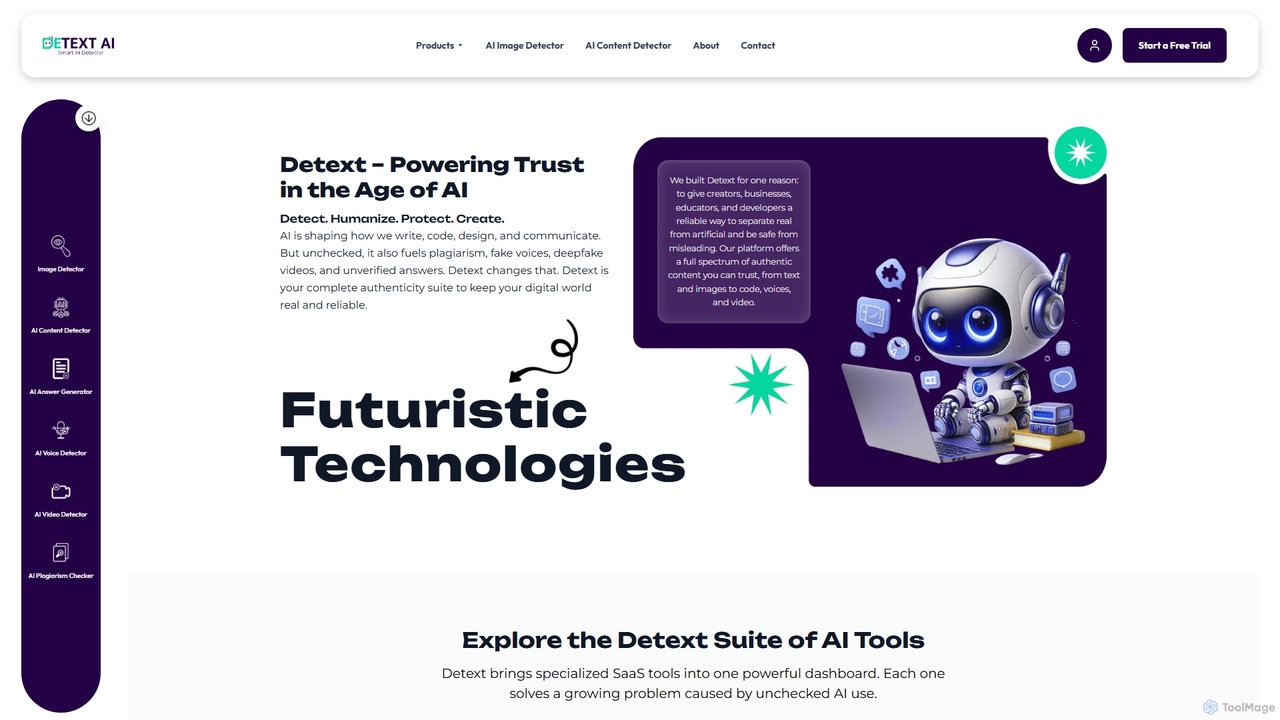
Detext is a comprehensive AI authenticity suite offering advanced tools to detect AI-generated content across text, images, audio, and video. It also provides an AI humanizer and answer generator, empowering users to verify originality, prevent plagiarism, and protect digital integrity in an AI-driven world.
About Digital Forensics
Digital Forensics tools are specialized AI-powered solutions designed for investigating cyber incidents, recovering digital evidence, and analyzing data breaches. These tools leverage advanced algorithms to identify, preserve, extract, and interpret electronic data from various sources. They are crucial for reconstructing events, understanding attack vectors, and supporting legal proceedings or internal compliance efforts. This technology significantly enhances the speed and accuracy of complex digital investigations.
Core Features
- Data Acquisition & Preservation: Securely collects and preserves digital evidence from devices, networks, and cloud environments without altering original data.
- Automated Evidence Analysis: Utilizes AI to rapidly scan, index, and analyze vast amounts of data for anomalies, malicious activities, and relevant artifacts.
- Timeline Reconstruction: Generates chronological timelines of events, user activities, and system changes to understand the sequence of an incident.
- Malware & Threat Intelligence Integration: Identifies known malware signatures and integrates with threat intelligence feeds to detect sophisticated attacks.
- Reporting & Visualization: Creates comprehensive, legally admissible reports and visual representations of findings for stakeholders and legal teams.
Applicable Scenarios
Law enforcement agencies use these tools to investigate cybercrimes, gather evidence from suspect devices, and build cases for prosecution. Corporate security teams deploy them for incident response after a data breach, identifying the scope of compromise and affected systems. Legal firms utilize them for e-discovery in litigation, efficiently sifting through electronic documents for relevant information.
How to Choose
When selecting Digital Forensics tools, consider the scope of data sources it supports (e.g., cloud, mobile, network), its automation capabilities for analysis, and compliance with legal standards like chain of custody. Evaluate its integration with existing security infrastructure and the clarity of its reporting features for legal admissibility.

Digital ForensicsUse Cases
Investigating a Corporate Data Breach
A corporate security team uses Digital Forensics tools to respond to a suspected data breach. The tools automatically scan compromised servers and endpoints, identifying the initial point of entry, the extent of data exfiltration, and the timeline of attacker activities. This enables rapid containment and accurate reporting to regulatory bodies.
Recovering Evidence from a Suspect Device
Law enforcement investigators employ Digital Forensics software to extract and analyze data from a suspect's computer or mobile phone. The tools bypass encryption, recover deleted files, and reconstruct user activity logs, providing critical evidence for criminal investigations while maintaining the integrity of the original data.
E-Discovery for Legal Litigation
Legal professionals leverage Digital Forensics platforms for e-discovery in complex litigation cases. The tools efficiently process and review massive volumes of electronic documents, emails, and communications, identifying relevant information and privileged data, significantly reducing manual review time and costs.
Analyzing Malware Infection Vectors
Cybersecurity analysts utilize Digital Forensics tools to dissect sophisticated malware infections. The tools perform deep analysis of system memory, file systems, and network traffic to understand how the malware infiltrated the system, its propagation methods, and its payload, aiding in the development of effective countermeasures.
Responding to Insider Threat Incidents
Organizations use Digital Forensics solutions to investigate potential insider threats, such as unauthorized data access or intellectual property theft. The tools monitor user activity, track data movements, and identify suspicious patterns, providing irrefutable evidence for internal disciplinary actions or legal recourse.
Validating Data Integrity After a System Migration
IT departments deploy Digital Forensics techniques to verify the integrity and completeness of data after a major system migration or upgrade. The tools compare hashes, file structures, and metadata to ensure no data loss or corruption occurred, providing assurance for critical business operations.