StrongestLayer
StrongestLayer is an AI-driven email security platform that specializes in detecting and neutralizing advanced phishing attacks, including those …
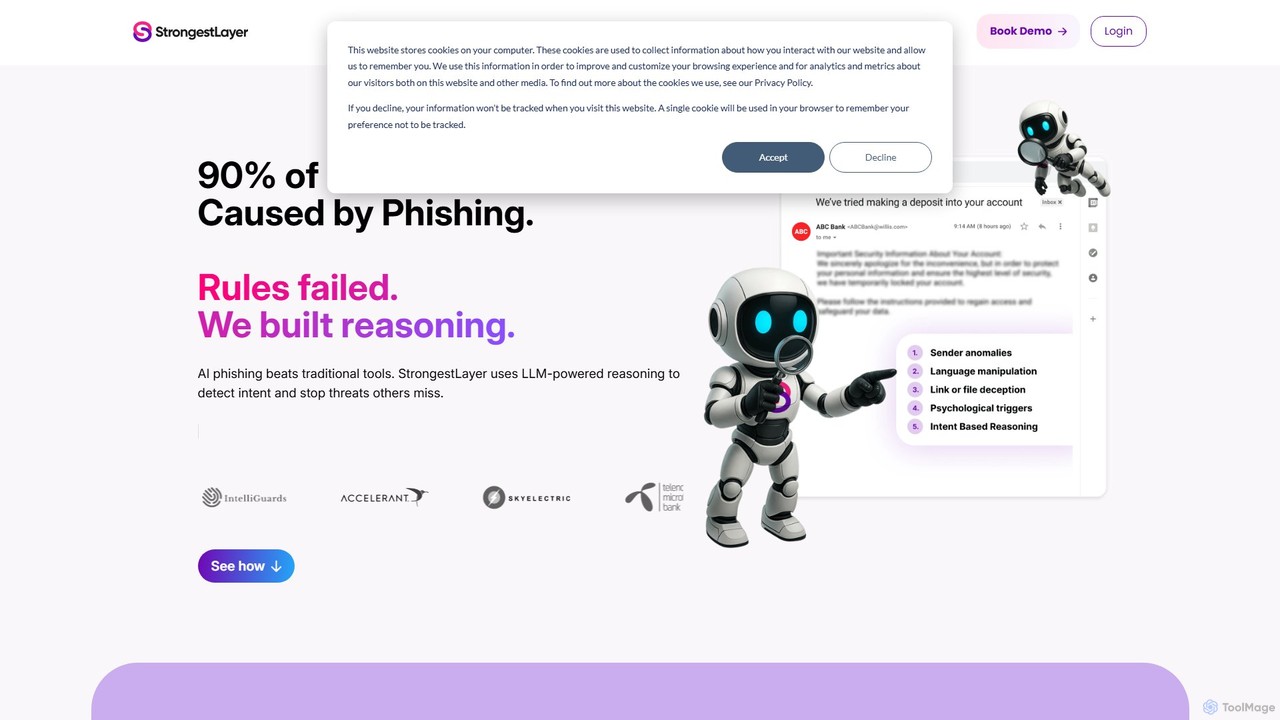
StrongestLayer is an AI-driven email security platform that specializes in detecting and neutralizing advanced phishing attacks, including those crafted by generative AI. It provides real-time threat analysis and an 'Inbox Advisor' to empower users, closing the security gaps left by traditional defense systems and protecting organizations from zero-day threats and business email compromise.
PowerDMARC
PowerDMARC is an AI-powered email authentication and security platform. It simplifies the implementation of DMARC, SPF, and DKIM …
PowerDMARC is an AI-powered email authentication and security platform. It simplifies the implementation of DMARC, SPF, and DKIM to protect domains from phishing and spoofing. The platform provides comprehensive analytics, threat intelligence, and guided setup to enhance email deliverability and secure brand communication.
Censornet
Censornet is an autonomous, integrated cloud security platform that unifies Web Security, Email Security, and Cloud Application Security …
Censornet is an autonomous, integrated cloud security platform that unifies Web Security, Email Security, and Cloud Application Security (CASB). Powered by AI, it provides mid-market organizations and MSPs with a single, easy-to-manage solution to protect people, apps, and data from cyber threats without the complexity of multiple point products.
About Email Security
AI Email Security tools are a specialized category of solutions that use artificial intelligence to protect email systems from advanced cyber threats. Leveraging machine learning and natural language processing, these tools analyze email content, sender behavior, and network patterns to identify sophisticated attacks like phishing, business email compromise (BEC), and zero-day malware. They provide a proactive defense layer that goes beyond traditional signature-based filters, significantly reducing the risk of data breaches and financial loss. Unlike static rule-based systems, AI-powered solutions continuously learn and adapt to new attack vectors.
Core Features
- Advanced Threat Detection: Uses AI to identify phishing, spear-phishing, and BEC attacks that evade traditional filters.
- Malware and Ransomware Protection: Scans attachments and links in real-time using behavioral analysis to detect unknown threats.
- Data Loss Prevention (DLP): Analyzes outbound emails to prevent sensitive information from being accidentally or maliciously shared.
- Impersonation Protection: Detects anomalies in sender identity, display names, and email headers to prevent executive spoofing.
- Automated Threat Remediation: Automatically quarantines or removes malicious emails from user inboxes, even after delivery.
Use Cases
These tools are essential for organizations of all sizes, particularly in sectors like finance, healthcare, and legal services that handle sensitive data. IT security teams and compliance officers use them to protect against targeted attacks, secure cloud email platforms like Microsoft 365 and Google Workspace, and automate incident response, strengthening the overall security posture.
How to Choose
When selecting an AI Email Security tool, evaluate its detection accuracy, specifically its false positive and negative rates. Ensure it integrates seamlessly with your existing email platform. Assess its automated remediation capabilities for post-delivery threats and verify its scalability to handle your organization's email volume. Finally, consider the quality of its threat intelligence and reporting features.
Email SecurityUse Cases
Preventing Business Email Compromise (BEC) Attacks
A finance department receives an email that appears to be from the CEO, urgently requesting a wire transfer to a new vendor. A traditional filter might miss this as it contains no malicious links or attachments. The AI Email Security tool analyzes the context, noting the unusual language of urgency, the new recipient bank details, and a slight deviation in the sender's typical email patterns. It flags the email as a high-risk impersonation attempt, quarantines it, and alerts the security team, preventing a potential six-figure financial loss.
Blocking Zero-Day Malware in Attachments
An employee receives an email with a PDF invoice attachment from a supposed partner. This PDF contains a zero-day exploit not yet known to traditional antivirus software. The AI security tool doesn't rely on signatures. Instead, it uses a sandbox environment to detonate the attachment safely. Its behavioral analysis engine detects malicious actions, such as attempts to encrypt files or connect to a command-and-control server. The email is immediately blocked, and the threat data is used to protect the rest of the organization.
Automating Phishing Incident Response
A user reports a phishing email that has already been delivered to hundreds of inboxes. For a security team, manually finding and deleting every instance is time-consuming and prone to error. The AI Email Security tool automates this. Once the threat is confirmed, its system scans all mailboxes and instantly removes every copy of the malicious email. This process, known as post-delivery remediation, reduces the incident response time from hours to minutes, drastically minimizing the window for other employees to fall victim.
Protecting Sensitive Customer Data (DLP)
A healthcare provider's employee accidentally composes an email containing a spreadsheet of patient records to an external, personal email address. A rule-based DLP might miss this if not configured perfectly. The AI-powered DLP module understands the content and context. It recognizes the data structure as Protected Health Information (PHI), blocks the outbound email before it leaves the network, and notifies the compliance officer. This prevents a serious data breach and potential regulatory fines (e.g., HIPAA).
Filtering Sophisticated Spear-Phishing Campaigns
An executive receives a highly personalized email appearing to be from a trusted business partner, referencing a recent project to build credibility. The email contains a link to a credential harvesting site. The AI security tool analyzes multiple vectors: it notes the link's domain was registered only recently, the sender's IP address is unusual for that partner, and the email's linguistic style shows subtle signs of social engineering. By combining these weak signals into a strong indicator of attack, it blocks the email, protecting high-value credentials.
Securing Cloud Email (Microsoft 365/Google Workspace)
An organization uses Microsoft 365, which has its own security features. However, they need an additional layer of defense against advanced threats that might bypass native protection. An AI Email Security tool integrates via API with their cloud environment. It analyzes all email traffic—inbound, outbound, and internal—for threats. For example, it can detect a compromised internal account sending malicious emails to other employees, a scenario that native security might not flag as suspicious since it originates from a trusted source.