ToolMage
Sign in

Best 1 Chatting AI tools for Social

Popular Chatting AI tools in Social include Uhmegle, helping you work more efficiently.

Uhmegle
Free

Uhmegle

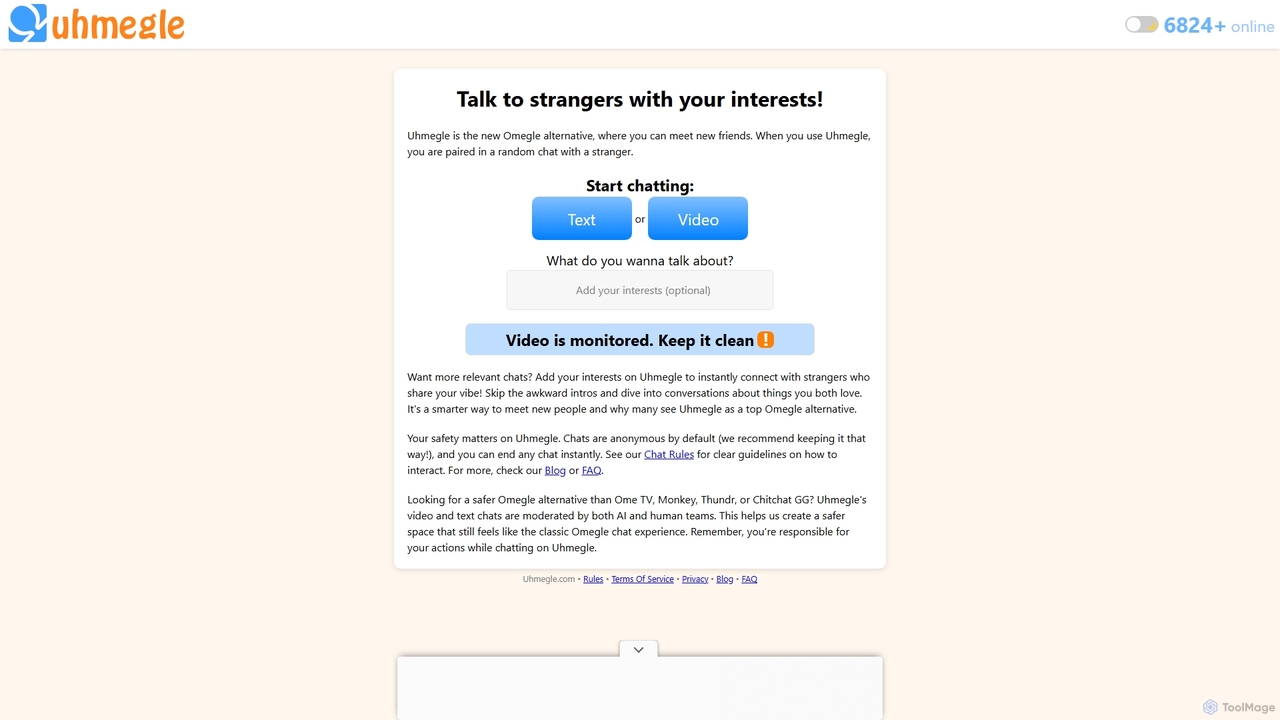
Uhmegle is a modern Omegle alternative that uses AI for safer, interest-based text and video chats with strangers. It features AI and human moderation, a multi-country selector, and a focus on anonymity, allowing users to connect with like-minded people globally in a secure and user-friendly environment on any device.

Online Communities
Visits 1.9MFavorites 86Likes 108

About Chatting

AI Chatting tools are a class of applications designed to facilitate dynamic, human-like conversations using artificial intelligence. These tools leverage advanced large language models (LLMs) and Natural Language Processing (NLP) to understand context, generate coherent responses, and simulate distinct personalities. They are primarily used for creating virtual companions, engaging in interactive entertainment, practicing languages, or enhancing online social interactions. Unlike general social media platforms, AI Chatting tools focus specifically on the quality and depth of the conversational experience itself.

Core Features

  • AI Personality Customization: Define an AI's character traits, background story, and communication style.
  • Contextual Memory: Enables the AI to remember previous parts of the conversation for more coherent dialogue.
  • Real-time Voice & Text Chat: Supports seamless interaction through both typed messages and spoken words.
  • Role-Playing Scenarios: Allows users to create and participate in interactive stories or simulations with AI characters.
  • Multi-language Support: Facilitates conversations with AI or other users across different languages with instant translation.

Use Cases

These tools are widely used by individuals seeking companionship or entertainment, writers and game developers for creating interactive narratives, and language learners for immersive practice. In community management, they can act as intelligent moderators or greeters in online forums and gaming servers.

How to Choose

When selecting an AI Chatting tool, consider the depth of personality customization available, the quality of its conversational memory, and the supported communication modes (text, voice, avatars). Also evaluate the platform's community features, content policies, and pricing model, especially the difference between free and premium conversation limits.

Chatting use cases

1

Creating a Personalized AI Companion

An individual looking for a supportive and non-judgmental conversational partner uses an AI Chatting tool to build a virtual friend from scratch. They start by defining the AI's core personality traits, such as being empathetic, witty, or intellectual. They then provide a backstory, interests, and even a specific communication style. Through ongoing conversations, the AI learns the user's preferences and remembers key details about their life, creating a deeply personalized and evolving relationship. This provides a consistent source of companionship and a safe space for users to express their thoughts and feelings without fear of judgment.

2

Interactive Role-Playing and Storytelling

A writer or game developer uses an AI Chatting tool to prototype dynamic characters and explore narrative branches. They set up a scenario and define a character's personality and motivations. Then, they interact with the AI character as if they were a player, testing dialogue options and observing how the AI responds to different inputs. This allows for rapid iteration on character development and plot points without needing to write extensive, branching scripts manually. The AI's ability to improvise within its defined personality creates unexpected and organic story moments, enriching the creative process.

3

Immersive Language Learning Practice

A student learning Spanish uses an AI Chatting tool to practice conversational skills. They select an AI persona configured as a native Spanish speaker from Madrid. The student can engage in realistic, everyday conversations, such as ordering food at a restaurant or asking for directions, entirely in Spanish. The AI provides instant, contextually appropriate responses and can gently correct grammatical mistakes or suggest more natural phrasing. This immersive practice helps the student build confidence and fluency in a low-pressure environment, available 24/7, which is often more accessible and less intimidating than practicing with a human tutor.

4

Simulating Professional Conversations for Training

A corporate trainer designs a simulation for new sales representatives using an AI Chatting tool. They create several AI client personas, each with different objections, budgets, and communication styles (e.g., 'The Skeptic', 'The Enthusiast', 'The Price-Conscious Buyer'). Trainees must then engage in a sales pitch conversation with these AI clients. The tool allows the trainer to monitor the conversations and provide feedback. This method provides a safe and repeatable environment for trainees to practice handling difficult conversations, refining their pitch, and improving their negotiation skills before interacting with real customers.

5

Creating Interactive Brand Mascots

A marketing team develops an AI-powered brand mascot to engage with visitors on their company website. They use an AI Chatting tool to give the mascot a fun, helpful personality that aligns with their brand identity. The mascot can answer frequently asked questions about products, guide users through the website, and even tell jokes or share interesting facts related to the industry. This creates a more memorable and interactive user experience compared to a static website or a standard FAQ page. It helps build brand affinity and can keep potential customers engaged on the site for longer periods.

6

Automating Community Engagement and Support

A community manager for a large online gaming forum deploys an AI chat agent to improve member experience. The AI is programmed with the community's rules and a helpful, friendly persona. It automatically welcomes new members, answers common questions about game mechanics, and gently reminds users of the rules when it detects violations. It can also initiate fun, topic-based conversations in designated channels to keep the community active. This frees up the human manager's time to focus on more complex issues, such as resolving disputes and organizing community events, while ensuring members receive prompt and consistent support.

Chatting FAQ

What are AI Chatting tools?

AI Chatting tools are applications that use artificial intelligence, particularly large language models (LLMs), to engage in realistic, open-ended conversations with users. Unlike simple chatbots that follow scripts, these tools can understand context, express personality, and remember past interactions. Key features often include personality customization, long-term memory, and support for both text and voice. They are commonly used for companionship, entertainment, role-playing, and language practice.

How to choose the right AI Chatting tool?

To choose the right AI Chatting tool, consider these factors:

  • Customization Depth: Evaluate how deeply you can customize the AI's personality, knowledge, and conversational style.
  • Memory Capability: Check if the tool offers long-term memory to ensure conversations are coherent and build over time.
  • Interaction Modes: Decide if you need text-only, voice chat, or even avatar-based interactions.
  • Content Policies & Safety: Review the platform's content filters and safety features to ensure they align with your comfort level.
  • Pricing Model: Compare free tiers versus subscription plans. Look at message limits, feature access, and the overall value provided.
What's the difference between AI Chatting tools and standard chatbots?

The main difference lies in complexity and purpose. Standard chatbots are typically rule-based or use simpler AI to perform specific tasks, like answering FAQs or booking appointments. They follow a predefined script and have limited conversational ability. AI Chatting tools, on the other hand, use advanced LLMs to engage in open-ended, dynamic, and context-aware conversations. Their primary purpose is the conversation itself—for companionship, role-playing, or creative exploration—rather than just completing a task. They exhibit personality, learn from interactions, and can discuss a vast range of topics.

What are the main features of modern AI Chatting platforms?

Modern AI Chatting platforms typically offer a rich set of features focused on creating immersive and personalized experiences. Key features include:

  • Advanced Personality Sliders: Fine-tune traits like empathy, humor, and intellect.
  • Long-Term Memory: The ability for the AI to recall details from past conversations.
  • Voice Chat: Real-time, spoken conversations with realistic AI voices.
  • Multi-Character Conversations: The ability to create and chat with multiple AI characters in a single group chat.
  • Scenario Creation: Tools for users to build their own role-playing worlds and situations for the AI to participate in.
Who can benefit from using AI Chatting tools?

A wide range of users can benefit from AI Chatting tools. Individuals seeking companionship or a non-judgmental space to talk find great value in them. Creatives, such as writers and game developers, use them for brainstorming, character development, and interactive storytelling. Language learners can practice conversational skills in an immersive, low-pressure environment. Additionally, community managers and marketers can use them to create engaging brand experiences or automate simple community interactions, freeing them up for more strategic tasks.