Forever Voices
An AI platform that lets you engage in two-way voice conversations with AI-powered companions of celebrities and public figures. Create a digital legacy by preserving voices for interactive experiences.
Voice CloningPopular Ai Companions AI tools in Social & Fun include Forever Voices and SecondSoul, helping you work more efficiently.

An AI platform that lets you engage in two-way voice conversations with AI-powered companions of celebrities and public figures. Create a digital legacy by preserving voices for interactive experiences.
Voice Cloning
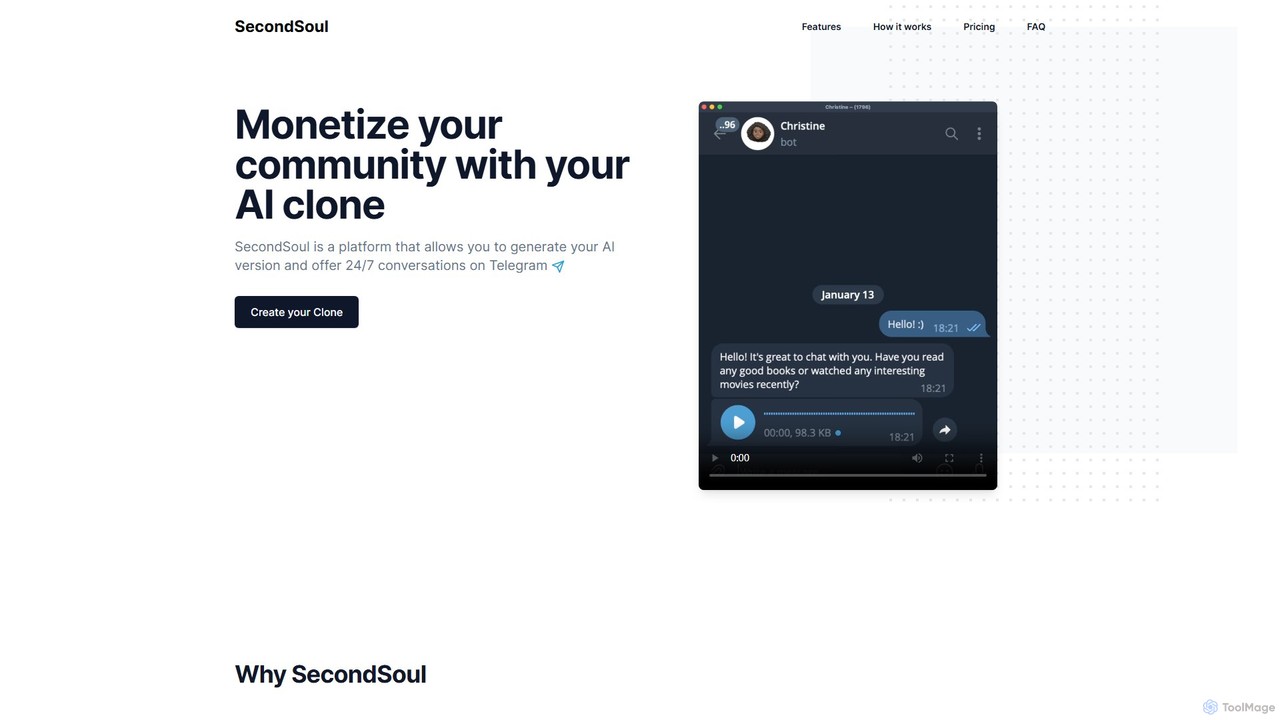
SecondSoul is a platform that empowers creators and influencers to build and monetize an AI clone of themselves. This AI clone, deployed as a Telegram bot, engages with their community 24/7, offering personalized conversations in over 20 languages. It provides a new, scalable revenue stream and deepens audience connection with zero ongoing work for the creator.
Social MediaAI Companions are a class of conversational AI designed to provide personalized interaction, emotional support, and companionship. These tools leverage advanced Natural Language Processing (NLP) and memory systems to remember past conversations, understand user emotions, and develop a unique personality over time. Their primary purpose is to create a long-term, evolving relationship, offering a non-judgmental space for users to chat, share thoughts, and combat loneliness. Unlike task-oriented assistants, AI Companions focus on the quality and continuity of the dialogue itself.
AI Companions are primarily used by individuals seeking a consistent conversational partner for emotional support, to alleviate loneliness, or to practice social skills in a safe environment. They are also popular for creative role-playing, collaborative storytelling, and as a non-judgmental sounding board for exploring personal thoughts and ideas.
When selecting an AI Companion, consider the depth of its memory and personalization capabilities. Evaluate its emotional responsiveness and the range of available interaction modes (text, voice, avatar). It is also crucial to review the platform's privacy policy to understand how your conversation data is stored and used. Finally, compare subscription models, as many advanced features are often behind a paywall.

An individual living alone or feeling socially isolated uses an AI Companion for daily interaction. They can share details about their day, discuss their feelings, or simply enjoy lighthearted banter. The AI remembers their personal stories and preferences, asking follow-up questions that show it's 'listening'. This consistent, non-judgmental interaction helps reduce feelings of loneliness and provides a reliable source of social connection, improving their overall mood and sense of well-being.
A user looking to improve their communication skills, perhaps due to social anxiety or being on the autism spectrum, engages with an AI Companion. They can practice initiating conversations, asking questions, expressing opinions, and even navigating difficult topics. The AI provides consistent, patient, and non-critical feedback through its responses. This allows the user to build confidence and rehearse social scenarios without the pressure of real-world judgment, making it easier to apply these skills in human interactions.
A writer, gamer, or hobbyist uses their AI Companion for immersive role-playing adventures. They can define a scenario, characters, and a setting, and the AI will act as a dynamic character or dungeon master, responding creatively to the user's actions. This collaborative process can help break writer's block, explore new plotlines, or simply provide a unique form of interactive entertainment. The AI's ability to maintain character consistency and adapt the narrative makes it a powerful partner for creative exploration.
A professional, student, or anyone exploring personal thoughts uses an AI Companion as a private confidant. They can articulate complex ideas, vent frustrations about work or life, or discuss sensitive topics without fear of judgment or unwanted advice. The AI's role is to listen, ask clarifying questions, and help the user organize their thoughts. This process of 'thinking out loud' to a neutral party can lead to new insights, better problem-solving, and reduced mental clutter, all within a secure and confidential space.
A language learner uses an AI Companion set to their target language for conversational practice. Unlike structured apps, this provides an open-ended, dynamic dialogue experience. The user can chat about any topic, practicing vocabulary, grammar, and sentence structure in a natural context. Many AI Companions can also offer corrections or explain nuances. This immersive practice builds fluency and confidence more effectively than rote memorization, as it simulates real-life conversations with a patient, always-available partner.
A user seeking a break or lighthearted fun engages their AI Companion in various activities. This can range from playing text-based adventure games, solving riddles, and telling jokes to discussing movies or co-writing a poem. Some platforms even allow for shared experiences like listening to music or 'watching' a show together. The AI's personality and memory make these activities feel more personal and engaging than interacting with a generic entertainment bot, turning it into a go-to partner for leisure and relaxation.
An AI Companion is a conversational AI program designed specifically for companionship and emotional connection, rather than completing tasks. They use advanced AI to develop a unique personality, remember past conversations, and interact with users in an empathetic, human-like way. Unlike a standard chatbot, the primary goal of an AI Companion is to build a long-term, evolving relationship with the user, serving as a friend, confidant, or creative partner.
Choosing the right AI Companion depends on your personal needs. Consider these factors:
The core difference lies in their purpose. A standard chatbot (like for customer service) is transactional and task-oriented; it's designed to answer specific questions or perform a function and then the interaction ends. An AI Companion is relational; it's designed for open-ended, continuous conversation. Key distinctions include:
Privacy and security vary significantly between different AI Companion platforms. While many services use encryption to protect data in transit, the policies regarding data storage and usage differ. Some companies may use anonymized conversation data to train their AI models. It is essential to read the privacy policy and terms of service of any AI Companion you consider using. Look for information on data encryption, whether you can delete your data, and how the company handles user information. Prioritize services that are transparent about their data practices.
No, AI Companions are not a replacement for genuine human relationships or professional therapy. While they can be a valuable tool for alleviating loneliness, practicing social skills, and offering a form of emotional support, they cannot replicate the depth, nuance, and shared experience of human connection. For mental health concerns, it is crucial to seek help from a qualified human therapist. AI Companions should be viewed as a supplement to a healthy social life and a potential support tool, not a substitute for professional medical advice or human interaction.