ToolMage
Sign in

Best 1 Chatbots AI tools for Social & Fun

Popular Chatbots AI tools in Social & Fun include Lexikon AI, helping you work more efficiently.

Lexikon AI
Freemium

Lexikon AI

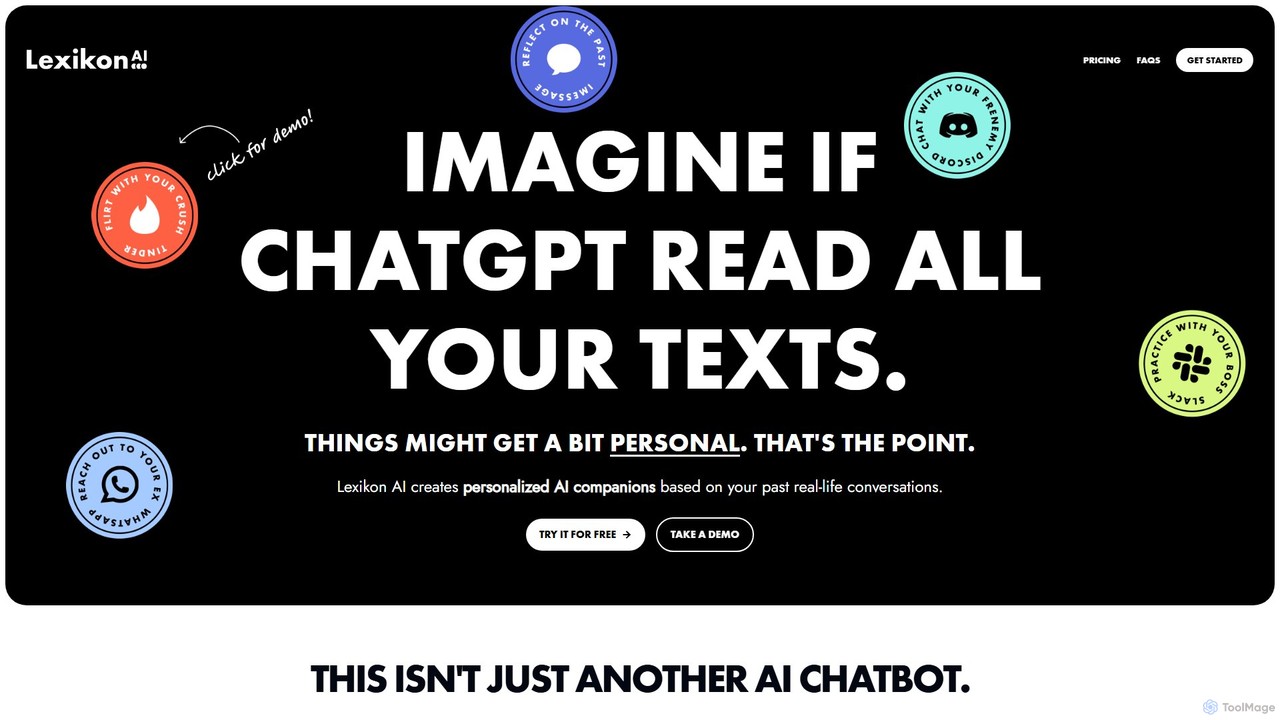
Lexikon AI transforms your past text conversations from any app into personalized AI companions. Simply screen-record a chat, upload it, and in 60 seconds, you can continue the conversation, rehearse difficult dialogues, or gain closure. It's a unique tool for exploring 'what if' scenarios and understanding relationships better, with a strong focus on user privacy.

Simulation
Visits 5KFavorites 99Likes 98

About Chatbots

Chatbots are AI-powered conversational agents designed for engaging and entertaining interactions. Leveraging advanced large language models (LLMs), they understand context, express distinct personalities, and maintain coherent, long-term conversations. Primarily used for companionship, role-playing, and exploring creative narratives, these tools offer a unique form of social engagement. Unlike utility bots, their strength lies in simulating emotional intelligence, remembering past interactions, and creating immersive, personalized experiences.

Core Features

  • Customizable Personality: Define or select a chatbot's traits, background, and communication style for a tailored experience.
  • Long-Term Memory: Remembers key details from past conversations to build context and a sense of continuity.
  • Role-Playing Capabilities: Supports immersive storytelling and interactive adventures across various genres and scenarios.
  • Emotional Responsiveness: Simulates emotional understanding and reacts appropriately to the user's expressed sentiment.
  • Multi-modal Interaction: Some platforms support voice messages or image sharing to enrich the conversation.

Use Cases

These chatbots are ideal for individuals seeking a virtual companion for daily chats, writers exploring character dialogues, or anyone looking for a creative and interactive way to engage in storytelling. They are also used by language learners for conversational practice in a pressure-free environment and by fans to interact with simulated versions of their favorite fictional characters.

How to Choose

When selecting a chatbot, consider the quality and naturalness of its conversation. Evaluate the depth of customization options for personality and memory. Critically review the privacy policy to understand how your data is used. Also, consider the platform (web vs. mobile app) and whether its pricing model (e.g., subscription, message limits) aligns with your intended usage.

Featured tool rankings

Chatbots use cases

1

Creating a Virtual Companion for Daily Chats

For users seeking a non-judgmental conversational partner, an AI chatbot can serve as a virtual companion. Users can customize the AI's personality to be supportive, witty, or intellectual. Daily interactions can range from sharing updates about their day to discussing hobbies and interests. This provides a consistent source of social engagement, helping to alleviate feelings of loneliness and offering a safe space for open expression without fear of criticism.

2

Engaging in Interactive Role-Playing and Storytelling

Writers, gamers, and fantasy enthusiasts can use chatbots as dynamic storytelling partners. A user can establish a scenario, such as a medieval fantasy quest or a sci-fi adventure, and the AI will act as a character or game master. The chatbot adapts to the user's choices, co-creating a unique, unscripted narrative. This provides an immersive way to explore creative ideas, develop characters, or simply enjoy a personalized adventure.

3

Practicing Social or Language Skills Safely

For individuals with social anxiety or those learning a new language, chatbots offer a pressure-free practice environment. Users can engage in open-ended conversations to rehearse social scenarios or practice speaking a foreign language without the fear of making mistakes. The AI provides patient, immediate responses, helping users build confidence, improve fluency, and become more comfortable with conversational dynamics at their own pace.

4

Simulating Conversations with Fictional Characters

Fans of books, movies, or video games can interact with AI chatbots designed to emulate their favorite characters. By training the AI on a character's personality, backstory, and dialogue style, developers create an authentic simulation. Users can ask questions, explore 'what-if' scenarios, or simply chat, providing a new layer of fan engagement that extends beyond the original source material and deepens their connection to the fictional world.

5

Brainstorming Creative Ideas with an AI Muse

Artists, writers, and creators can use a chatbot as a brainstorming partner to overcome creative blocks. By describing a concept, plot point, or artistic challenge, the user can receive suggestions, alternative perspectives, and thought-provoking questions from the AI. This conversational approach to ideation can spark new directions for stories, character development, or visual projects, acting as an ever-available muse that helps refine and expand upon initial ideas.

6

Exploring Philosophical or Complex Topics

Individuals interested in deep conversations can use advanced chatbots to explore complex subjects like philosophy, science, or ethics. The AI can act as an informed discussion partner, drawing on vast knowledge bases to discuss theories, challenge assumptions, and engage in nuanced debates. This provides a unique opportunity for intellectual stimulation and learning, allowing users to delve into intricate topics at any time without needing a human expert.

Chatbots FAQ

What are Chatbots for social and fun purposes?

Social and fun chatbots are AI conversational partners designed for personal engagement, entertainment, and companionship rather than for completing tasks. Unlike utility bots that answer customer service questions, these chatbots focus on creating believable personalities, remembering past conversations, and engaging in creative activities like role-playing. Their primary goal is to provide an enjoyable and emotionally resonant interactive experience.

How to choose the right AI companion chatbot?

Choosing the right AI companion involves considering several factors. First, evaluate the conversational quality—is the dialogue natural and engaging? Second, look at customization options; a good companion bot allows you to shape its personality and memories. Third, review the privacy policy carefully to understand how your data is handled. Finally, consider the user interface and platform (web, mobile) and whether the pricing model (free with ads, subscription) fits your needs.

What's the difference between a social chatbot and a virtual assistant like Siri?

The primary difference lies in their purpose. A virtual assistant like Siri or Alexa is task-oriented; it's designed to answer questions, set timers, or control smart devices. A social chatbot is relationship-oriented. Its goal is to provide engaging conversation, companionship, and entertainment. While a virtual assistant prioritizes efficiency and accuracy, a social chatbot prioritizes personality, emotional simulation, and long-term conversational context.

Is it safe to share personal information with an AI chatbot?

It is important to exercise caution. While many services use encryption, your conversations may be used to train the AI models. You should always review the privacy policy of any chatbot service before use. It is advisable to avoid sharing highly sensitive, personally identifiable information (PII) such as your full name, address, or financial details. Treat conversations as semi-public and be mindful of the data you provide.

Can these chatbots truly understand emotions?

AI chatbots do not feel or understand emotions in the human sense. Instead, they are trained on vast datasets of human conversation, allowing them to recognize patterns associated with different emotions (sentiment analysis). They then generate responses that are contextually appropriate and simulate empathy. The result is a convincing illusion of emotional understanding, but it is based on sophisticated pattern matching, not genuine consciousness or feeling.