
soccersm
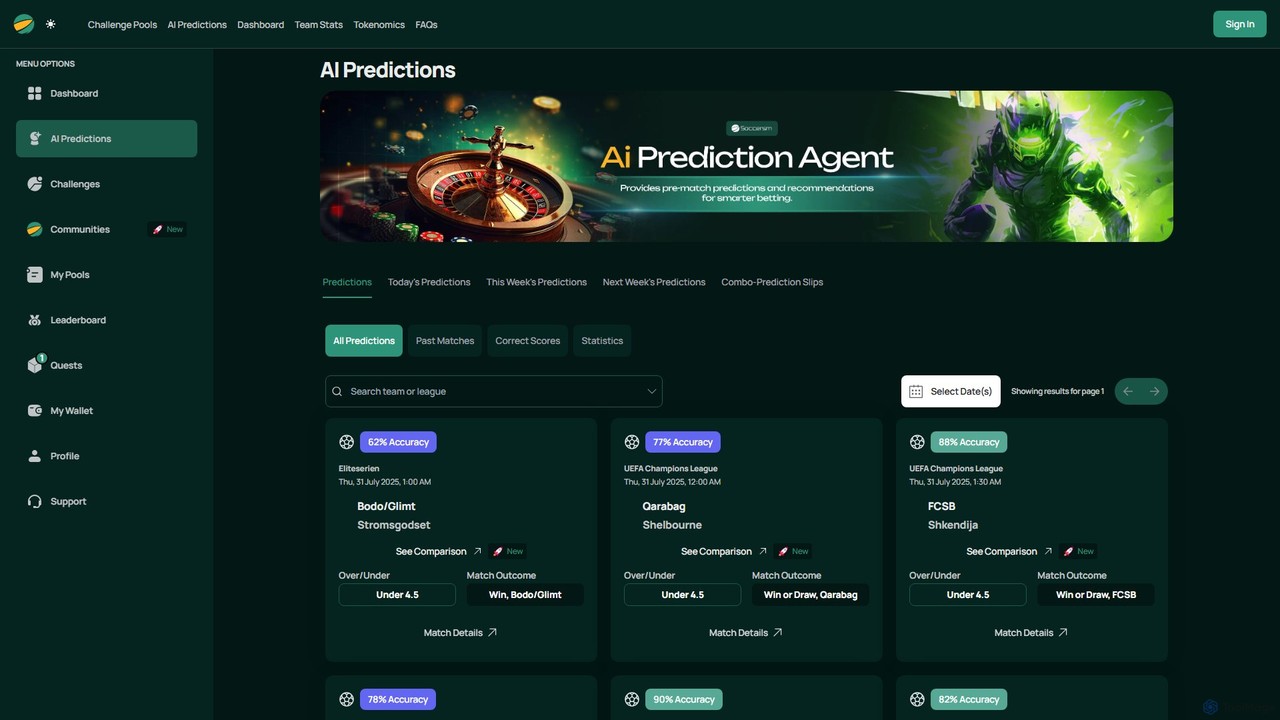
Soccersm is an AI-powered platform offering detailed soccer match predictions, including outcomes, over/under, and correct scores. Beyond sports, …
Soccersm is an AI-powered platform offering detailed soccer match predictions, including outcomes, over/under, and correct scores. Beyond sports, it features a social prediction market where users can create and join challenge pools on various topics like crypto and politics, using the platform's currency. It combines data-driven insights with community engagement and gamification elements like leaderboards and quests.
About Gamification
AI Gamification tools are a class of software that applies game-design elements and principles to non-game contexts using artificial intelligence. These tools leverage machine learning to analyze user behavior, dynamically adjust challenges, and personalize rewards to significantly boost engagement and motivation. They are used to transform routine tasks in business, education, and marketing into compelling, interactive experiences. Unlike static gamification systems, AI-powered platforms adapt in real-time to individual user skill levels and preferences, creating a more effective and sustainable engagement loop.
Core Features
- Personalized Journeys: AI creates unique challenges, rewards, and learning paths for each user based on their behavior and performance.
- Dynamic Difficulty Adjustment: The system automatically modifies the complexity of tasks to keep users in a state of flow, preventing boredom or frustration.
- Predictive Analytics: Machine learning models forecast user churn or disengagement and can trigger automated interventions to retain them.
- Behavioral Analytics: Provides deep insights into user motivation and interaction patterns, helping to refine engagement strategies.
- Automated Reward Management: Intelligently suggests and distributes the most effective rewards (points, badges, virtual goods) for individual users.
Use Cases
AI Gamification is widely adopted in corporate training to make learning modules more engaging, in marketing for creating interactive customer loyalty programs, and in educational technology (EdTech) to motivate students. It is also used in wellness apps to encourage habit formation and in sales departments to drive team performance through competitive leaderboards.
How to Choose
When selecting an AI Gamification tool, consider its integration capabilities with your existing platforms (like CRM or LMS). Evaluate the depth of its AI-powered personalization and analytics. Also, assess its scalability to handle your user base, the ease of creating and managing gamification rules, and the variety of game mechanics it supports.
GamificationUse Cases
Enhancing Corporate Training Engagement
An HR manager for a large enterprise needs to ensure high completion rates for mandatory compliance training. They use an AI Gamification platform integrated with their Learning Management System (LMS). The AI analyzes each employee's learning pace and knowledge gaps, then generates personalized quizzes and interactive challenges. It creates team-based competitions and leaderboards, fostering a sense of friendly rivalry. As a result, training engagement increases by 60%, and knowledge retention improves significantly, reducing compliance risks for the company.
Boosting Customer Loyalty Program Activity
A marketing manager for an e-commerce brand wants to increase activity in their loyalty app. They implement an AI Gamification tool that analyzes user purchase history and browsing behavior. Based on this data, the AI offers personalized challenges like 'Purchase from a new category to earn double points' or 'Log in for 3 consecutive days for a surprise badge'. This dynamic, tailored approach makes the loyalty program feel more like a personal game, leading to a 45% increase in daily active users and a 20% uplift in repeat purchases.
Motivating Students in an E-Learning Platform
An EdTech company aims to reduce student dropout rates in their online coding courses. They integrate an AI Gamification engine that tracks student progress and identifies areas of difficulty. When a student struggles with a concept, the AI suggests fun, bite-sized coding challenges or mini-games to reinforce learning. It also awards experience points (XP) for completing modules and unlocks new cosmetic items for their avatars. This personalized support system keeps students motivated, leading to a 30% decrease in course abandonment.
Driving Habit Formation in a Wellness App
A developer of a meditation app wants to encourage users to build a consistent daily practice. They use an AI Gamification module that learns each user's schedule and motivation triggers. The AI sets personalized 'streak' goals and sends intelligent reminders at times the user is most likely to be receptive. It also uses predictive analytics to offer a guided meditation on 'stress relief' after detecting the user has had a busy day (based on calendar integration). This proactive, personalized approach helps increase the 30-day user retention rate by 35%.
Increasing Sales Team Performance
A sales director wants to motivate their team and increase quarterly revenue. They integrate an AI Gamification tool with their CRM. The tool creates real-time leaderboards for metrics like 'calls made' and 'deals closed'. The AI component dynamically creates weekly 'sprints' and team-based challenges, adjusting targets based on historical performance to keep them challenging but achievable. It also automatically awards badges for milestones like 'First Million Dollar Deal'. This system fosters healthy competition and transparency, resulting in a 15% increase in overall team sales productivity.
Gamifying Community Forum Participation
A community manager for a software product wants to encourage expert users to answer questions in the online forum. They deploy an AI Gamification system that analyzes the quality of user posts. The AI automatically awards points and 'Expert' badges for well-received answers, creating a reputation system. It also identifies emerging power users and suggests them for a moderator program. This gamified approach transforms passive readers into active contributors, increasing the answer rate for new questions by 50% and reducing the support team's workload.