Microlaunch
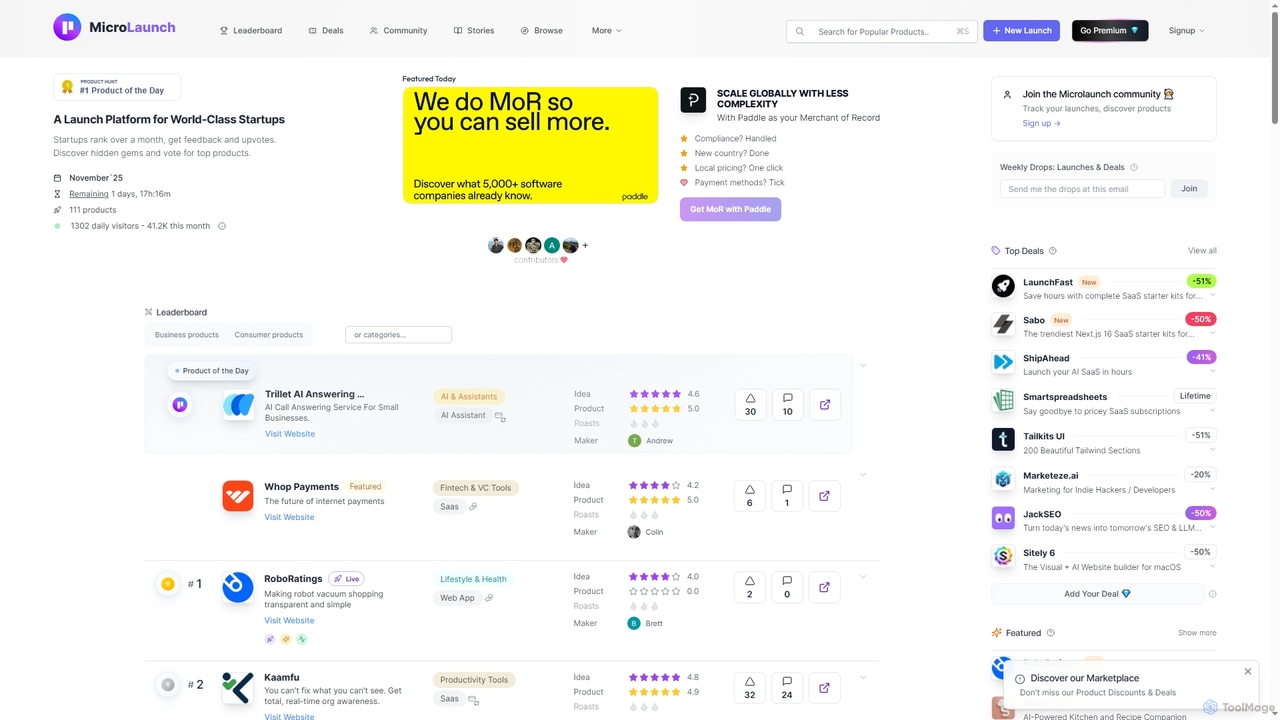
A launch platform and marketplace for startups and tech founders. It helps new products gain visibility, user feedback, and initial sales through a 30-day launch campaign, featured placements, and community engagement.
FeedbackPopular Marketplace AI tools in Startup Tools include Microlaunch, helping you work more efficiently.

A launch platform and marketplace for startups and tech founders. It helps new products gain visibility, user feedback, and initial sales through a 30-day launch campaign, featured placements, and community engagement.
FeedbackAI Marketplace tools are specialized platforms or software solutions that leverage artificial intelligence to facilitate the buying, selling, or exchange of goods, services, or data. These tools are built upon advanced algorithms for matching, personalization, and dynamic optimization, enabling efficient connections between providers and consumers. They empower startups to build scalable, intelligent platforms that adapt to user behavior and market dynamics, forming a crucial component of modern digital entrepreneurship.
Startups utilize AI Marketplace tools to launch and scale various business models. This includes creating niche service marketplaces for freelancers, optimizing e-commerce platforms with hyper-personalized product recommendations, or building B2B platforms for efficient resource sharing and supplier matching. These tools are essential for any startup aiming to create a dynamic, user-centric exchange environment.
When selecting an AI Marketplace tool, consider its scalability to accommodate growth, the sophistication of its AI matching and personalization engines, and its integration capabilities with existing business systems. Evaluate the level of customization offered, the pricing model, and the quality of support to ensure it aligns with your startup's specific needs and technical expertise.

A startup aiming to connect specialized freelancers (e.g., AI prompt engineers, niche language translators) with clients can use AI Marketplace tools to build a platform that intelligently matches service providers with client requests based on skills, experience, and project requirements. This automates the discovery process, reduces manual vetting, and ensures optimal pairings, accelerating the startup's growth and user satisfaction.
An e-commerce startup can deploy AI Marketplace tools to enhance its product recommendation engine and search functionality. By analyzing user browsing history, purchase patterns, and real-time interactions, the AI can present highly relevant products, personalize homepage layouts, and refine search results. This leads to increased conversion rates, higher average order values, and a more engaging shopping experience for customers.
Startups in the ride-sharing, food delivery, or equipment rental sectors leverage AI Marketplace tools for dynamic pricing. The AI analyzes factors like real-time demand, supply availability, traffic conditions, and historical data to adjust prices instantly. This maximizes revenue during peak times, balances supply and demand, and optimizes resource allocation, ensuring competitive pricing and operational efficiency.
For startups operating peer-to-peer rental or second-hand goods platforms, AI Marketplace tools are crucial for maintaining trust and safety. AI algorithms monitor transaction patterns, user behavior, and communication for anomalies, flagging potential fraudulent activities or suspicious listings. This proactive approach protects users from scams, reduces financial losses, and strengthens the platform's reputation.
A startup building a marketplace for user-generated content (e.g., digital art, stock photos, classifieds) can use AI tools for automated content moderation. AI can quickly identify and filter out inappropriate, illegal, or low-quality listings based on predefined rules and image/text analysis. This ensures content quality, compliance with platform policies, and a safe browsing environment, saving significant manual moderation effort.
A B2B startup creating a platform to connect businesses with specific suppliers (e.g., manufacturing components, IT services) can utilize AI Marketplace tools for intelligent matching. The AI processes detailed business requirements, supplier capabilities, certifications, and past performance data to recommend the most suitable partners. This streamlines procurement, reduces search time, and fosters more effective business collaborations.
AI Marketplace tools are software solutions that use artificial intelligence to power platforms where goods, services, or data are exchanged. They leverage AI for intelligent matching, personalized recommendations, dynamic pricing, and fraud detection, creating more efficient and user-centric marketplaces. These tools are essential for startups looking to build scalable and adaptive digital ecosystems.
When selecting an AI Marketplace tool, startups should prioritize scalability, the sophistication of its AI features (e.g., matching algorithms, personalization), and ease of integration with existing systems. Consider the level of customization, the vendor's support, and the pricing model to ensure it aligns with your business model, growth projections, and technical capabilities.
Integrating AI into a marketplace offers several key benefits: enhanced user experience through personalization and intelligent recommendations, optimized pricing strategies for maximum revenue, improved trust and safety via advanced fraud detection, and increased operational efficiency through automation of tasks like listing management and content moderation. This leads to higher engagement and conversion rates.
AI Marketplace tools primarily address challenges such as inefficient matching between buyers and sellers, suboptimal pricing, lack of personalization, and the complexities of fraud and trust management. They also help overcome the scalability issues of manual operations, enabling platforms to handle large volumes of users and transactions while maintaining a high-quality experience.
While traditional e-commerce platforms focus on direct sales from a single vendor, AI Marketplace tools facilitate multi-vendor or peer-to-peer exchanges, often with a strong emphasis on connecting disparate parties. The key difference lies in their heavy reliance on AI for dynamic matching, personalized discovery, and real-time optimization, which goes beyond the static product catalogs and basic search functions of conventional e-commerce.