ToolMage
Sign in

Best 1 Video Interview AI tools for Video

Popular Video Interview AI tools in Video include Hire Hoc, helping you work more efficiently.

Hire Hoc
Freemium

Hire Hoc

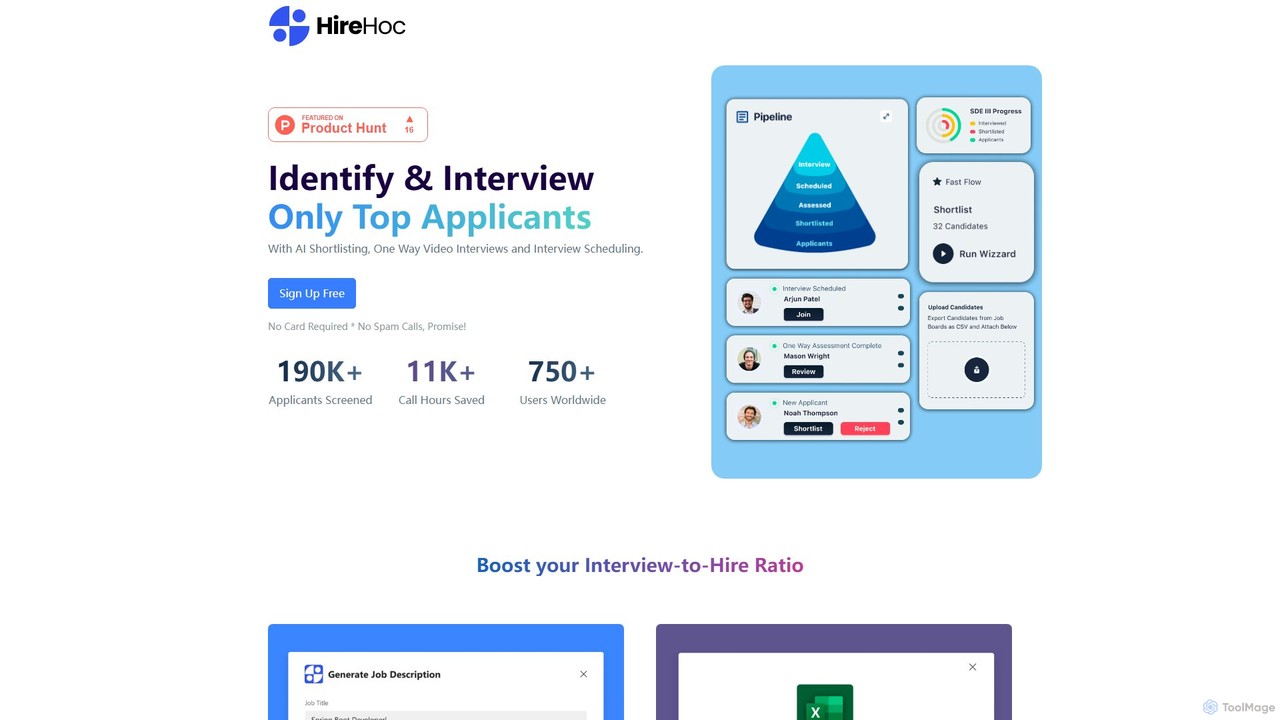
Hire Hoc is an AI-powered hiring platform designed to streamline the recruitment process. It helps recruiters identify and interview top applicants using AI-driven shortlisting, one-way video interviews, and automated interview scheduling. The tool aims to increase the interview-to-hire ratio, reduce no-shows, and save significant time for hiring teams.

Recruiting
Visits 4.1KFavorites 164Likes 137

About Video Interview

AI Video Interview tools are specialized platforms designed to automate and analyze video-based job interviews. These tools leverage artificial intelligence, including natural language processing (NLP) and computer vision, to evaluate candidate responses, verbal cues, and non-verbal communication. They provide recruiters with data-driven insights to streamline the screening process, reduce unconscious bias, and efficiently manage a large volume of applicants. This technology transforms traditional interviewing by introducing objective, scalable, and consistent evaluation methods.

Core Features

  • AI-Powered Analysis: Objectively assesses candidate responses by analyzing keywords, speech patterns, tone of voice, and facial expressions.
  • Asynchronous (One-Way) Interviews: Allows candidates to record answers to preset questions on their own time, eliminating scheduling conflicts.
  • Structured Question Banks: Provides customizable and standardized questions to ensure a fair and consistent interview experience for all applicants.
  • Automated Scoring and Ranking: Generates performance scores and ranks candidates based on predefined criteria, speeding up the shortlisting process.
  • ATS Integration: Seamlessly connects with existing Applicant Tracking Systems to centralize candidate data and workflow.

Use Cases

These tools are widely used in high-volume recruitment scenarios, such as for retail, customer service, and graduate programs. Global organizations utilize them to conduct initial screenings across different time zones without logistical challenges. HR departments also adopt this technology to enhance objectivity and mitigate human bias in the early stages of the hiring process, ensuring a focus on skills and qualifications.

How to Choose

When selecting an AI Video Interview tool, consider the depth of its AI analytics and whether it aligns with your evaluation needs. Assess its integration capabilities with your current ATS and HR software. Evaluate the candidate experience to ensure it is user-friendly and professional. Finally, review data privacy policies and compliance with regulations like GDPR to protect candidate information.

Featured tool rankings

Video Interview use cases

1

High-Volume Candidate Screening for Retail

A national retail chain needs to hire hundreds of seasonal employees for the holiday season. The HR team uses an AI video interview platform to manage the influx of applications. They create a set of five standardized questions focusing on customer service skills and availability. Candidates receive a link to complete a one-way video interview within 48 hours. The AI analyzes responses for keywords related to positive language and enthusiasm, then scores and ranks all applicants. This allows the small HR team to focus their time on interviewing the top 10% of candidates, reducing screening time by over 80%.

2

Standardizing Global Graduate Recruitment

A multinational consulting firm runs a global graduate recruitment program, receiving applications from various universities worldwide. To ensure fairness and consistency, they use an AI video interview tool for the first round. All candidates receive the same set of behavioral and case-study questions. The AI analyzes verbal fluency, problem-solving structure, and confidence levels from the video responses. This standardized data allows recruiters from different regions to evaluate candidates on a level playing field, removing potential biases related to accents or cultural interview styles and helping identify top global talent objectively.

3

Reducing Unconscious Bias in Tech Hiring

A software company aims to improve diversity in its engineering teams. They integrate an AI video interview platform into their hiring process to mitigate unconscious bias. The platform is configured to ignore demographic indicators and focus solely on the content of a candidate's answers to technical questions. The AI transcribes the interviews and analyzes the terminology used, the logic of the explanations, and problem-solving approaches. Hiring managers receive a ranked list of candidates with objective scores based on technical merit, ensuring that initial screening decisions are driven by skill rather than background, appearance, or communication style.

4

Assessing Communication Skills for Sales Roles

A fast-growing SaaS company needs to hire account executives with excellent communication and persuasion skills. They use AI video interviews to present candidates with simulated client scenarios, such as handling an objection or pitching a product feature. The AI analyzes not only what the candidates say but also their tone of voice, speaking pace, and use of persuasive language. The platform generates a 'communication score' for each candidate, providing hiring managers with quantitative data on who is most effective at articulating value and building rapport, even in a virtual setting.

5

Remote Hiring Across Different Time Zones

A fully remote company with employees in 20+ countries needs a hiring solution that accommodates global time zones. They adopt asynchronous video interviews for all initial screenings. A hiring manager in Europe can send an interview request to candidates in Asia and North America. The candidates can record their responses at a time that is convenient for them, such as in the morning or late at night. This eliminates the back-and-forth of scheduling calls and ensures every candidate gets an equal opportunity to present themselves, regardless of their location, significantly accelerating the global talent acquisition pipeline.

6

Technical Pre-screening for Software Engineers

A technology startup needs to efficiently vet a large number of applicants for a Senior Software Engineer role. They use an AI video interview tool that integrates with a coding challenge platform. Candidates are first asked behavioral questions via video, then are directed to a timed coding exercise within the same interface. The AI analyzes their verbal explanation of their coding approach, while the integrated platform auto-grades the code for functionality and efficiency. This combined approach provides a holistic view of a candidate's technical and communication skills, saving the engineering team dozens of hours on unqualified interviews.

Video Interview FAQ

What are AI Video Interview tools?

AI Video Interview tools are software platforms that help companies automate and analyze job interviews conducted via video. Unlike simple video conferencing, these tools use artificial intelligence to assess candidate responses based on factors like keywords, speech patterns, and sometimes even non-verbal cues. They are primarily used in the early stages of recruitment to screen large numbers of applicants efficiently and objectively, providing recruiters with data-driven rankings and insights to identify the most promising candidates for later-stage interviews.

How do AI Video Interview tools differ from standard video conferencing tools like Zoom?

The key difference lies in their purpose and features. Standard tools like Zoom or Google Meet are designed for real-time communication and collaboration. AI Video Interview tools, on the other hand, are specialized for recruitment. They include features that conferencing tools lack, such as:

  • Asynchronous interviews: Candidates record answers on their own time.
  • AI analysis: They analyze verbal and non-verbal data to score candidates objectively.
  • Structured process: They provide standardized question banks and workflows integrated with Applicant Tracking Systems (ATS).
  • Bias reduction: They are designed to focus on skills and qualifications, helping to mitigate human bias.
In short, video conferencing tools are for holding meetings, while AI video interview tools are for systematically screening and evaluating candidates.

How do you choose the right AI Video Interview tool?

Choosing the right tool depends on your specific hiring needs. Consider these key factors:

  • Type of Analysis: Determine if you need basic keyword analysis or more advanced sentiment and non-verbal cue analysis.
  • Integration: Ensure the tool integrates smoothly with your existing Applicant Tracking System (ATS) and other HR software to avoid data silos.
  • Candidate Experience: Select a platform that is intuitive, professional, and provides a positive experience for applicants to protect your employer brand.
  • Customization and Scalability: Look for a tool that allows you to customize question sets and workflows, and can scale to handle your application volume.
  • Compliance and Security: Verify that the platform complies with data privacy regulations like GDPR and has robust security measures.

Can AI video interviews completely replace human recruiters?

No, AI video interviews are designed to augment, not replace, human recruiters. Their primary strength is in the top-of-funnel screening process, where they can efficiently and objectively handle high volumes of applications. This frees up recruiters' time from repetitive screening tasks. However, human judgment, empathy, and the ability to assess cultural fit and complex nuances remain critical for final decision-making, building candidate relationships, and negotiating offers. The most effective approach combines the data-driven efficiency of AI for initial screening with the nuanced, interpersonal skills of human recruiters for later stages.

How do AI Video Interview tools help reduce hiring bias?

AI video interview tools help reduce bias by standardizing the initial screening process. Every candidate receives the same questions in the same format, ensuring a consistent evaluation baseline. The AI is programmed to focus on objective, job-related criteria such as the use of specific keywords, skills demonstrated in answers, or problem-solving structures. This minimizes the impact of unconscious human biases related to factors like age, gender, ethnicity, or even the interviewer's mood. By providing data-driven scores, these tools help ensure that candidates are advanced based on merit and qualifications, promoting a more equitable hiring process.