next_forge
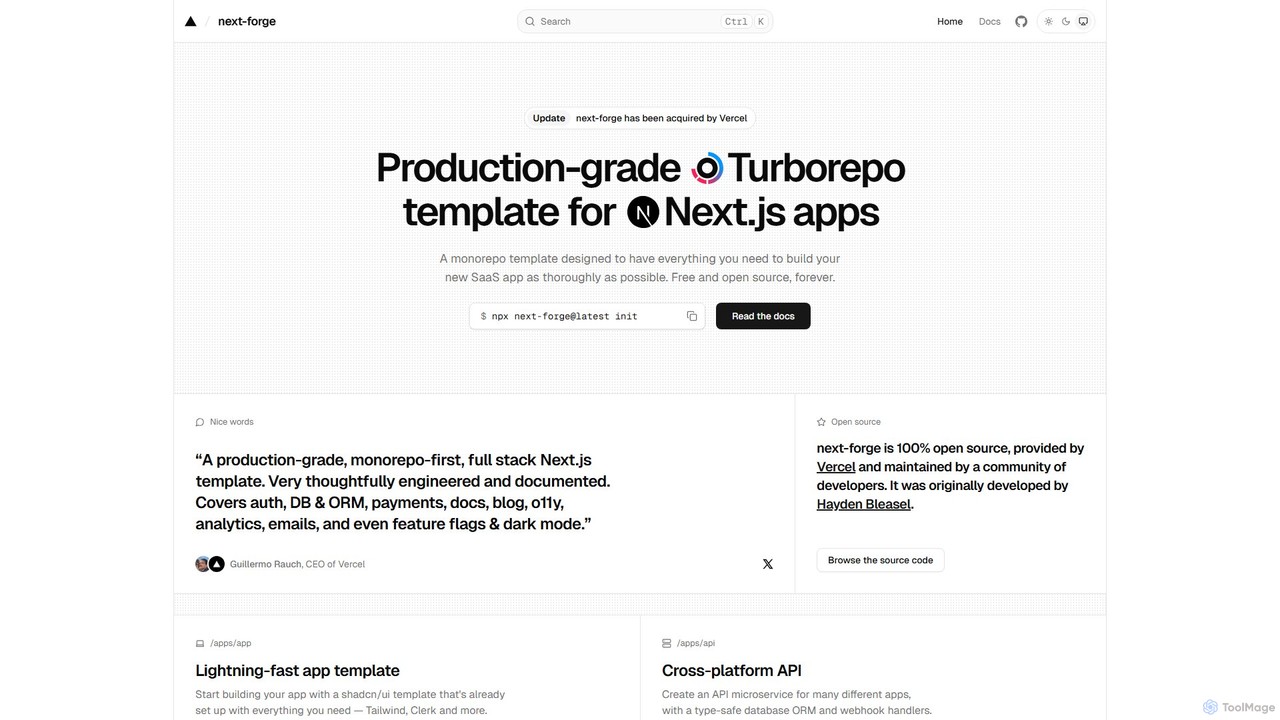
A production-grade, open-source Turborepo template for Next.js applications. Designed to accelerate SaaS development with pre-configured features like authentication, payments, database, analytics, and more. Backed by Vercel.
BoilerplatePopular Framework AI tools in Web Development include next_forge, helping you work more efficiently.

A production-grade, open-source Turborepo template for Next.js applications. Designed to accelerate SaaS development with pre-configured features like authentication, payments, database, analytics, and more. Backed by Vercel.
BoilerplateFrameworks are structured environments and toolsets designed to streamline the development of AI-powered web applications and integrate artificial intelligence functionalities into web projects. These frameworks provide pre-built components, libraries, and architectural patterns that abstract complex AI/ML tasks, allowing developers to focus on application logic rather than low-level implementations. They accelerate the creation of intelligent features like natural language processing, computer vision, and predictive analytics within web platforms, enhancing user experience and operational efficiency.
AI frameworks are essential for developers and organizations aiming to embed intelligence directly into their web services. They are used by data scientists to deploy models, by web developers to add AI features without deep ML expertise, and by startups to rapidly prototype intelligent applications. Common applications include building interactive AI chatbots, creating personalized user experiences, and developing sophisticated data analysis tools that leverage machine learning insights.
Selecting an AI framework involves evaluating several factors: consider the specific AI tasks you need to perform (e.g., NLP, CV), the programming languages your team is proficient in, and the framework's ecosystem (community support, documentation, available integrations). Assess its scalability for future growth, ease of deployment, and compatibility with your existing web infrastructure. Also, review its licensing model and long-term maintenance support.

Customer service teams can leverage AI frameworks to develop sophisticated chatbots that understand natural language queries, provide instant answers, and even escalate complex issues to human agents. This automates routine inquiries, improves response times, and frees up human agents for more critical tasks, significantly enhancing customer satisfaction and operational efficiency.
E-commerce platforms and content providers use AI frameworks to build recommendation systems that analyze user behavior, preferences, and historical data. These engines suggest relevant products, articles, or media, leading to increased engagement, higher conversion rates, and a more tailored user experience across the web application.
Business analysts and data scientists utilize AI frameworks to create dynamic web dashboards that not only visualize data but also incorporate predictive analytics and anomaly detection. This allows for real-time insights into business performance, identifying trends, forecasting future outcomes, and alerting users to critical deviations, enabling proactive decision-making.
Web applications requiring image or video analysis, such as online photo editors, security monitoring systems, or e-commerce product visual search, benefit from AI frameworks. Developers can integrate features like object detection, facial recognition, or image classification, providing powerful visual processing capabilities directly within the web interface.
Data science teams often develop complex machine learning models offline. AI frameworks provide the necessary tools to package and deploy these models as robust, scalable web APIs. This enables other web applications or services to easily consume the model's predictions, facilitating seamless integration of advanced AI capabilities into various digital products.
Content creators, marketers, and researchers can use AI frameworks to build web-based NLP tools for tasks like sentiment analysis of customer reviews, automated text summarization, or language translation. These tools process large volumes of text data, extracting valuable insights and automating content-related workflows, saving significant manual effort.
AI Frameworks in web development are comprehensive software packages that provide a structured approach to building web applications with integrated artificial intelligence capabilities. They offer pre-built components, libraries, and tools for common AI tasks like machine learning, natural language processing, and computer vision, simplifying the process of adding intelligence to web platforms.
While general web development frameworks (like React, Django) focus on the overall structure, routing, and data handling of web applications, AI frameworks specifically provide tools and abstractions for integrating AI/ML functionalities. AI frameworks often include specialized libraries for model training, deployment, and data preprocessing, which are not typically core to general web frameworks, though they can be used together.
Using an AI framework accelerates development by providing ready-to-use components and standardized practices for AI integration. It reduces complexity, improves code maintainability, and often offers optimized performance for AI tasks. Furthermore, many frameworks come with strong community support and extensive documentation, lowering the barrier to entry for developers.
AI frameworks typically offer features such as pre-trained AI models, APIs for various AI services (e.g., text generation, image analysis), tools for data management and preprocessing, and utilities for deploying machine learning models as web endpoints. They also often include components for managing AI model lifecycles and integrating with popular web technologies.
To choose the right AI framework, consider your project's specific AI requirements (e.g., NLP, computer vision, predictive analytics), the programming languages your team is familiar with, and the framework's ecosystem (community, documentation, integrations). Evaluate its scalability, performance, ease of deployment, and compatibility with your existing tech stack to ensure it meets both current and future needs.