
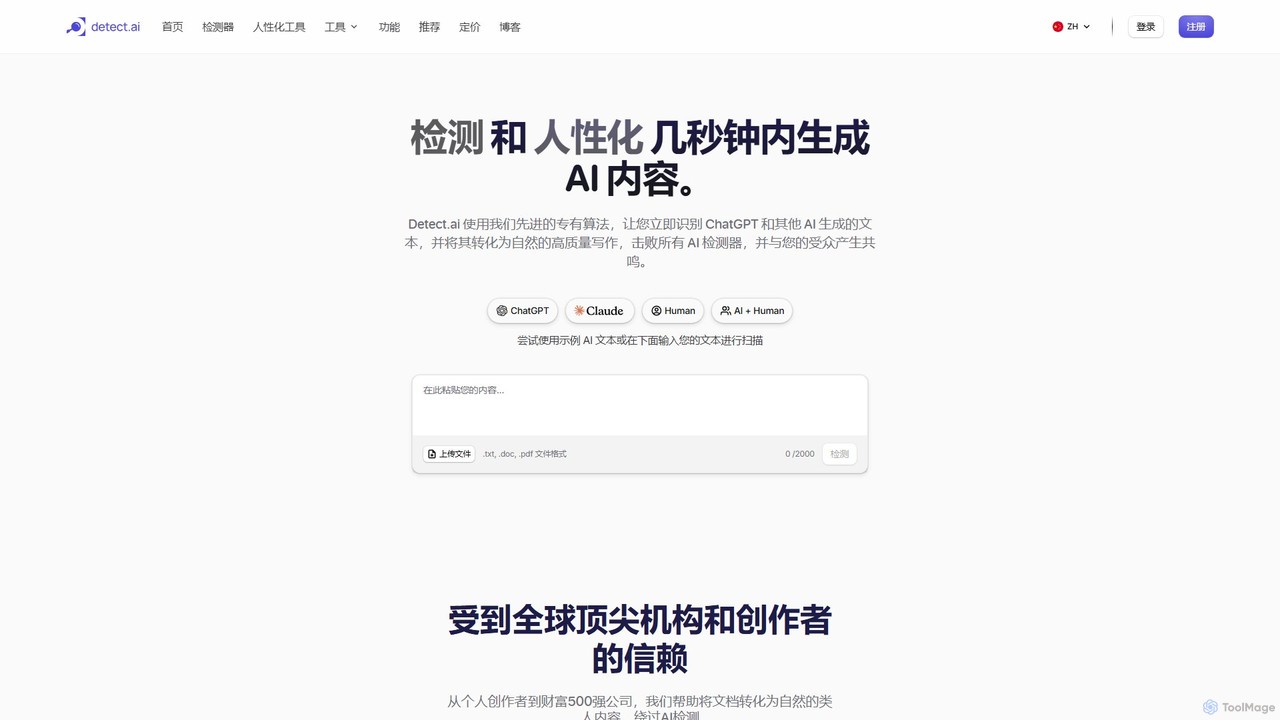
Detect.ai
Detect.ai is a powerful suite featuring an advanced AI detector and content humanizer. It identifies AI-generated text from …
Detect.ai is a powerful suite featuring an advanced AI detector and content humanizer. It identifies AI-generated text from models like ChatGPT with high accuracy and rewrites it to sound natural and authentic, ensuring it bypasses all AI detection systems while preserving the original meaning and tone.
About Ai Content Detection
AI Content Detection tools are specialized applications designed to analyze text and determine the probability that it was generated by an artificial intelligence model. These tools utilize advanced natural language processing (NLP) and machine learning algorithms, trained on vast datasets of both human-written and AI-generated text, to identify statistical patterns, perplexity, and burstiness characteristic of machine-authored content. Their primary value lies in upholding authenticity, ensuring academic integrity, and helping content creators and publishers maintain transparency with their audiences. They serve as a critical checkpoint in workflows where originality is paramount.
Core Features
- Probability Scoring: Provides a percentage score indicating the likelihood that the analyzed text is AI-generated versus human-written.
- Sentence-level Highlighting: Visually marks specific sentences or passages that exhibit strong characteristics of AI generation, allowing for detailed review.
- AI Model Attribution: Some advanced detectors attempt to identify which specific large language model (e.g., GPT-4, Claude) may have been used to create the content.
- API Integration: Offers API access for developers to embed detection capabilities directly into content management systems (CMS), learning management systems (LMS), or other applications.
Use Cases
These tools are widely used in academia by educators and institutions to check student submissions for unauthorized AI use. Publishers, content agencies, and SEO specialists also use them to audit content, ensuring it meets originality guidelines and avoids potential search engine penalties. Legal and research fields may use them to verify the authenticity of documents.
How to Choose
When selecting an AI Content Detection tool, consider its accuracy and reported false positive rates. Evaluate its support for different languages and its ability to detect content from various AI models. For workflow efficiency, check for integrations like browser extensions or Google Docs add-ons. Finally, consider the granularity of the analysis—whether it provides a simple overall score or detailed, sentence-level feedback.
Ai Content DetectionUse Cases
Verifying Academic Integrity in Student Submissions
An educator at a university needs to ensure that the essays submitted by students are their own original work and not generated by AI. They use an AI Content Detection tool by uploading each student's paper. The tool scans the text and provides a report with an overall AI probability score and highlights specific sentences that are likely machine-generated. This allows the educator to quickly identify suspicious submissions for further review and discussion with the student, thereby upholding the institution's academic integrity policies and promoting fair assessment.
Maintaining Editorial Standards for Online Publications
A content manager for a digital magazine is responsible for maintaining high editorial standards, which include publishing only human-authored articles. Before publishing a piece from a freelance writer, they paste the text into an AI detection tool. The tool provides instant feedback on the likelihood of AI involvement. If the score is high, the manager can return the article to the writer for revision or clarification. This process acts as a quality control measure, ensuring the publication's content remains authentic, original, and aligned with its brand voice, thus preserving reader trust.
Auditing SEO Content for Originality and Quality
An SEO agency needs to ensure the content they produce for clients, or receive from contractors, is not low-quality, mass-produced AI text that could be penalized by search engines. An SEO specialist uses an AI detection tool as part of their content audit process. They analyze blog posts, articles, and web copy to flag any content that appears heavily AI-generated. This allows them to rewrite or replace problematic sections, ensuring the final content is high-quality, demonstrates expertise, and adheres to search engine guidelines for helpful, reliable, people-first content.
Validating Authenticity in Grant and Research Proposals
A research institution's review board needs to verify the authenticity of grant proposals and scientific papers. Before a formal review, an administrator runs the submitted documents through an AI content detector integrated with their system. The tool flags sections that deviate from the author's typical writing style or show signs of AI generation. This preliminary check helps maintain the integrity of the scientific process, ensuring that funding and publication decisions are based on genuine, human-driven research and insights, rather than AI-generated summaries or arguments.
Screening User-Generated Content at Scale
A large online forum or social media platform wants to prevent the spread of AI-generated spam or disinformation. Their content moderation team integrates an AI detection API into their review queue. The API automatically scans new posts and comments, assigning an AI probability score. Content exceeding a certain threshold is automatically flagged for human review. This automates the initial screening process, allowing human moderators to focus their attention on the most likely policy-violating content, improving moderation efficiency and platform safety.
Protecting Brand Voice and Authenticity
A marketing team for a well-established brand wants to ensure all external communications, from blog posts to press releases, maintain a consistent and authentic human voice. Before any content is published, it is run through an AI detection tool. This serves as a final check to ensure that even AI-assisted writing processes have not resulted in content that feels generic or robotic. By verifying that the final output reads as human-authored, the team protects the brand's established tone and personality, strengthening its connection with its audience.