AskingTips
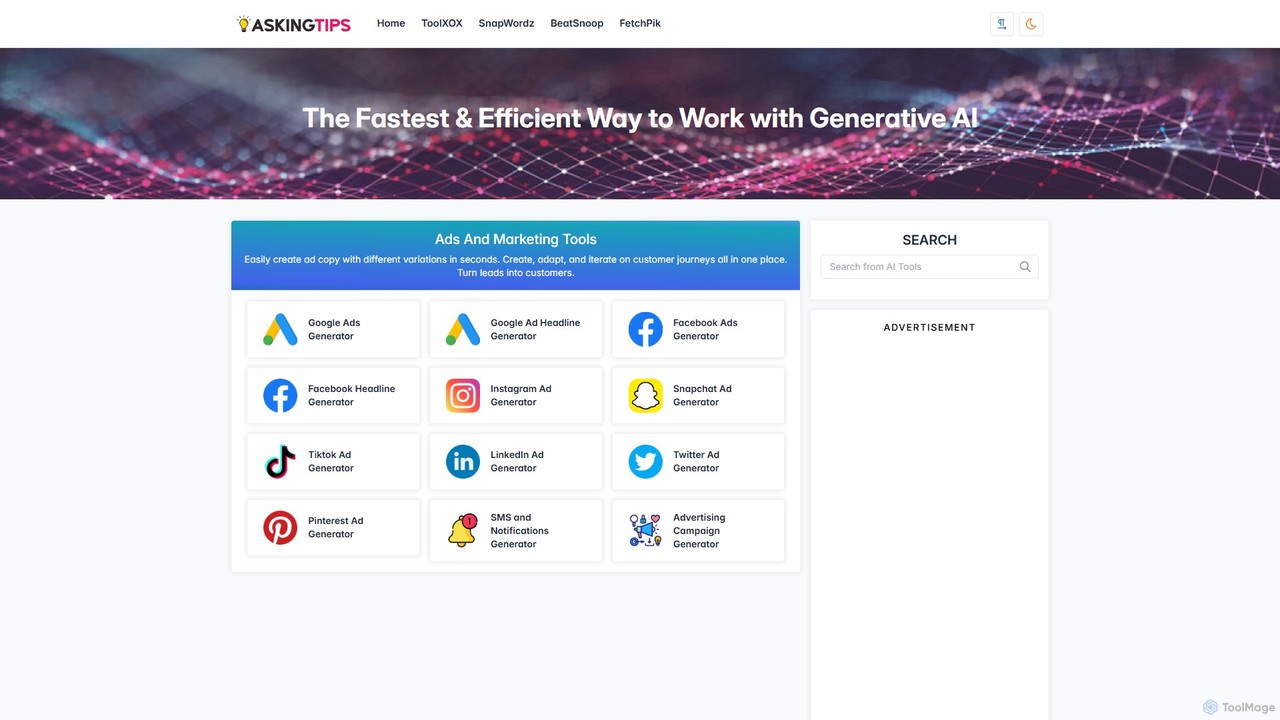
AskingTips is a comprehensive suite of free AI-powered tools designed to enhance productivity across various domains. It offers …
AskingTips is a comprehensive suite of free AI-powered tools designed to enhance productivity across various domains. It offers a wide range of generators for marketing, SEO, content creation, web development, and image editing, making advanced AI technology accessible to everyone, from marketers and bloggers to developers and students, without any cost.
About Generative Ai
Generative AI for writing refers to tools that create new, original text based on user prompts. These tools leverage large language models (LLMs) to understand context, style, and intent, producing everything from short phrases to complete articles. They are primarily used to accelerate content creation, brainstorm ideas, and generate initial drafts for marketing, creative, and technical writing. The key strength of these tools is their ability to produce human-like, coherent text that can be adapted for various tones and formats, serving as a powerful creative partner.
Core Features
- Text Generation from Prompts: Creates original content based on keywords, outlines, or detailed instructions.
- Tone and Style Adjustment: Allows users to specify and alter the writing style, such as professional, casual, or persuasive.
- Content Expansion and Elaboration: Takes a short sentence or idea and develops it into a full paragraph or section.
- Multi-format Content Creation: Generates various types of written content, including blog posts, emails, social media captions, and ad copy.
Use Cases
Generative AI tools are widely adopted by content marketers for drafting blog posts and social media updates, by copywriters for creating ad variations, and by authors for overcoming writer's block. In business, they assist in generating reports, emails, and product descriptions, significantly speeding up communication workflows.
How to Choose
When selecting a Generative AI writing tool, consider the quality and coherence of the generated text. Evaluate the range of available templates and formats, the ease of use of the interface, and the level of control over tone and style. Also, review the pricing model (e.g., subscription-based, pay-per-word) and any usage limits to ensure it aligns with your content volume needs.

Generative AiUse Cases
Drafting Blog Posts and Articles
Content marketers and bloggers use Generative AI to transform a simple outline or a set of keywords into a full-length draft. By providing a topic, desired tone (e.g., professional, casual), and key points, the AI generates structured paragraphs, introductions, and conclusions. This process significantly reduces initial writing time, allowing creators to focus on refining, fact-checking, and adding their unique perspective. It can cut the time from idea to first draft by over 70%.
Generating Social Media Content Calendars
Social media managers are tasked with creating a consistent stream of engaging content. A Generative AI tool can produce a month's worth of post ideas, captions, and relevant hashtags based on a company's brand voice and campaign goals. The user inputs the platform (e.g., LinkedIn, Instagram), target audience, and key themes. The AI then generates a variety of post formats, such as questions, tips, and announcements, helping to maintain an active and diverse social media presence with less manual effort.
Creating Ad Copy Variations for A/B Testing
For digital marketers, A/B testing ad copy is crucial for optimizing campaign performance. Instead of manually writing dozens of headlines and descriptions, a marketer can use a Generative AI tool. By providing the product name, key benefits, and a call-to-action, the AI can generate numerous variations targeting different emotional triggers (e.g., urgency, curiosity, social proof). This allows for rapid testing of multiple ad concepts to identify the most effective messaging quickly and efficiently.
Generating Personalized Email Outreach
Sales and business development teams often need to send personalized emails at scale. A Generative AI tool can create customized email templates. By inputting information about a prospect from their LinkedIn profile or company website (e.g., role, recent achievements, company news), the AI can generate a unique opening line or a relevant talking point. This level of personalization increases the likelihood of getting a response compared to generic templates, while still saving significant time.
Overcoming Writer's Block for Creative Projects
Authors, screenwriters, and creative writers often face writer's block. Generative AI can act as a brainstorming partner. By inputting a character description, a plot point, or a simple scene idea, the writer can receive multiple suggestions for dialogue, plot developments, or descriptive passages. This doesn't replace the writer's creativity but provides a spark to move the story forward, offering new angles and possibilities that can be refined and integrated into the original work.
Generating Product Descriptions for E-commerce
E-commerce managers with hundreds or thousands of products need unique, SEO-friendly descriptions for each. Manually writing them is time-consuming. Using a Generative AI tool, a manager can upload a spreadsheet with product features, specifications, and target keywords. The AI then generates compelling and unique descriptions for each item, highlighting key benefits and incorporating keywords naturally. This process automates a repetitive task, improves product page SEO, and ensures consistency in brand voice across the store.