
Writing Best in category 1 results Journaling AI Tool

Popular AI tools in the Journaling field of Writing include mycody, etc., helping you quickly improve efficiency.

mycody

mycody

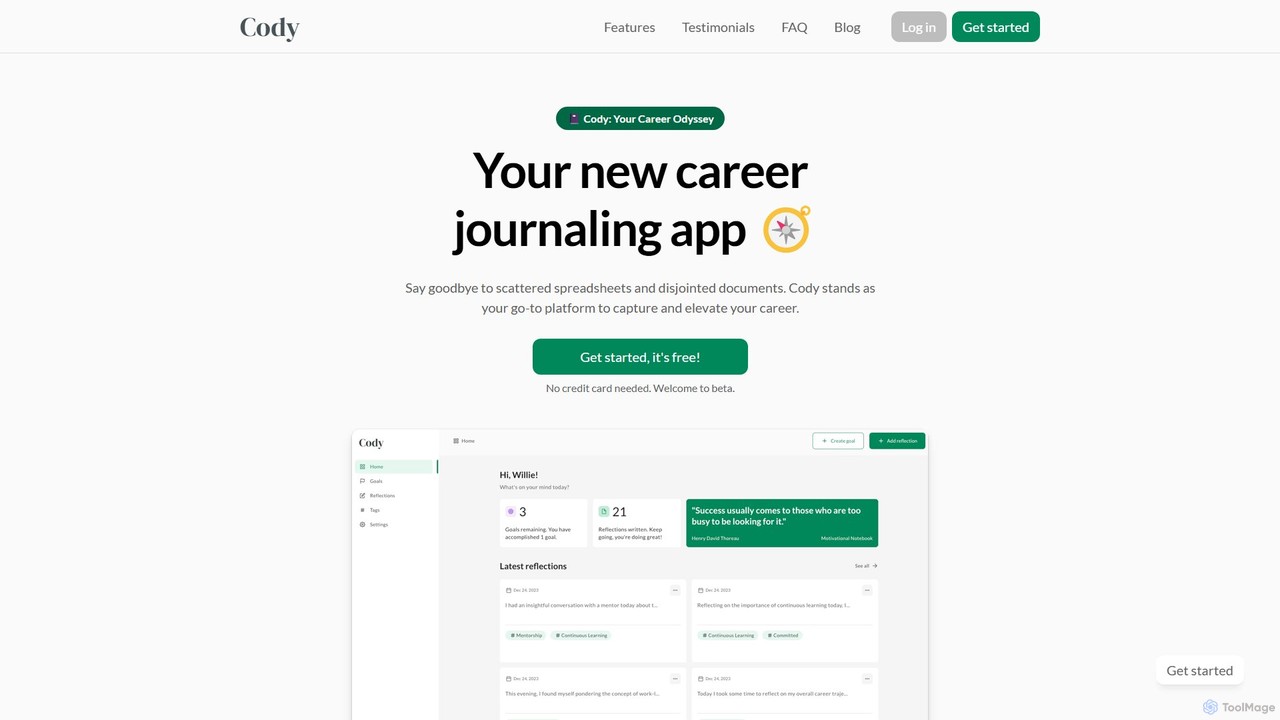
mycody is an AI-powered career journaling platform designed to help professionals track achievements, set goals, and gain personalized …

2.3K

About Journaling

AI Journaling tools are applications that use artificial intelligence to create a more interactive and insightful diary experience. These tools go beyond simple text entry by employing Natural Language Processing (NLP) to analyze entries for sentiment, themes, and emotional patterns. They help users understand their thoughts and feelings more deeply by providing personalized prompts, summarizing trends, and offering guided reflections. This transforms journaling from a passive recording activity into an active tool for mental wellness and personal growth.

Core Features

  • Intelligent Prompts: Generates personalized questions and topics based on previous entries to encourage deeper reflection.
  • Sentiment Analysis: Automatically detects and tracks the emotional tone of writing over time, visualizing mood trends.
  • Pattern Recognition: Identifies recurring themes, people, and activities mentioned in the journal to reveal hidden connections and triggers.
  • Voice-to-Text Transcription: Allows users to speak their thoughts naturally, with the AI converting them into written entries for easy logging.
  • Data Summarization: Provides weekly or monthly summaries of emotional states, key topics, and personal progress.

Use Cases

These tools are widely used by individuals focused on mental health management, personal development, and mindfulness. Therapists may recommend them to clients as a supplementary tool for tracking progress between sessions. Professionals also use them for stress management and to reflect on career goals, while students find them helpful for navigating academic pressures.

How to Choose

When selecting an AI Journaling tool, prioritize its privacy policy and data encryption methods. Evaluate the depth and quality of its analytical insights and the relevance of its generated prompts. Consider the user interface for ease of use and check for features like cross-device sync, export options, and integrations with calendar or health apps.

JournalingUse Cases

1

Tracking and Understanding Emotional Patterns

For individuals seeking to improve their mental wellness, an AI journaling tool serves as a personal emotional analyst. A user can create daily entries describing their experiences, feelings, and anxieties. The AI then processes this text to perform sentiment analysis, identifying moments of joy, stress, or sadness. Over weeks, it generates charts and summaries that visualize mood fluctuations, connecting them to specific events or times of day. This helps the user recognize triggers—like poor sleep leading to irritability—and develop healthier coping strategies based on data-driven insights.

2

Guided Self-Reflection for Personal Growth

A professional aiming for career advancement uses an AI journal to structure their self-reflection. Instead of staring at a blank page, they receive AI-generated prompts like, 'What was a challenge you faced this week, and how did you handle it?' or 'Describe a moment you felt proud of your work.' By responding to these targeted questions, the user can analyze their performance, identify areas for improvement, and track progress toward their goals. The AI can also identify recurring themes, such as a consistent difficulty with time management, prompting a more focused effort on that specific skill.

3

Companion for Cognitive Behavioral Therapy (CBT)

A person undergoing Cognitive Behavioral Therapy (CBT) uses an AI journaling app as a supplementary tool. They can log 'thought records' whenever they experience negative automatic thoughts. The app, guided by CBT principles, can then prompt them to identify cognitive distortions (e.g., 'catastrophizing' or 'black-and-white thinking') and help them reframe those thoughts in a more balanced way. The AI can track the frequency of certain distortions over time, providing both the user and their therapist with valuable data on progress and persistent challenges, making therapy sessions more productive.

4

Cultivating a Gratitude Habit

A user wants to build a consistent gratitude practice to improve their overall well-being. They use an AI journaling tool that specifically offers daily gratitude prompts, such as 'What is something simple that brought you joy today?' or 'Who is someone you're thankful for and why?'. The AI not only provides variety in prompts to keep the practice engaging but also analyzes the entries to highlight recurring sources of happiness. It might generate a 'word cloud' of positive themes or a weekly summary of joyful moments, reinforcing the positive mindset and making the benefits of the gratitude practice tangible and visible.

5

Processing Major Life Events

Someone navigating a significant life transition, such as a career change, relocation, or the end of a relationship, uses an AI journal to process their complex emotions. The act of writing provides an outlet, while the AI's features offer structure. The tool can ask guiding questions to help the user explore different facets of their experience. Over time, the sentiment analysis feature can show a gradual shift from feelings of anxiety and sadness towards acceptance and optimism. This visual feedback provides encouragement and a tangible sense of progress during a challenging period, validating their emotional journey.

6

Boosting Creativity and Idea Generation

A writer, artist, or entrepreneur experiencing a creative block uses an AI journal as a brainstorming partner. They can use the voice-to-text feature to engage in a 'stream of consciousness' dialogue, speaking freely without the pressure of perfect grammar. The AI can then analyze this unstructured input and identify emerging themes or keywords. It might ask follow-up questions like, 'You mentioned 'sustainability' several times. How does that connect to your new project idea?' This interactive process helps to uncover subconscious ideas and forge new creative connections, turning a simple journal into a dynamic ideation tool.

JournalingFrequently Asked Questions