Writing Best in category 1 results Outline Generation AI Tool

Popular AI tools in the Outline Generation field of Writing include easyoutlines_f5115, etc., helping you quickly improve efficiency.

easyoutlines_f5115

easyoutlines_f5115

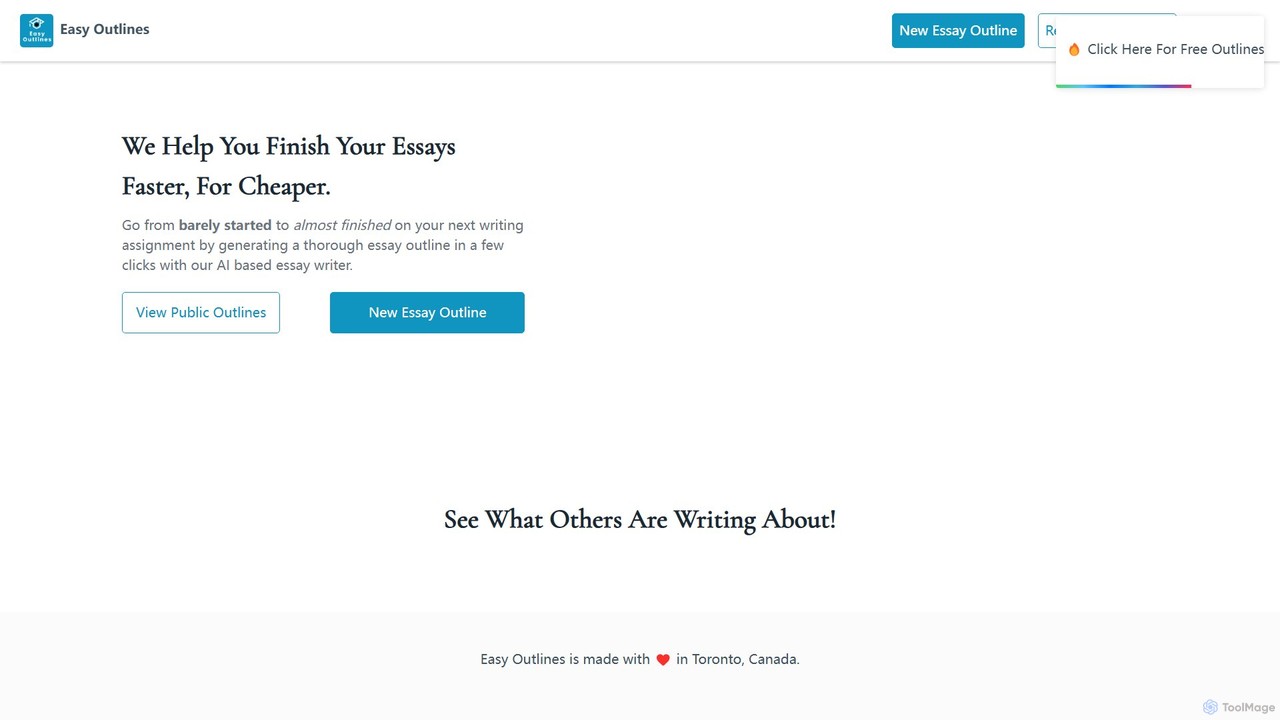
Easy Outlines is an AI-powered tool designed to help students and writers create structured essay outlines quickly and …

2.8K

About Outline Generation

Outline Generation tools are AI-powered applications that automatically create structured frameworks for written content. They analyze a given topic or prompt to produce a logical hierarchy of headings, subheadings, and key points. This process helps writers, students, and content creators to organize their thoughts, ensure comprehensive coverage of a subject, and significantly accelerate the initial stages of the writing process. By leveraging large language models, these tools understand context to generate relevant, coherent structures that serve as a solid foundation for any document.

Core Features

  • Hierarchical Structuring: Generates multi-level outlines with main headings (H1, H2) and sub-points (H3, H4) from a single topic.
  • Keyword-Driven Expansion: Builds out relevant sections and talking points based on user-provided keywords or core concepts.
  • Customizable Depth and Format: Allows users to control the complexity of the outline and choose output formats like bullet points or numbered lists.
  • Content Brief Generation: Provides brief descriptions or key talking points for each section to guide the writing process.

Use Cases

These tools are invaluable for content marketers planning SEO articles, students structuring academic essays, and business professionals preparing reports or presentations. For instance, a marketer can generate a complete blog post structure from a target keyword, while a researcher can quickly map out the chapters of a thesis, ensuring a logical flow of arguments.

How to Choose

When selecting an Outline Generation tool, consider the quality and logical coherence of the generated structures. Evaluate its ability to customize the outline's depth and detail. Check for integrations with writing platforms like Google Docs or WordPress, and assess whether the pricing model (e.g., subscription vs. pay-per-use) aligns with your content creation frequency.

Outline GenerationUse Cases

1

Structuring SEO Blog Posts and Articles

Content marketers and SEO specialists use Outline Generation tools to create well-structured articles that rank high on search engines. By inputting a primary keyword like 'benefits of remote work,' the AI generates a comprehensive outline including an introduction, multiple H2 headings for different benefits (e.g., 'Increased Productivity,' 'Better Work-Life Balance'), supporting H3 points for each, and a conclusion. This ensures all relevant subtopics are covered, improves readability, and saves hours of manual research and planning time, allowing creators to focus on writing high-quality content.

2

Planning Academic Papers and Essays

Students and researchers leverage these tools to structure complex academic arguments. For a research paper on 'The Impact of Climate Change on Coastal Cities,' a user can generate an outline that logically organizes the introduction, literature review, methodology, findings, discussion, and conclusion sections. The AI can suggest sub-points for each section, such as specific case studies for the 'findings' chapter or different theoretical frameworks for the 'literature review.' This provides a clear roadmap, prevents writer's block, and ensures the final paper is coherent and well-argued.

3

Developing Business Reports and Presentations

Business professionals, from analysts to managers, use outline generators to quickly draft reports, proposals, and presentation decks. When tasked with creating a 'Q3 Financial Performance Report,' an AI can instantly produce a standard business report structure: Executive Summary, Key Performance Indicators (KPIs), Financial Analysis, Challenges & Risks, and Strategic Recommendations. This ensures all critical business areas are addressed systematically. For presentations, it can create a slide-by-slide breakdown, helping to build a compelling narrative and saving significant preparation time.

4

Scripting Videos and Podcast Episodes

Video creators and podcasters use outline generators to map out their content flow before recording. By providing a topic like 'A Beginner's Guide to Cryptocurrency,' the tool can structure an episode with segments for 'Introduction to Blockchain,' 'Major Cryptocurrencies (Bitcoin, Ethereum),' 'How to Buy and Store Crypto,' and a 'Q&A/Conclusion' section. This structured approach ensures a logical progression, helps maintain audience engagement, and simplifies the editing process by providing a clear, time-stamped guide for the entire production.

5

Designing Course Curriculums and Lesson Plans

Educators and instructional designers find these tools highly effective for curriculum development. To create a course on 'Introduction to Digital Marketing,' an AI can generate a modular outline covering key areas like SEO, Content Marketing, Social Media Marketing, and Email Marketing. It can further break down each module into specific lesson topics, such as 'Keyword Research' and 'On-Page SEO' for the SEO module. This hierarchical structure helps in organizing learning materials logically and ensures a comprehensive and easy-to-follow syllabus for students.

6

Outlining Book Chapters and Narrative Arcs

Authors and novelists use outline generators to structure their books, whether fiction or non-fiction. For a non-fiction book on 'The History of Artificial Intelligence,' the tool can create a chronological chapter outline from its origins to future trends. For a fiction novel, an author can input a plot premise, and the AI can suggest a three-act structure, outlining key plot points, character arcs, and potential subplots. This provides a high-level blueprint that helps maintain narrative consistency and momentum throughout the lengthy writing process.

Outline GenerationFrequently Asked Questions