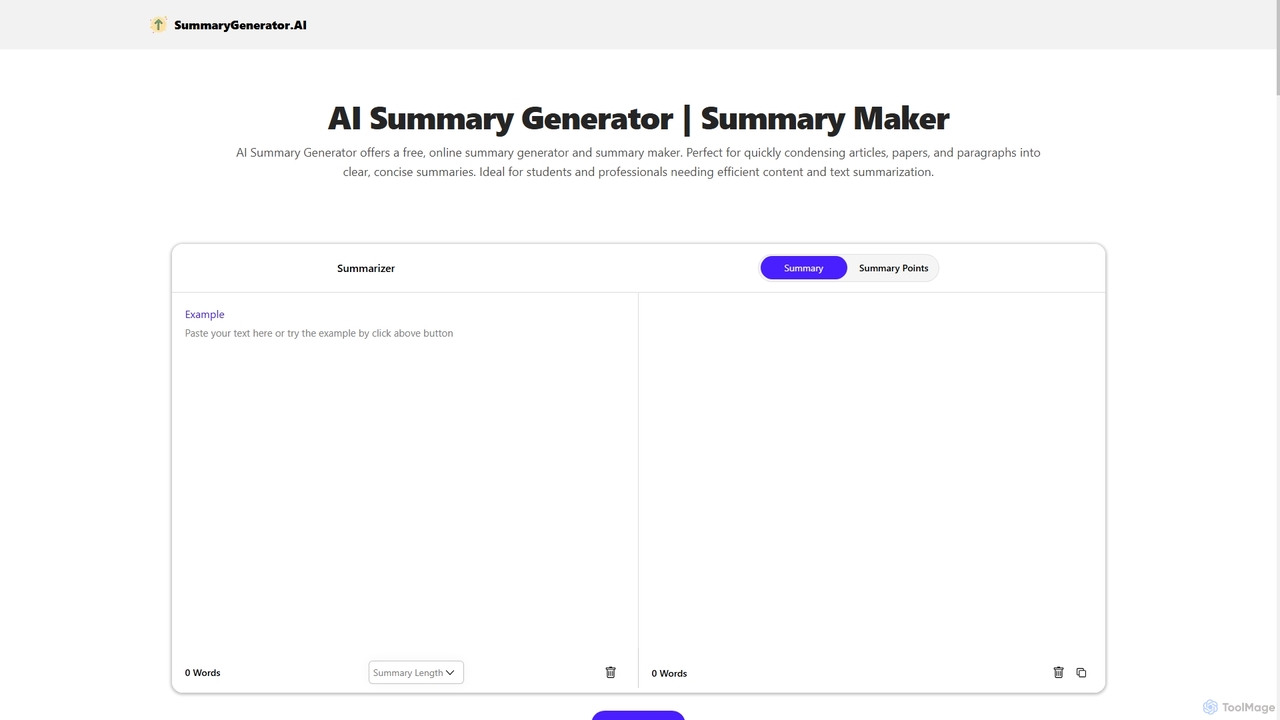
Text Condensing tools are AI-powered applications designed to automatically shorten or summarize lengthy texts while preserving their core meaning and essential information. These tools leverage advanced Natural Language Processing (NLP) and machine learning algorithms to identify key sentences, extract critical data, and eliminate redundancy, transforming verbose content into concise summaries. By distilling complex information into digestible formats, they significantly enhance readability and allow users to quickly grasp the essence of any document, making information consumption and content creation more efficient across various domains.
Core Features
- Automatic Summarization: Generates concise summaries from long documents, employing either extractive methods (selecting key sentences) or abstractive methods (rephrasing content in new sentences) to capture the main points.
- Key Information Extraction: Identifies and highlights the most critical facts, figures, names, and concepts within a text, providing a quick overview of essential data.
- Customizable Length & Density: Offers granular control over the output, allowing users to specify the desired summary length (e.g., percentage of original text) or adjust the level of detail to suit different purposes.
- Readability Enhancement: Simplifies complex sentences, jargon, and convoluted structures to improve the overall clarity, flow, and comprehension of the shortened content, making it accessible to a wider audience.
- Multi-language Support: Processes and condenses text in a wide array of languages, enabling global teams and individuals to efficiently manage information across linguistic barriers.
Applicable Scenarios
Text Condensing tools prove invaluable across diverse professional and personal contexts. Researchers and students extensively use them to quickly review academic papers, scientific articles, and textbooks, extracting key findings and methodologies without the need to read every word. Business professionals leverage these tools to summarize lengthy reports, detailed meeting transcripts, or extensive email threads, ensuring efficient internal communication and facilitating faster, informed decision-making. Furthermore, content creators, journalists, and marketers utilize these AI solutions to transform long-form articles, blog posts, or press releases into engaging, bite-sized snippets suitable for social media, newsletters, or promotional materials, maximizing audience reach and engagement.
How to Choose
When selecting a Text Condensing tool, prioritize the accuracy and coherence of the summary generation, ensuring the core message and context remain fully intact. Evaluate the level of customization offered, such as adjustable summary length, the ability to focus on specific topics or keywords, and different summarization modes (extractive vs. abstractive). Consider integration capabilities with your existing content management systems, writing platforms, or browsers. It's also crucial to check for robust support for the languages you frequently use and to assess the output quality for natural language flow and readability. Finally, compare pricing models, data privacy policies, and user reviews to find a solution that best aligns with your budget, security requirements, and specific workflow needs.