
ToolMage
Sign in

Best 1 Unrestricted Writing AI tools for Writing

Popular Unrestricted Writing AI tools in Writing include NoFilterGPT, helping you work more efficiently.

NoFilterGPT
Freemium

NoFilterGPT

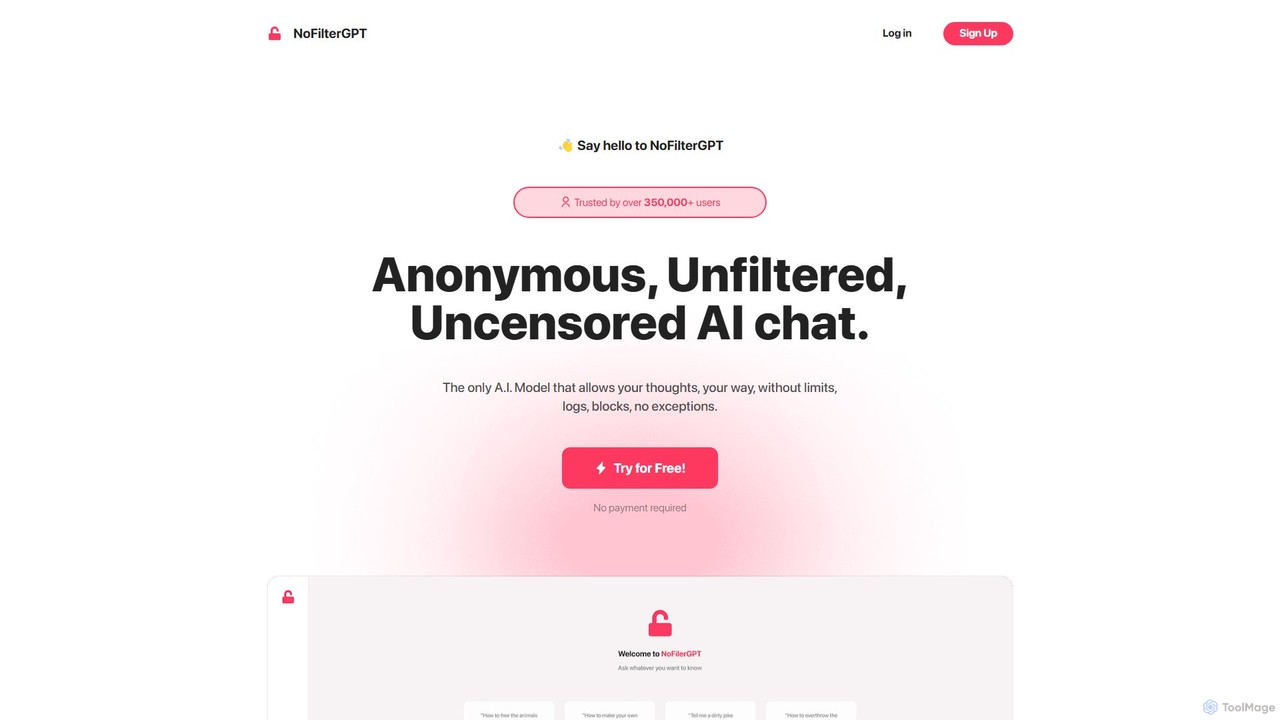
NoFilterGPT is an anonymous, unfiltered, and uncensored AI chat platform. It offers unrestricted conversations, AI image generation, voice chat, and a developer API, prioritizing user privacy with no-logs and encrypted communication. Ideal for users and developers seeking creative freedom beyond typical AI constraints.

Api
Visits 264.7KFavorites 126Likes 117

About Unrestricted Writing

Unrestricted Writing tools are a specialized category of AI writers designed with minimal content filters and restrictions. They operate on language models that prioritize freedom of expression, allowing users to generate content on a wide array of topics, including those that may be considered sensitive, controversial, or highly niche. This makes them particularly valuable for creative writers, researchers, and users exploring complex narratives without encountering frequent content blocks. These tools offer a higher degree of creative autonomy compared to more mainstream writing assistants.

Core Features

  • Minimal Content Filters: Enables the exploration of mature themes, complex conflicts, and controversial subjects without censorship.
  • High Creative Freedom: Generates unique characters, intricate plots, and unconventional literary styles with fewer constraints.
  • Advanced Narrative Control: Provides options to guide the story, maintain character consistency, and manage long-form projects like novels or scripts.
  • Diverse Tonal Range: Capable of producing content in various tones, from dark and gritty to satirical or highly experimental.

Use Cases

These tools are primarily used by fiction authors, screenwriters, and game developers for crafting narratives with mature themes or complex moral ambiguity. Researchers also use them to simulate dialogues or analyze perspectives on sensitive social issues. They are ideal for any project where creative freedom and the ability to explore the full spectrum of human experience are paramount.

How to Choose

When selecting an Unrestricted Writing tool, evaluate the level of content freedom versus the platform's terms of service. Assess the quality and coherence of the underlying AI model, especially for long-form content. Prioritize tools with strong privacy policies, as the generated content can be sensitive. Also, consider features specific to narrative writing, such as character memory and plot management.

Unrestricted Writing use cases

1

Crafting Complex Fictional Narratives

A novelist working on a dark fantasy series uses an Unrestricted Writing tool to explore morally ambiguous characters and plotlines. The tool allows them to generate scenes involving intense conflict, mature themes, and realistic consequences without triggering content filters. This enables a deeper, more authentic exploration of the story's world and its inhabitants, resulting in a richer and more compelling narrative for readers.

2

Developing Dialogue for Mature-Rated Video Games

A narrative designer for an M-rated role-playing game needs to write authentic dialogue for various factions, including morally grey antagonists. An Unrestricted Writing tool helps generate raw, unfiltered conversations that reflect the game's gritty tone. It can produce varied lines of dialogue for NPCs, capturing unique personalities and motivations, which significantly speeds up the writing process while maintaining a high level of creative quality.

3

Brainstorming Unconventional Screenplay Ideas

A screenwriter is stuck in a creative rut and wants to develop a script that challenges genre conventions. They use an Unrestricted Writing tool as a brainstorming partner, feeding it provocative 'what if' scenarios. The AI generates unconventional plot twists, character arcs, and thematic concepts that mainstream tools might avoid. This process helps the writer break free from clichés and develop a truly original and thought-provoking screenplay.

4

Enhancing Immersive Role-Playing Sessions

A user engages in solo, text-based role-playing, with the AI acting as the Game Master. The unrestricted nature of the tool allows for a truly dynamic and unpredictable adventure. The AI can create complex scenarios, react realistically to any player action, and portray a wide range of characters and environments without limitations. This creates a deeply personal and immersive storytelling experience that adapts in real-time to the player's choices.

5

Academic Exploration of Controversial Topics

A sociologist is researching online discourse surrounding a sensitive political issue. They use an Unrestricted Writing tool to simulate various viewpoints and generate hypothetical arguments from different ideological perspectives. This allows them to analyze rhetorical strategies and potential communication breakdowns in a controlled environment. The tool's ability to handle controversial subjects provides valuable, nuanced data that would be difficult to obtain with more filtered AI models.

6

Generating Edgy Marketing Copy for Niche Brands

A marketer for an alternative fashion brand needs copy that breaks conventions and speaks directly to a subculture. Standard AI writers produce generic, safe text. By using an Unrestricted Writing tool, the marketer can generate bold, provocative, and unconventional ad copy, taglines, and product descriptions. This helps the brand maintain its edgy identity and create marketing materials that genuinely resonate with its target audience, standing out from mainstream competitors.

Unrestricted Writing FAQ

What are Unrestricted Writing AI tools?

Unrestricted Writing AI tools are a type of generative AI focused on text creation with minimal content filters. Unlike mainstream AI writers that often have strict safety protocols, these tools are designed to give users maximum creative freedom. They are particularly useful for fiction writers, game developers, and researchers who need to explore a wide range of themes, including those that are complex, mature, or controversial, without being blocked by AI censorship.

How do Unrestricted Writing tools differ from standard AI writers?

The primary difference lies in content moderation. Standard AI writers (like general-purpose chatbots) have robust filters to prevent the generation of potentially sensitive, explicit, or harmful content. Unrestricted Writing tools have significantly fewer or more lenient filters. This allows them to handle a broader range of prompts and produce content on topics that standard writers would refuse, prioritizing user autonomy and creative expression over strict content control.

Who are the primary users of Unrestricted Writing tools?

These tools are most beneficial for users whose creative or research needs are constrained by standard AI filters. Key user groups include:

  • Fiction Authors & Screenwriters: For creating realistic conflict, mature themes, and complex characters.
  • Game Developers: For writing dialogue and narratives for games with mature ratings.
  • Role-Players: For creating dynamic and unconstrained interactive stories.
  • Researchers: For simulating and analyzing discourse on sensitive or controversial topics.
Is the output from Unrestricted Writing tools of lower quality?

Not necessarily. The quality of the output is determined by the underlying language model, not the presence or absence of filters. Many high-quality unrestricted tools use powerful, sophisticated models capable of producing coherent and well-written text. However, because they are less constrained, the output can sometimes be more unpredictable. This often requires more guidance and editing from the user, but it also allows for a greater range of creative possibilities compared to more heavily guided, filtered systems.

What should I consider when choosing an Unrestricted Writing tool?

When selecting a tool, focus on these key factors:

  • Content Policy: Understand the tool's specific terms of service and any remaining limitations.
  • Model Quality: Assess its ability to maintain coherence, context, and style, especially in long-form writing.
  • Narrative Features: Look for functions like story memory (lorebooks), character profiles, and plot management to aid in complex projects.
  • Privacy and Data Security: Since you may be generating sensitive content, verify how your data is stored and used by the platform.