
Writing Best in category 1 results Writing Generator AI Tool

Popular AI tools in the Writing Generator field of Writing include Ai Mailer, etc., helping you quickly improve efficiency.

Free
Ai Mailer

Ai Mailer

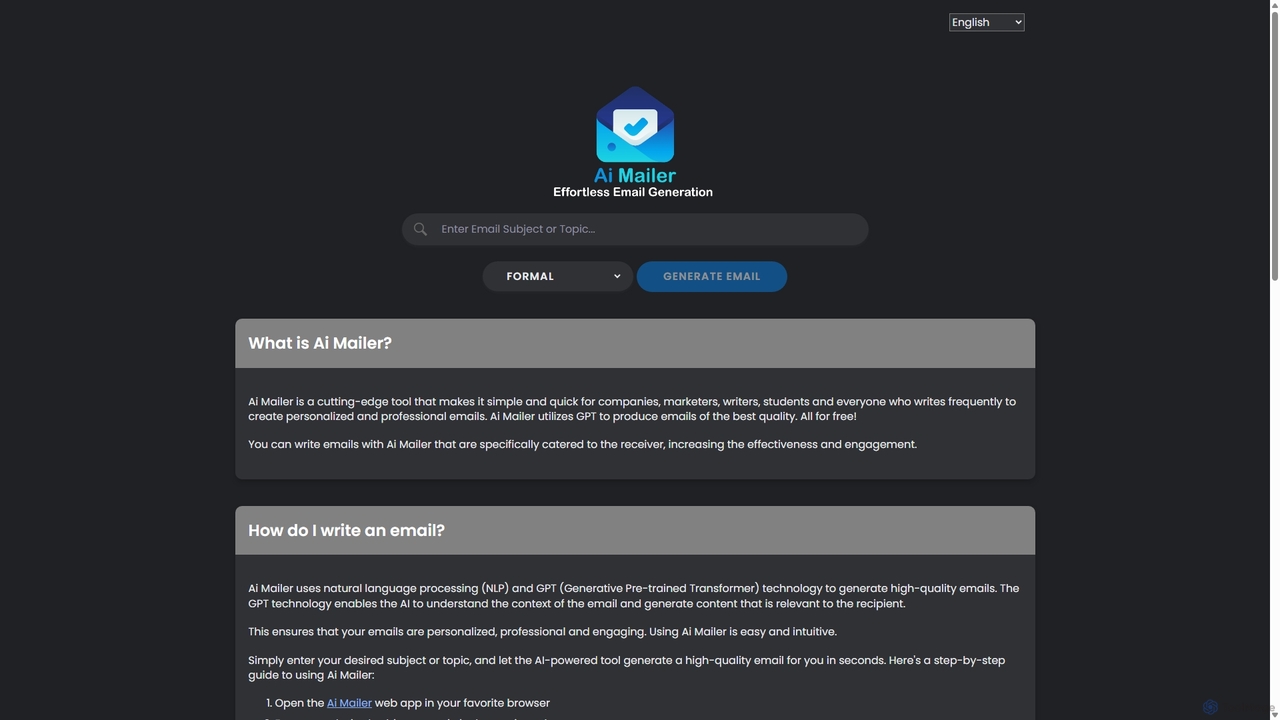
Ai Mailer is a free, AI-powered tool that leverages ChatGPT to effortlessly generate high-quality, professional emails. Simply provide …

4.7K

About Writing Generator

Writing Generators are AI-powered tools designed to create original text content from user prompts. Leveraging large language models (LLMs), these tools interpret instructions to produce a wide range of written materials, from short ad copy to complete articles. Their primary value lies in accelerating the content creation process, overcoming writer's block, and scaling content production for various platforms. Unlike grammar checkers or paraphrasers, writing generators focus on synthesizing new information and ideas into coherent text from scratch.

Core Features

  • Prompt-Based Generation: Creates text based on user-provided keywords, outlines, or detailed instructions.
  • Tone and Style Control: Allows users to specify the desired tone (e.g., formal, casual, humorous) and writing style.
  • Content Templates: Offers pre-built frameworks for specific formats like blog posts, emails, social media captions, and product descriptions.
  • Multi-Language Support: Capable of understanding prompts and generating content in numerous languages.
  • Content Expansion: Takes a short piece of text and elaborates on it to create a more detailed paragraph or section.

Use Cases

These tools are widely used by marketing teams for creating ad copy and social media content, bloggers and content creators for drafting articles, and businesses for generating professional emails and reports. They are also valuable for students in structuring essays and for developers in writing documentation.

How to Choose

When selecting a Writing Generator, consider the quality and coherence of the generated text, the variety of available content templates, the level of control over tone and style, and whether it includes features like plagiarism checkers. Also, evaluate its language support and integration capabilities with other software you use.

Writing GeneratorUse Cases

1

Generate High-Converting Ad Copy

A marketing specialist needs to create multiple ad variations for a new social media campaign to A/B test different angles. Instead of spending hours brainstorming, they input the product's key features, target audience demographics, and desired call-to-action into a Writing Generator. The tool instantly produces ten distinct ad copy versions with varied headlines and hooks. This allows the team to launch tests faster, identify the most effective messaging, and improve campaign ROI by up to 20% while saving significant creative time.

2

Drafting Blog Posts and Articles

A content creator manages a blog and needs to publish three new articles per week. To combat writer's block and speed up the process, they use a Writing Generator. They start by providing a title and a brief outline for an article. The AI generates a structured first draft, including an introduction, main body paragraphs with key points, and a conclusion. The creator then spends their time refining, adding personal insights, and fact-checking the draft. This workflow reduces the initial writing time from four hours to just one, allowing them to focus on quality and meet their publishing schedule consistently.

3

Automating Personalized Email Outreach

A sales development representative (SDR) is tasked with reaching out to 50 new leads daily. Crafting a unique, personalized email for each lead is time-consuming. Using a Writing Generator, the SDR creates a base template and uses prompts with specific lead information (like company name, industry, and job title) to generate personalized opening lines and value propositions. The tool helps create semi-automated yet highly relevant emails, increasing the open rate by 30% and securing more meetings, all while reducing the time spent on manual email writing by half.

4

Overcoming Writer's Block for Fiction

A novelist is working on a complex fantasy story but feels stuck on a particular chapter, unable to decide how a character should react to a major plot twist. They turn to a Writing Generator for creative inspiration. By inputting the context of the scene and the character's personality traits, they ask the tool to generate five different possible reactions or dialogue snippets. While not using the text verbatim, the generated ideas—ranging from an angry outburst to a moment of quiet calculation—spark a new direction for the chapter, effectively breaking the writer's block and moving the story forward.

5

Structuring Academic Papers and Essays

A university student is starting a research paper on a complex topic and struggles with organizing their thoughts into a coherent structure. They use a Writing Generator as a structural aid. By inputting their thesis statement and the main supporting arguments they've gathered from research, the tool generates a detailed outline. This outline includes suggested topic sentences for each paragraph, logical transitions between sections, and potential counterarguments to address. This provides a solid framework, saving the student hours of planning and allowing them to focus on the critical analysis and writing of the paper itself.

6

Creating Technical Documentation and Code Comments

A software developer has just completed a complex API endpoint but needs to write clear documentation for other team members. This is often a tedious task. They use a Writing Generator that specializes in code. By pasting the function's code and providing a brief description of its purpose, the tool automatically generates a detailed explanation of the parameters, the expected output, and potential error cases. It also generates concise in-line comments for the code itself. This practice ensures documentation is never skipped, improves code maintainability, and reduces onboarding time for new developers.

Writing GeneratorFrequently Asked Questions