Academic Best in category 1 results Publishing AI Tool

Popular AI tools in the Publishing field of Academic include Paperpal, etc., helping you quickly improve efficiency.

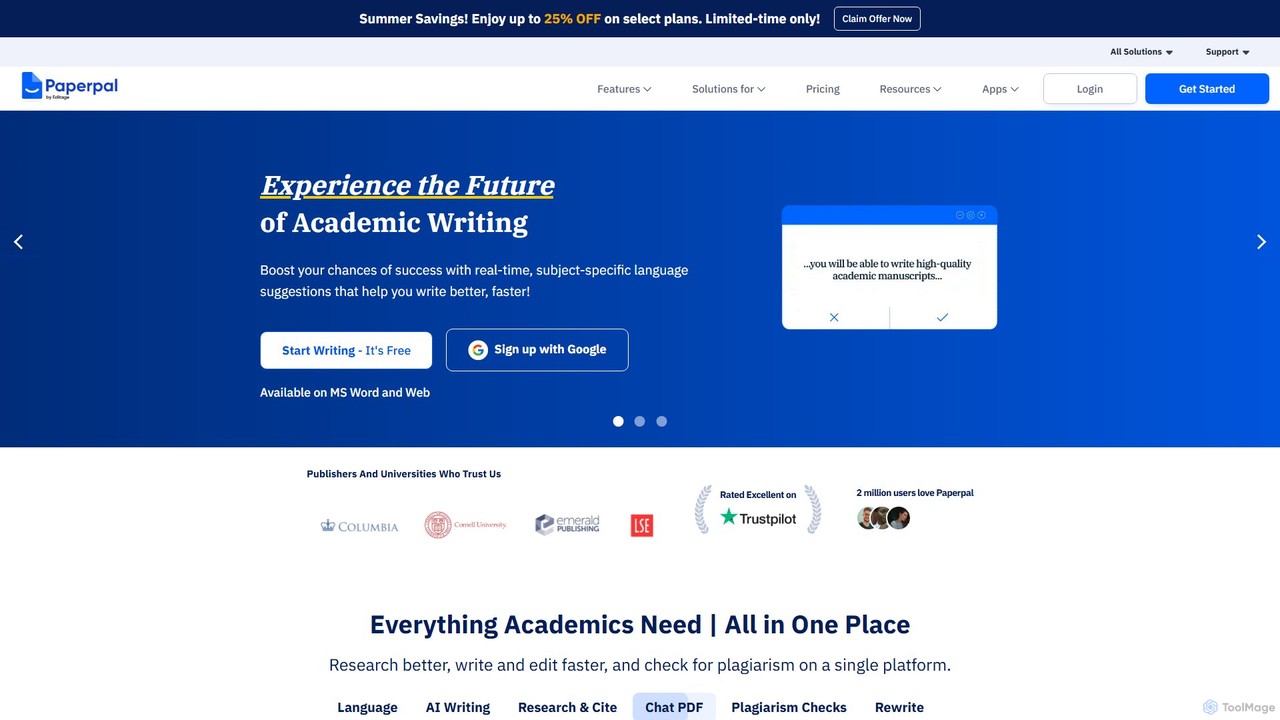
Paperpal

Paperpal

Paperpal is an AI-powered academic writing assistant for researchers, students, and academics. It offers a comprehensive suite of …

1.4M

About Publishing

AI Publishing tools are specialized academic assistants designed to streamline the manuscript preparation and submission process. They leverage natural language processing (NLP) and machine learning to automatically format documents, check for compliance with journal guidelines, and enhance writing quality. These tools help researchers and students save significant time on tedious technical requirements, allowing them to focus on the core scientific content. By automating checks for style, structure, and references, they increase the likelihood of passing initial editorial screening.

Core Features

  • Journal Formatting Automation: Automatically applies the specific formatting rules of thousands of academic journals, including fonts, margins, headings, and citation styles.
  • Pre-Submission Checks: Conducts a comprehensive audit of the manuscript against a target journal's submission checklist, flagging errors or missing elements.
  • Reference Management: Validates citation accuracy, ensures consistency between in-text citations and the bibliography, and corrects reference formatting.
  • Academic Language Enhancement: Provides suggestions to improve clarity, conciseness, and tone, ensuring the language meets scholarly standards.

Use Cases

These tools are primarily used by academic researchers, PhD students, and scientific writers across all disciplines. They are essential when preparing a manuscript for submission to a peer-reviewed journal, converting a dissertation into a publishable article, or ensuring a conference paper adheres to strict formatting guidelines. Their use is particularly beneficial for non-native English speakers aiming to publish in international journals.

How to Choose

When selecting an AI Publishing tool, consider the breadth of its journal template database—ensure it covers your target publications. Evaluate its integration capabilities with your preferred writing software, such as Microsoft Word, LaTeX, or Google Docs. Assess the depth of its analysis, from basic formatting to advanced language and structural suggestions. Finally, consider collaboration features if you are working as part of a research team.

PublishingUse Cases

1

Automating Journal-Specific Manuscript Formatting

A biomedical researcher has just completed a manuscript for a high-impact journal like 'Cell'. Instead of spending hours manually adjusting margins, citation styles (e.g., from APA to Vancouver), and figure placements according to the journal's 50-page style guide, they use an AI publishing tool. They simply select 'Cell' from a dropdown menu, and the tool automatically reformats the entire Word document in under a minute. This ensures full compliance with technical requirements and avoids an immediate desk rejection due to formatting errors.

2

Performing a Pre-Submission Quality Check

A PhD student is about to make their first submission to a peer-reviewed journal. They are unsure if they have met all the requirements. They upload their manuscript to an AI publishing tool for a readiness check. The AI scans the document and generates a report highlighting several issues: the abstract exceeds the word count limit, two figures are missing captions, and there is an in-text citation for 'Smith, 2022' that does not appear in the reference list. By fixing these issues beforehand, the student significantly improves the manuscript's professionalism and chances of passing the initial screening.

3

Finding a Suitable Journal for a Manuscript

A research group in materials science has developed a novel polymer but is unsure which journal would be the best fit for publication. They use an AI tool's 'Journal Finder' feature. By pasting their abstract and keywords, the AI analyzes the text and compares it against a vast database of academic journals. It returns a ranked list of suggestions, including 'Advanced Materials' and 'Journal of Polymer Science', complete with details on impact factor, average review time, and scope alignment. This data-driven approach helps the team make an informed decision and target the most relevant outlets for their work.

4

Enhancing Academic Language for Non-Native Speakers

A researcher from Japan has written a paper in English for an international computer science conference. While the technical content is strong, they are concerned about the language fluency. Using an AI publishing tool, they receive suggestions to replace awkward phrasing with more standard academic expressions, correct subtle grammatical errors, and ensure consistent use of technical terminology. For example, the tool suggests changing 'we made a new algorithm' to the more formal 'we developed a novel algorithm'. This polishing step helps ensure the paper is judged on its scientific merit, not on language proficiency.

5

Converting a Thesis Chapter into a Journal Article

A recent PhD graduate wants to publish a chapter from their dissertation. The chapter is over 15,000 words, written in a narrative style suitable for a thesis. They use an AI tool to help adapt it for a journal that has a 6,000-word limit. The AI provides a summary to help identify core arguments, suggests ways to restructure sections for a more concise format (e.g., combining introduction and literature review), and flags verbose sentences for shortening. It also helps reformat the extensive bibliography from the thesis style to the specific journal's citation format, saving days of manual work.

6

Ensuring Citation and Reference Consistency

A team of four authors collaborates on a review paper using a shared document. Each author adds references using slightly different styles. Before submission, they run the document through an AI publishing tool. The tool scans all 150 references, automatically unifies them into the target journal's required 'IEEE' style, identifies three in-text citations that are missing from the final reference list, and flags a duplicate entry. This automated process prevents common citation errors that can lead to reviewer frustration or accusations of poor scholarship, ensuring the bibliography is accurate and professional.

PublishingFrequently Asked Questions