v0 report
v0 report is an advanced AI document generator that automates the creation of professional-quality reports, essays, research papers, …
v0 report is an advanced AI document generator that automates the creation of professional-quality reports, essays, research papers, and summaries. By simply providing a prompt, uploading data, or using its web scraping feature, users can generate customized, well-structured documents in minutes. It supports various document types, from academic theses to business analytics, and integrates with Google Docs, making it ideal for students, researchers, and professionals seeking to enhance productivity and document quality.
EduWiz AI
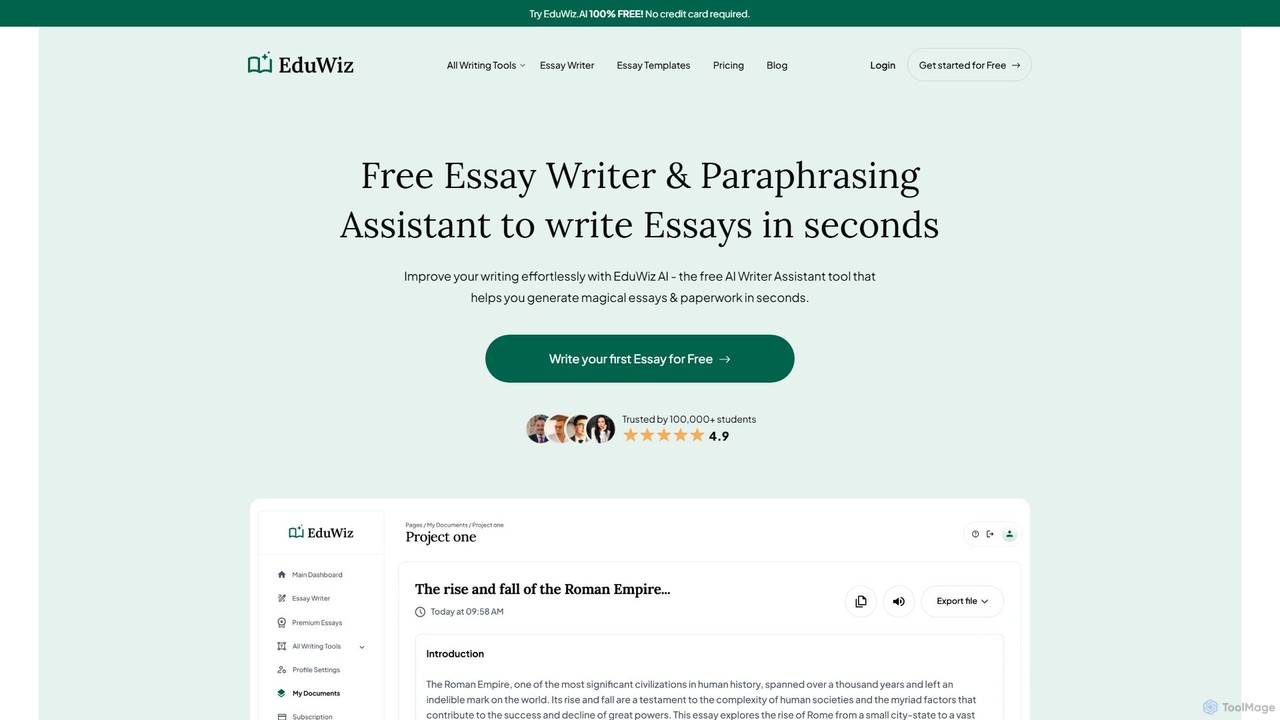
EduWiz AI is an all-in-one AI writing assistant designed for students, teachers, and writers. It offers a suite …
EduWiz AI is an all-in-one AI writing assistant designed for students, teachers, and writers. It offers a suite of tools including an essay writer, paraphraser, summarizer, and text humanizer to enhance writing quality and efficiency. With customizable templates and multiple citation formats, it helps users create high-quality academic papers, blog posts, and other content in seconds, streamlining the entire writing process.
ScienHub
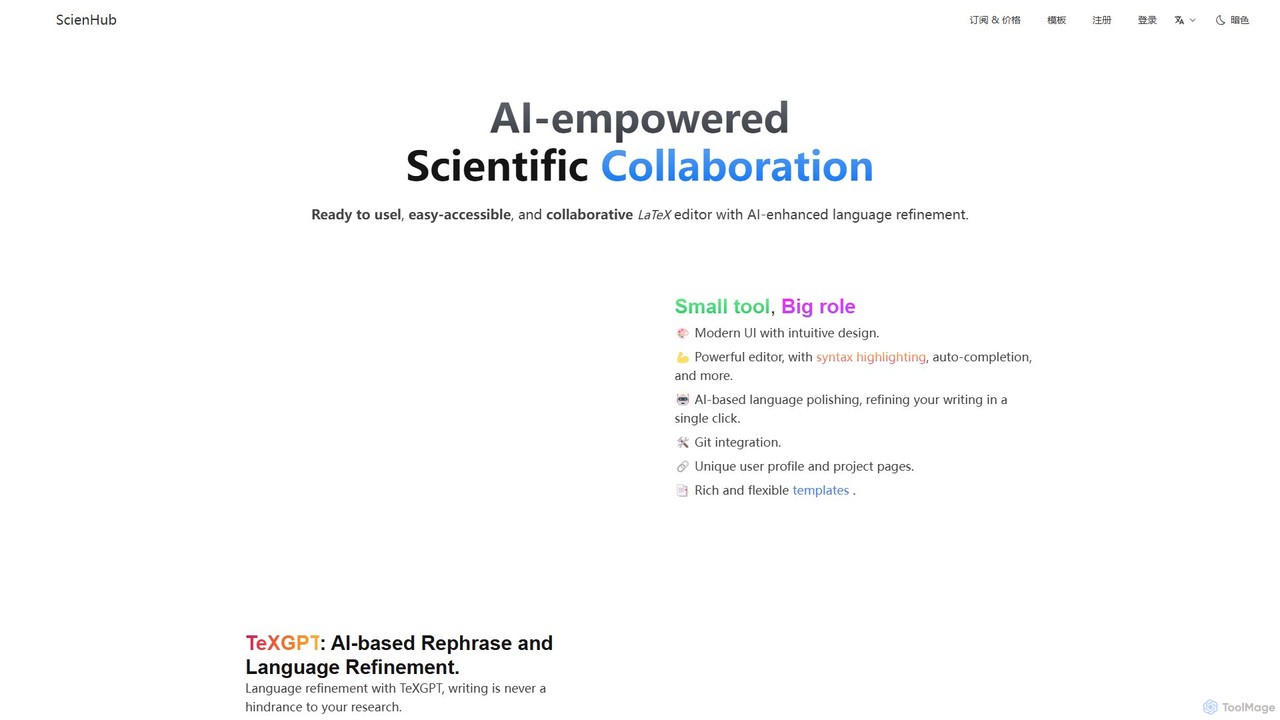
ScienHub is an AI-powered, collaborative online LaTeX editor designed for researchers, academics, and students. It streamlines scientific writing …
ScienHub is an AI-powered, collaborative online LaTeX editor designed for researchers, academics, and students. It streamlines scientific writing with features like AI-driven language refinement (TeXGPT), real-time collaboration, Git integration, and Zotero support. Its modern interface and rich template library make creating professional academic documents easier than ever.
About Research
Research AI tools are AI-powered platforms designed to assist and automate various stages of the academic and professional research process. These tools leverage advanced natural language processing, machine learning, and data analysis to process vast amounts of information, identify patterns, and generate actionable insights. They significantly streamline tasks such as literature review, data collection, analysis, hypothesis generation, and report writing, enhancing the efficiency, accuracy, and depth of inquiry for researchers.
Core Features
- Literature Review & Management: Automatically identifies, summarizes, organizes, and cites academic literature.
- Data Analysis & Visualization: Processes complex datasets, identifies trends, and generates insightful charts and graphs.
- Intelligent Summarization & Extraction: Extracts key information, arguments, and findings from lengthy texts and documents.
- Research Design Assistance: Aids in formulating research questions, hypotheses, and appropriate methodologies.
- Language Polishing & Proofreading: Optimizes the linguistic quality, grammar, and academic tone of research papers.
Applicable Scenarios
These tools are invaluable for academic researchers, university students, data scientists, market analysts, and R&D teams. They are used to accelerate discovery, validate theories, and synthesize complex information across diverse fields, from social sciences to engineering and medicine.
How to Choose
When selecting an AI research tool, consider its specific functionalities (e.g., qualitative vs. quantitative analysis), integration capabilities with existing research workflows, the accuracy and transparency of its AI models, and its adherence to data privacy and ethical research standards. Evaluate the tool's ability to handle your specific data types and research methodologies.

ResearchUse Cases
Automating Literature Reviews
Academic researchers and postgraduate students can use AI research tools to rapidly scan, summarize, and organize hundreds of academic papers. By inputting research questions, the tool identifies relevant studies, extracts key findings, and helps pinpoint research gaps, significantly reducing the time spent on initial literature synthesis and allowing more focus on critical analysis.
Analyzing Complex Datasets
Data scientists and scientific researchers utilize AI tools to process and interpret large, intricate datasets from experiments or surveys. The AI can identify subtle patterns, correlations, and anomalies that might be missed by manual analysis, generating predictive models and visualizations that lead to novel discoveries and more robust conclusions.
Assisting Research Report Writing
Consultants and market analysts employ AI research tools to transform raw data, interview transcripts, and notes into structured report drafts. The AI can synthesize information, generate executive summaries, and suggest narrative flows, accelerating the report generation process and ensuring consistency in findings presentation for clients or stakeholders.
Patent and Market Trend Analysis
Corporate R&D teams and business strategists leverage AI research tools to monitor vast patent databases, industry reports, and news articles. The tools identify emerging technological trends, competitive landscapes, and potential intellectual property risks, informing strategic decisions for product development and market entry.
Hypothesis Generation and Validation
Scientists and medical researchers use AI tools to explore existing knowledge bases and generate novel research hypotheses based on identified gaps or correlations. The AI can also assist in designing preliminary experiments or simulations to validate these hypotheses, accelerating the early stages of scientific inquiry and discovery.
Academic Paper Language Refinement
Non-native English-speaking scholars utilize AI research tools specifically for language polishing and proofreading of their academic manuscripts. The AI corrects grammatical errors, improves sentence structure, enhances vocabulary for academic tone, and ensures clarity and conciseness, significantly increasing the likelihood of successful publication in international journals.