TENET
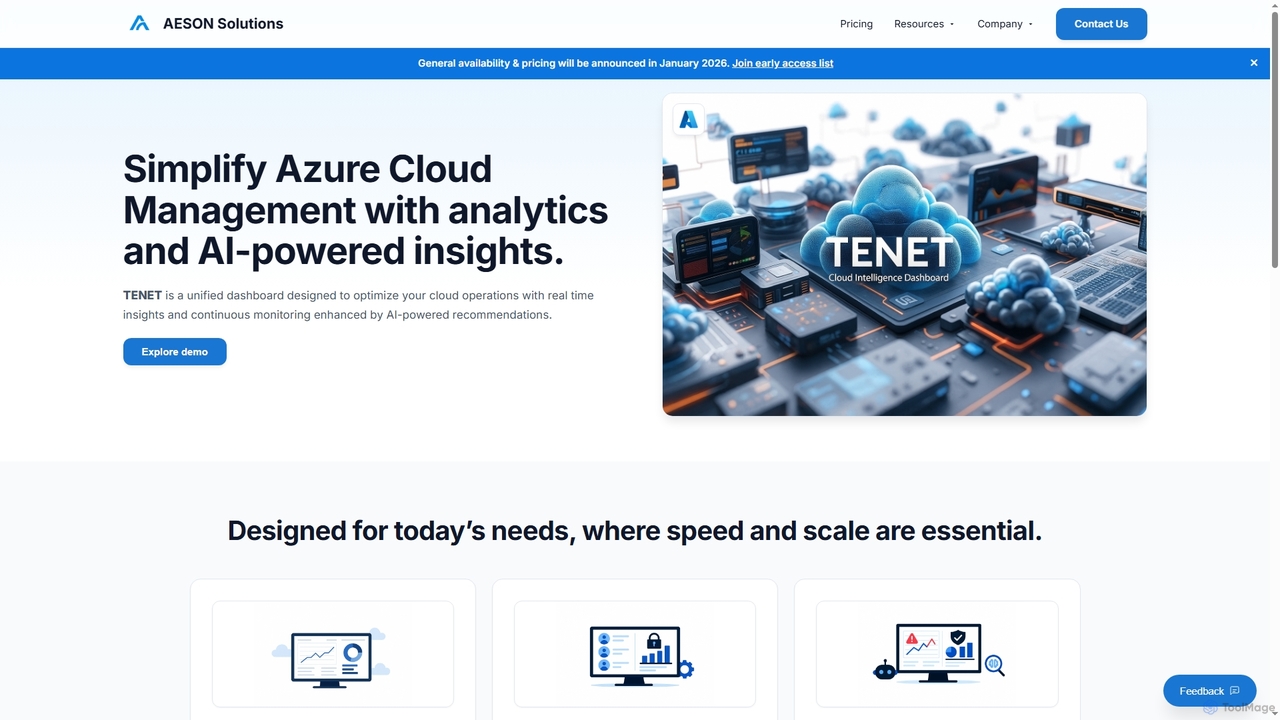
TENET is an AI-powered Azure Cloud Intelligence Platform by AESON Solutions, designed to simplify cloud management. It provides …
TENET is an AI-powered Azure Cloud Intelligence Platform by AESON Solutions, designed to simplify cloud management. It provides a unified dashboard with real-time analytics and continuous monitoring, enhanced by AI-driven insights and recommendations to optimize cloud operations, detect anomalies, and strengthen security.
About Cloud Operations
Cloud Operations AI tools are specialized AI assistants designed to automate, optimize, and manage complex cloud infrastructures and services. Leveraging advanced machine learning and data analytics, these tools enhance the efficiency, reliability, and cost-effectiveness of cloud environments. They provide intelligent insights and proactive solutions for monitoring, resource allocation, security, and performance, ensuring seamless operation of critical cloud workloads.
Core Features
- Automated Monitoring & Alerting: Proactively detects anomalies, performance bottlenecks, and security threats across cloud resources, triggering immediate alerts.
- Resource Optimization: Intelligently analyzes usage patterns to recommend and automatically adjust cloud resource allocation, minimizing waste and reducing costs.
- Predictive Maintenance: Uses historical data to forecast potential issues before they impact services, enabling preventive actions and improving uptime.
- Cost Management & Governance: Provides detailed cost analysis, identifies spending inefficiencies, and enforces policy compliance across multi-cloud environments.
- Security Posture Management: Continuously assesses cloud configurations for vulnerabilities and compliance deviations, offering automated remediation suggestions.
Applicable Scenarios
Cloud Operations AI tools are crucial for organizations managing dynamic and large-scale cloud deployments. They are indispensable for DevOps teams seeking to streamline CI/CD pipelines, IT operations personnel aiming to reduce manual toil in incident management, and financial controllers focused on optimizing cloud spending. These tools support multi-cloud strategies, ensuring consistent performance and security across diverse platforms.
How to Choose
When selecting Cloud Operations AI tools, consider the breadth of cloud platforms supported (e.g., AWS, Azure, GCP), the depth of automation capabilities (from monitoring to self-healing), and the granularity of cost and performance insights. Evaluate integration with existing IT service management (ITSM) and CI/CD tools, as well as the vendor's commitment to security and compliance standards. Scalability and ease of deployment are also critical factors for growing cloud footprints.

Cloud OperationsUse Cases
Automating Cloud Cost Management and Optimization
For financial operations (FinOps) teams and cloud architects, AI-powered Cloud Operations tools automatically analyze cloud spending across multiple platforms. They identify underutilized resources, recommend rightsizing instances, and detect anomalous spending spikes. This enables organizations to reduce unnecessary expenditures by up to 30%, ensuring budget adherence and maximizing return on cloud investments without manual oversight.
Automated Anomaly Detection in Production
For SRE and DevOps teams, manually sifting through vast logs and metrics to identify performance degradation or service outages is time-consuming. Cloud Operations AI tools continuously monitor application performance and infrastructure health, automatically detecting unusual patterns or deviations from baselines. This enables proactive incident response, reducing mean time to resolution (MTTR) by up to 50% and preventing potential customer impact.
Proactive Anomaly Detection and Performance Troubleshooting
Site Reliability Engineers (SREs) and operations teams utilize Cloud Operations AI to continuously monitor application and infrastructure performance. The AI learns normal behavior patterns and immediately flags deviations, such as sudden latency spikes or resource exhaustion, often before they impact users. This proactive approach reduces mean time to resolution (MTTR) by 50% and prevents critical outages, maintaining service level agreements (SLAs).
Optimizing Cloud Resource Allocation
Cloud architects and finance managers often struggle with over-provisioned or under-utilized cloud resources, leading to unnecessary expenditure. AI-powered Cloud Operations tools analyze historical usage, workload patterns, and cost data to recommend optimal instance types, storage tiers, and scaling policies. This ensures resources are right-sized for demand, potentially cutting cloud bills by 20-30% without compromising performance.
Enhancing Cloud Security Posture with Automated Compliance
Security and compliance officers leverage Cloud Operations AI to automate security assessments and ensure continuous adherence to regulatory standards like GDPR, HIPAA, or SOC 2. The AI scans for misconfigurations, identifies vulnerabilities, and enforces security policies across cloud environments. This significantly reduces the risk of data breaches and audit failures, providing real-time visibility into the security health of the cloud infrastructure.
Predictive Scaling for E-commerce Traffic Spikes
E-commerce businesses experience unpredictable traffic surges during sales events or holidays, requiring rapid infrastructure scaling. Cloud Operations AI tools use machine learning to predict future demand based on past trends, marketing campaigns, and external factors. They automatically pre-scale resources before peak loads hit, ensuring website stability and responsiveness, preventing downtime, and maximizing sales opportunities.
Intelligent Resource Provisioning and Auto-Scaling
Cloud architects and developers use Cloud Operations AI to dynamically provision and scale resources based on predicted and real-time demand. Instead of manual adjustments or rigid rules, the AI learns usage patterns and automatically allocates compute, storage, and network resources. This ensures optimal performance during peak loads while minimizing costs during off-peak hours, leading to a more agile and responsive infrastructure.
Enhancing Cloud Security Posture
Security teams face the challenge of continuously monitoring dynamic cloud environments for misconfigurations, compliance violations, and emerging threats. AI-driven Cloud Operations tools provide real-time visibility into security configurations, identify deviations from best practices or regulatory standards (e.g., GDPR, HIPAA), and suggest automated remediation actions. This strengthens the overall security posture and reduces the attack surface.
Predictive Maintenance for Cloud Infrastructure
IT operations teams employ Cloud Operations AI for predictive maintenance, moving beyond reactive problem-solving. The AI analyzes historical data and real-time telemetry to forecast potential hardware failures, software glitches, or capacity shortages before they occur. This allows teams to schedule maintenance proactively, migrate workloads, or scale up resources, significantly reducing unplanned downtime and improving overall system reliability.
Automating Incident Response Workflows
IT operations teams spend significant time on repetitive incident response tasks, from triaging alerts to executing runbooks. Cloud Operations AI tools can automate parts of this workflow by correlating alerts, diagnosing root causes, and even initiating self-healing actions for common issues. This frees up engineers for more complex problems, accelerates resolution, and improves operational efficiency.
Automated Incident Response and Remediation
DevOps and NOC (Network Operations Center) teams leverage Cloud Operations AI to automate incident response workflows. When an anomaly or outage is detected, the AI can automatically trigger alerts, diagnose the root cause, and even execute predefined remediation actions, such as restarting services or rolling back deployments. This drastically reduces human intervention, accelerates recovery times, and minimizes the impact of incidents on business operations.
Multi-Cloud Cost Governance and Reporting
Enterprises operating across multiple cloud providers often lack a unified view of their spending and struggle with cost allocation. Cloud Operations AI tools aggregate cost data from various clouds, categorize spending by project or department, and identify opportunities for savings through reserved instances or spot markets. They generate comprehensive reports, enabling better financial planning and accountability across the organization.