WizNote
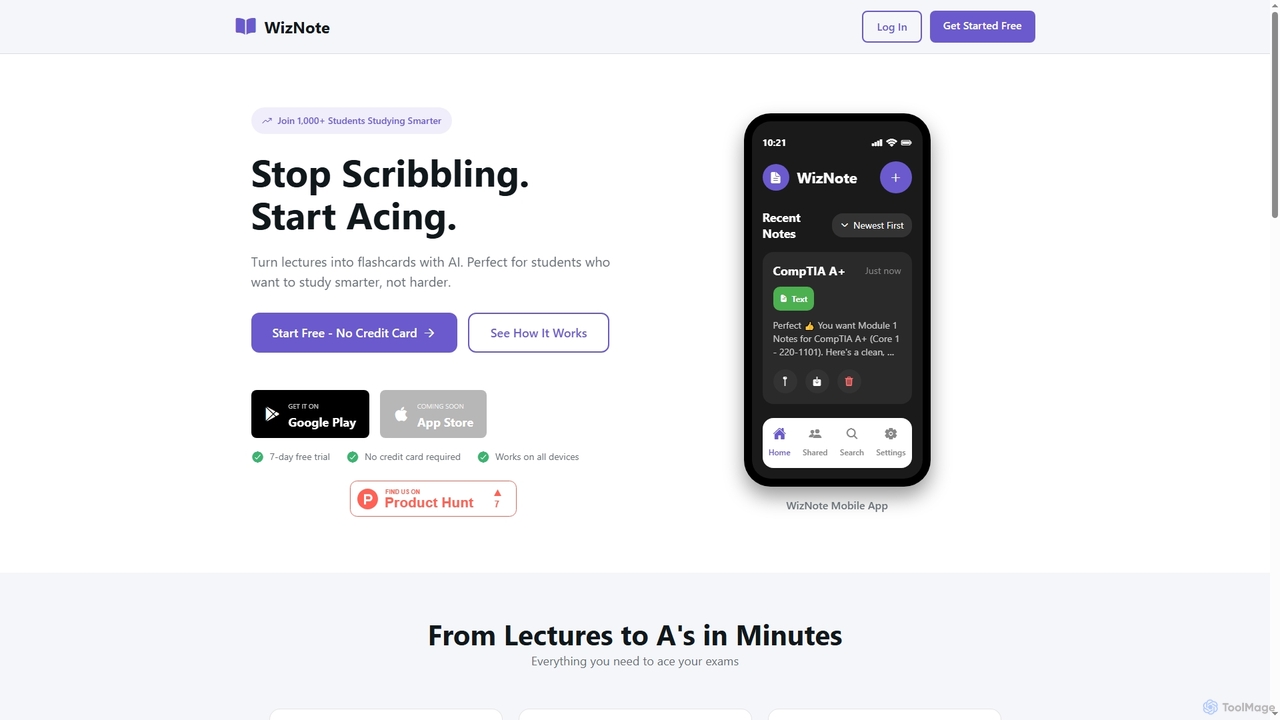
WizNote is an AI-powered study tool designed for students to transform lectures and notes into effective learning materials. …
WizNote is an AI-powered study tool designed for students to transform lectures and notes into effective learning materials. It offers instant AI transcriptions of recordings, automatic flashcard generation, smart summaries, and practice quizzes. Students can also upload PDFs for text extraction and access their study materials across all devices with real-time sync, aiming to help them study smarter and achieve better academic results.
About Learning Assistant
AI Learning Assistants are specialized tools designed to create personalized and interactive educational experiences. They leverage natural language processing (NLP) and machine learning to act as on-demand tutors, research aids, and dynamic study partners. These assistants enhance the learning process by providing instant answers, simplifying complex topics, and generating custom study materials from user-provided content. Their primary value lies in making learning more efficient, accessible, and tailored to individual needs and learning styles.
Core Features
- Personalized Tutoring: Offers tailored explanations and answers questions based on uploaded materials like lecture notes, textbooks, or articles.
- Content Summarization: Condenses long documents, videos, or web pages into concise summaries, highlighting key concepts and arguments.
- Interactive Quizzing: Automatically generates flashcards, multiple-choice questions, and practice tests from study materials to reinforce knowledge.
- Concept Clarification: Breaks down complex ideas, theories, or formulas into simpler, more understandable components with examples.
- Language Learning Support: Facilitates language acquisition through conversational practice, grammar correction, and vocabulary building exercises.
Applicable Scenarios
AI Learning Assistants are widely used across the entire educational spectrum. Students from high school to university use them for homework help, exam preparation, and understanding difficult subjects. Researchers and academics leverage them to quickly digest dense research papers and literature. Professionals utilize these tools for corporate training, upskilling, and mastering new technical knowledge efficiently.
Selection Criteria
When choosing an AI Learning Assistant, consider the supported content formats (PDF, DOCX, URL, YouTube). Evaluate the quality and depth of its explanations and summaries. Assess its interactive features, such as the ability to generate varied quiz types. Finally, check for integrations with other platforms like note-taking apps and consider the pricing model relative to your usage frequency.

Learning AssistantUse Cases
University Exam Preparation
A university student preparing for final exams uploads weeks of lecture notes, PDF textbooks, and relevant academic articles into a Learning Assistant. The tool processes all the documents and creates a unified knowledge base. The student then asks specific questions like 'Explain the difference between Keynesian and Monetarist economics' and receives a detailed, easy-to-understand answer based on the provided materials. They also use the tool to generate multiple-choice quizzes on key chapters, helping them identify knowledge gaps and focus their revision efforts more effectively, saving dozens of hours of manual review.
Learning a New Programming Language
A software developer aiming to learn Python uploads the official documentation and several tutorials into a Learning Assistant. Instead of reading linearly, they ask targeted questions like 'Show me an example of a list comprehension to filter even numbers' or 'What is the main difference between a tuple and a list?'. The assistant provides concise code snippets and explanations. This interactive approach allows the developer to build a mental model of the language faster than traditional methods. It also acts as a smart search engine for the documentation, providing context-aware answers that are more direct than a standard web search.
Digesting Complex Research Papers
A PhD candidate researching quantum computing uploads a dense, 30-page academic paper to their Learning Assistant. Within a minute, the tool provides a one-page summary, a list of key terminology with definitions, and an explanation of the paper's core methodology in simpler terms. The researcher can then ask follow-up questions like 'What were the limitations of the experiment discussed in section 4?' The assistant locates and synthesizes the relevant information, saving the researcher hours of careful reading and note-taking. This allows them to assess the relevance of dozens of papers in a fraction of the time it would normally take.
Interactive Language Learning Practice
Someone learning French for an upcoming trip uses a Learning Assistant with language capabilities. They start a conversation in French, and the AI responds as a native speaker, role-playing a scenario like ordering at a café. The assistant provides real-time corrections for grammar and suggests more natural phrasing. The user can ask 'Why did you use the subjunctive here?' and get an instant grammar lesson. This provides a safe, on-demand environment to practice speaking and listening skills, which is often a major bottleneck for language learners without access to native speakers.
Corporate Training and Onboarding
A new employee at a tech company is given access to a Learning Assistant pre-loaded with all company policies, product documentation, and training manuals. Instead of spending days searching through a complex internal wiki, the new hire can ask direct questions like 'What is our process for expense reimbursement?' or 'Summarize the key features of Product X'. The assistant provides immediate, accurate answers sourced directly from the official documents. This accelerates the onboarding process, reduces the burden on senior team members for repetitive questions, and ensures consistent information delivery.
Homework Help for K-12 Students
A middle school student struggling with a history assignment about the Roman Empire uploads their textbook chapter to a Learning Assistant. They ask, 'What were the main reasons for the fall of Rome?' The tool summarizes the key factors from the text, such as economic instability, overexpansion, and political corruption. The student can then ask for more detail on each point. For a math problem, they can input the question and ask for a step-by-step hint rather than the final answer. This approach fosters independent learning and critical thinking by guiding the student toward the solution without simply providing it.