ToolMage
Sign in

Best 1 Conversation Tools for Ai Assistants

Popular Conversation Tools in Ai Assistants include MemSync, helping you work more efficiently.

MemSync
Freemium

MemSync

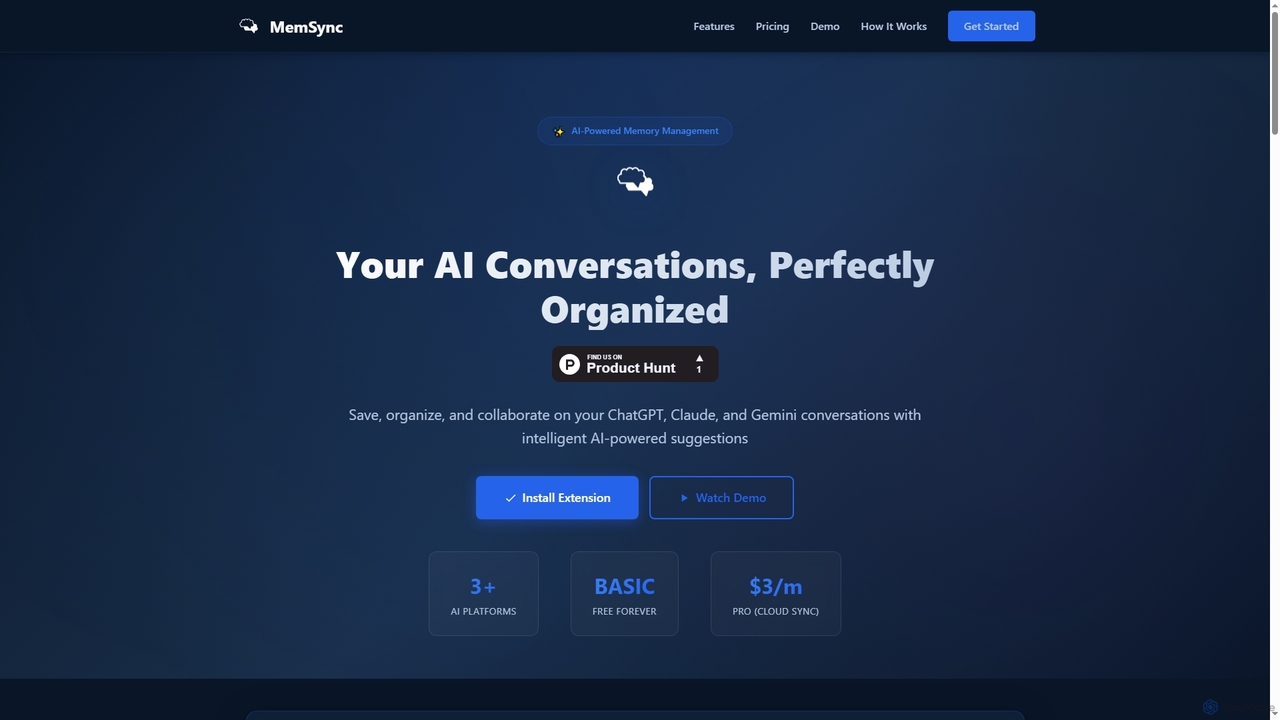
MemSync is an AI-powered browser extension designed to effortlessly save, organize, and collaborate on your AI conversations from platforms like ChatGPT, Claude, and Gemini. It offers smart memory saving, AI-driven organization suggestions, and seamless cloud synchronization.

Conversation Tools
Visits 5.7KFavorites 152Likes 150

About Conversation Tools

Conversation Tools are AI-powered applications designed to facilitate natural language interactions between humans and machines. Leveraging advanced Natural Language Processing (NLP) and machine learning, these tools can understand, interpret, and generate human-like text or speech, enabling dynamic and context-aware dialogues across various platforms. As a vital subset of AI Assistants, they enhance user experience across digital touchpoints by automating communication, providing instant support, streamlining information retrieval, and offering personalized engagement. Their ability to process and respond to complex queries makes them invaluable for modern digital communication strategies.

Core Features

  • Natural Language Understanding (NLU): Accurately interprets user intent, entities, and context from free-form text or speech, enabling precise comprehension of diverse inputs.
  • Context Management: Maintains conversational flow and remembers previous interactions, ensuring coherent, multi-turn dialogues that feel natural and personalized.
  • Response Generation: Generates relevant, human-like text or speech responses, drawing from predefined knowledge bases, generative AI models, or real-time data.
  • Integration Capabilities: Seamlessly connects with CRM systems, messaging platforms, websites, mobile apps, and other business applications for unified communication.
  • Sentiment Analysis: Detects the emotional tone and underlying sentiment of user input, allowing the tool to adapt its responses for more empathetic and appropriate interactions.
  • Multilingual Support: Offers the ability to understand and respond in multiple languages, catering to a global user base and diverse communication needs.

Applicable Scenarios

Conversation Tools are indispensable for businesses seeking to scale customer engagement, optimize internal communications, and for individuals looking for intelligent digital companions. In customer service, they automate FAQs, handle support tickets, and guide users through troubleshooting processes, significantly reducing response times. Sales teams utilize them for lead qualification, scheduling appointments, and delivering personalized product information. Marketing departments deploy them for interactive campaigns, gathering feedback, and enhancing user engagement on websites. Furthermore, they serve as virtual assistants for personal productivity, managing schedules, and providing quick access to information, transforming how users interact with technology and services.

How to Choose

Selecting the right Conversation Tool involves evaluating several critical factors to ensure it aligns with specific operational needs. First, assess the accuracy and robustness of its NLU capabilities, particularly for your target languages, industry-specific terminology, and the complexity of expected user queries. Second, examine its integration ecosystem to confirm compatibility with your existing CRM, messaging platforms, and other essential business applications. Third, consider the level of customization offered for branding, response tailoring, and workflow automation. Fourth, evaluate its scalability to handle varying user loads and future growth, alongside the ease of deployment and ongoing maintenance. Finally, prioritize tools that provide comprehensive analytics for monitoring performance, identifying areas for improvement, and demonstrating ROI.

Conversation Tools use cases

1

Automated Customer Service and Support

E-commerce businesses and service providers can deploy conversation tools to offer 24/7 automated customer support. By integrating with their knowledge base, the AI can instantly answer frequently asked questions, guide users through troubleshooting steps, and provide product information. This reduces the workload on human agents, improves response times, and ensures customers receive immediate assistance, leading to higher satisfaction rates and operational efficiency.

2

Lead Qualification and Sales Assistance

Sales and marketing teams can leverage conversation tools to engage website visitors, qualify leads, and assist with the sales funnel. The AI can ask pre-defined questions to gather prospect information, identify their needs, and even schedule demo calls or connect them with the appropriate sales representative. This streamlines the lead generation process, ensures sales teams focus on high-potential leads, and improves conversion rates by providing instant, personalized interaction.

3

Internal Knowledge Base and HR Support

Large organizations can implement conversation tools as internal virtual assistants to support employees. These tools can answer common HR questions (e.g., leave policies, benefits), provide IT support, or help navigate internal knowledge bases and company policies. This empowers employees with instant access to information, reduces the burden on HR and IT departments, and improves overall employee satisfaction and productivity by streamlining internal queries.

4

Language Learning and Practice

Individuals learning a new language can use conversation tools as interactive tutors. These AI companions provide a safe and accessible environment for practicing conversational skills, improving pronunciation, and expanding vocabulary. Users can engage in role-playing scenarios, receive instant feedback on grammar and fluency, and overcome the fear of speaking, accelerating their language acquisition journey without the need for a human partner.

5

Content Generation and Idea Brainstorming

Content creators, marketers, and writers can utilize conversation tools to brainstorm ideas, generate outlines, or even draft initial content. By engaging in a dialogue with the AI, users can explore different angles, refine concepts, and overcome writer's block. The tool can provide suggestions, expand on topics, and help structure narratives, significantly accelerating the content creation process and fostering creativity through interactive ideation.

6

Personal Productivity and Task Management

Individuals can integrate conversation tools into their daily routines as personal virtual assistants. These tools can help manage schedules, set reminders, answer quick questions, summarize documents, or even assist with basic research tasks. By interacting through natural language, users can offload cognitive load, stay organized, and access information more efficiently, transforming how they manage personal and professional tasks without complex interfaces.

Conversation Tools FAQ

What are Conversation Tools?

Conversation Tools are AI-powered applications that enable natural, human-like interactions between users and digital systems. They leverage advanced Natural Language Processing (NLP) to understand user intent, process complex queries, and generate relevant responses. These tools go beyond simple rule-based chatbots by maintaining context, learning from interactions, and facilitating multi-turn dialogues, making digital communication more intuitive and efficient.

How do I choose the best Conversation Tool for my business?

To select the best Conversation Tool, consider your specific needs. Evaluate its Natural Language Understanding (NLU) accuracy for your industry's terminology and target languages. Check its integration capabilities with your existing CRM, messaging platforms, and other business systems. Assess the level of customization for branding and response tailoring, and ensure it offers robust analytics for performance tracking. Finally, consider scalability, ease of deployment, and the vendor's support and update policies.

What's the difference between Conversation Tools and traditional chatbots?

The key difference lies in their intelligence and flexibility. Traditional chatbots are typically rule-based, following predefined scripts and keywords, making them suitable for simple FAQs. Conversation Tools, powered by advanced AI and NLP, can understand complex, nuanced language, maintain context across multiple turns, and even learn from interactions. This allows them to handle more dynamic, personalized, and human-like dialogues, adapting to user intent rather than just matching keywords, making them far more versatile for complex communication needs.

What are the core capabilities of modern Conversation Tools?

Modern Conversation Tools boast several core capabilities. These include advanced Natural Language Understanding (NLU) for interpreting complex user intent, robust context management to maintain coherent multi-turn dialogues, and sophisticated response generation using generative AI. They also feature seamless integration with various platforms, sentiment analysis to gauge user emotion, and often multilingual support. Some tools further offer proactive engagement, personalized recommendations, and deep analytics for continuous improvement.

Who can benefit most from using Conversation Tools?

A wide range of users and organizations can benefit significantly. Businesses in customer service, sales, and marketing can leverage them to automate interactions, qualify leads, and enhance engagement. HR departments can use them for internal support and knowledge sharing. Individuals learning languages or seeking personal productivity assistants will find them invaluable. Essentially, anyone looking to streamline communication, access information efficiently, or scale personalized interactions across digital channels will find Conversation Tools highly beneficial.