Standup Mate
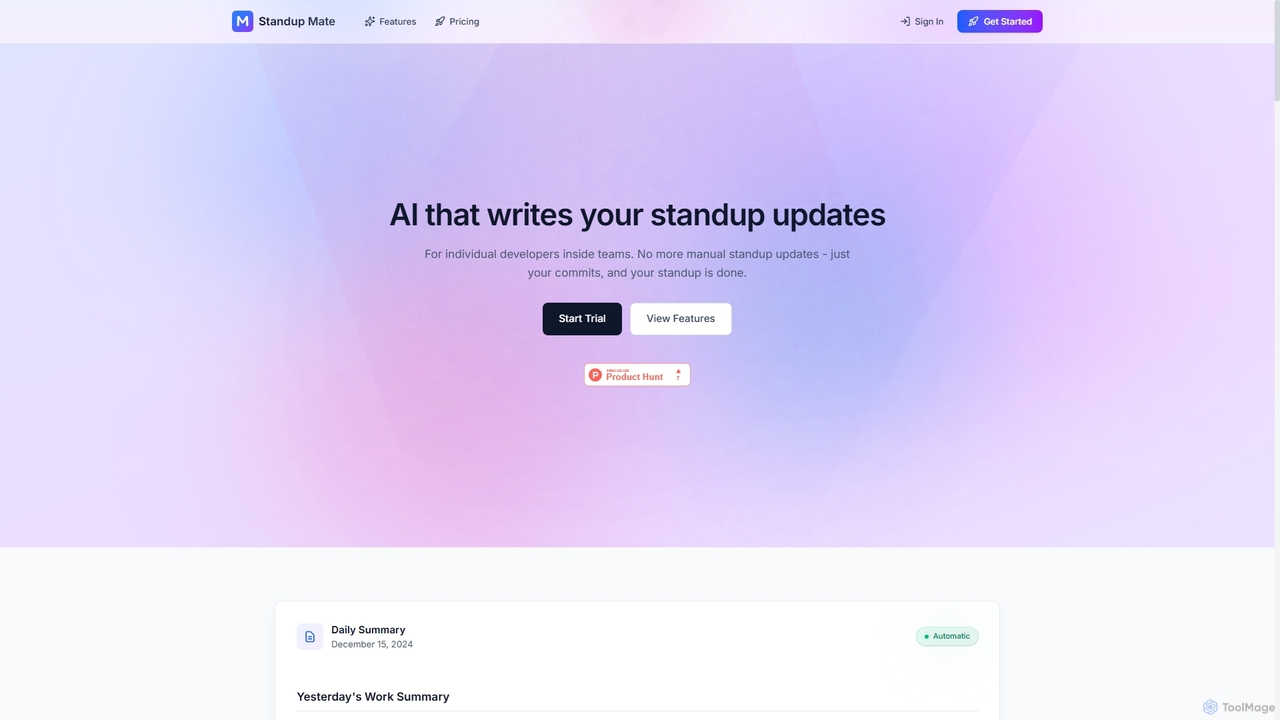
Standup Mate is an AI-powered tool that automatically generates daily standup updates and sprint reports directly from your …
Standup Mate is an AI-powered tool that automatically generates daily standup updates and sprint reports directly from your GitHub activity. Designed for individual developers, it transforms commits, pull requests, and issues into clear, concise summaries, saving valuable time and ensuring accurate reporting without manual effort.
About Workflow Automation
Workflow Automation tools are a specialized category of AI assistants designed to streamline and automate repetitive, rule-based, or data-driven tasks and processes across various business functions. These tools leverage artificial intelligence, machine learning, and robotic process automation (RPA) to execute sequences of actions, integrate disparate systems, and make intelligent decisions, significantly reducing manual effort and human error. By orchestrating complex workflows, they empower organizations to achieve greater operational efficiency, accelerate task completion, and free up human resources for more strategic initiatives.
Core Features
- Intelligent Task Orchestration: Automatically sequences and executes tasks based on predefined rules, triggers, and AI-driven decision logic.
- System Integration: Connects and synchronizes data across various applications, platforms, and databases (e.g., CRM, ERP, project management tools).
- Data Processing & Analysis: Automates data extraction, transformation, loading (ETL), and basic analysis to inform subsequent workflow steps.
- Adaptive Learning: Some advanced tools learn from past interactions and data patterns to optimize workflow paths and improve decision-making over time.
- Error Handling & Monitoring: Provides mechanisms to detect, report, and sometimes automatically resolve issues within automated processes, with real-time dashboards.
Use Cases
Workflow Automation tools are invaluable for businesses seeking to optimize their operational efficiency and reduce manual overhead. They are widely adopted in IT operations for incident management, in HR for onboarding processes, in finance for invoice processing, and in marketing for lead nurturing. Any department with repetitive, multi-step processes can benefit from these AI-powered solutions to enhance productivity and ensure consistency.
How to Choose
When selecting a Workflow Automation tool, consider its integration capabilities with your existing tech stack, the complexity of workflows it can handle, and its scalability to grow with your business needs. Evaluate the user-friendliness of its interface for non-technical users, the robustness of its AI decision-making features, and the pricing model. Security features and compliance standards are also crucial, especially for handling sensitive data.

Workflow AutomationUse Cases
Automating Customer Onboarding Process
For SaaS companies or service providers, automating customer onboarding can significantly improve user experience and reduce manual workload. An AI workflow automation tool can automatically send welcome emails, create user accounts in CRM, assign a customer success manager, schedule initial training sessions, and trigger follow-up tasks based on user engagement, ensuring a smooth and personalized journey from sign-up to active usage.
Streamlining Invoice Processing and Approval
Finance departments often deal with high volumes of invoices requiring multiple approvals. Workflow automation can capture invoice data, validate it against purchase orders, route it to the correct approvers based on predefined rules (e.g., amount, department), and then automatically initiate payment processing and record entries in the ERP system. This reduces processing time, minimizes errors, and enhances compliance.
Automating IT Incident Management
IT support teams can use workflow automation to respond to and resolve incidents more rapidly. When an alert is triggered (e.g., server downtime), the AI tool can automatically create a ticket, notify the relevant on-call engineer, gather diagnostic data, initiate basic troubleshooting steps, and escalate to higher-level support if initial attempts fail, ensuring minimal service disruption.
Optimizing Content Publishing Workflows
Content creators and marketing teams can automate various steps in their publishing pipeline. This includes automatically scheduling social media posts after content approval, distributing articles to email subscribers, updating website sitemaps, and notifying team members of new content, ensuring consistent and timely dissemination across all channels without manual oversight.
Automating HR Employee Lifecycle Management
From hiring to offboarding, HR processes involve numerous administrative tasks. Workflow automation can manage job application screening, interview scheduling, offer letter generation, background checks, and new hire paperwork. Similarly, for offboarding, it can automate access revocation, final pay processing, and exit interviews, ensuring compliance and efficiency throughout the employee lifecycle.
Enhancing Sales Lead Nurturing and Follow-up
Sales teams can leverage workflow automation to ensure no lead falls through the cracks. Upon lead generation, the tool can qualify leads based on predefined criteria, assign them to the appropriate sales representative, trigger personalized email sequences, schedule follow-up calls, and update CRM records, allowing sales reps to focus on high-value interactions rather than administrative tasks.