
Ai Chatbots Best in category 1 results Agents AI Tool

Popular AI tools in the Agents field of Ai Chatbots include A1Base, etc., helping you quickly improve efficiency.

A1Base

A1Base

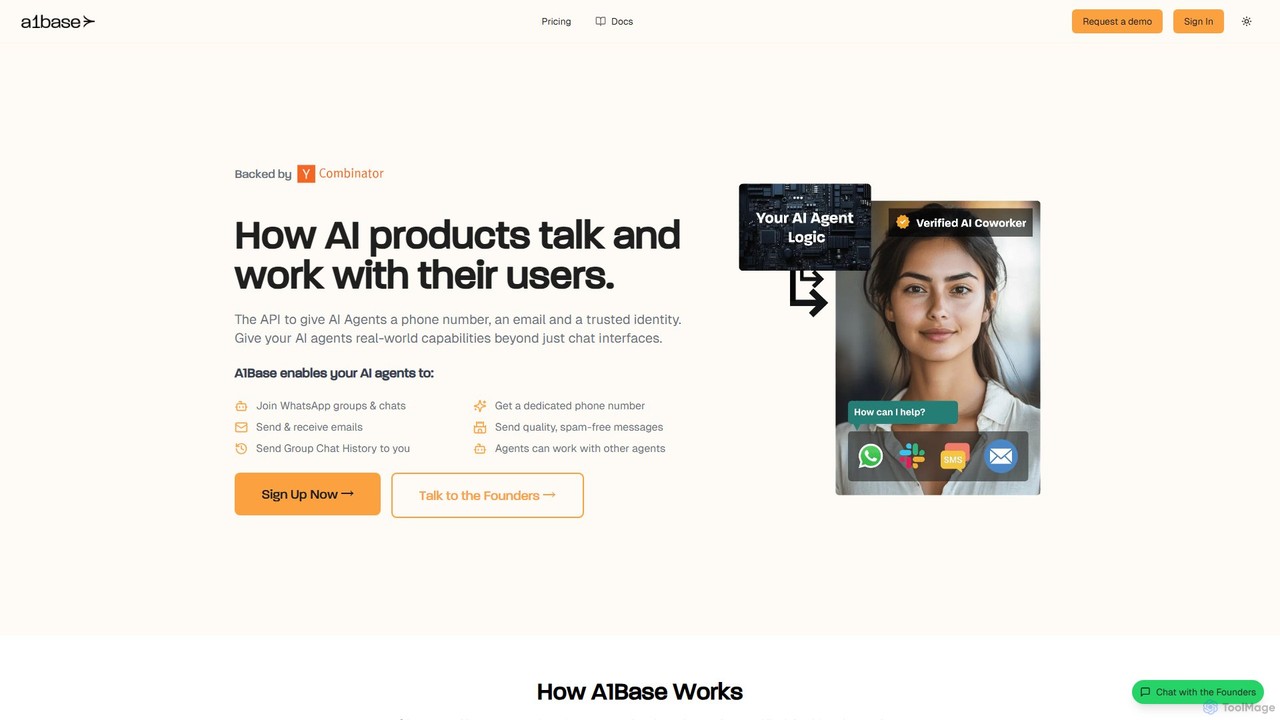
A1Base is a developer-focused API that equips AI agents with real-world communication capabilities. It provides dedicated phone numbers …

8.9K

About Agents

Agents are advanced AI-powered tools designed to understand complex goals, plan multi-step actions, and autonomously execute tasks across various applications and platforms. Unlike traditional AI chatbots that primarily engage in conversational responses, AI Agents are proactive and goal-oriented, capable of breaking down high-level objectives into actionable steps and performing them without constant human intervention. They represent a significant evolution in AI, moving beyond simple interaction to intelligent action, often leveraging other AI models and external tools to achieve their objectives.

Core Features

  • Goal-Oriented Planning: Ability to interpret high-level objectives and formulate a detailed, multi-step plan to achieve them.
  • Autonomous Execution: Independently perform actions, interact with APIs, and utilize various tools to complete tasks.
  • Tool Integration: Seamlessly connect and operate with a wide range of external services, databases, and specialized AI models.
  • Contextual Understanding: Maintain a deep understanding of the task's context and user preferences throughout complex workflows.
  • Learning & Adaptation: Continuously learn from interactions and outcomes, refining strategies and improving performance over time.

Applicable Scenarios

AI Agents are particularly valuable in environments requiring complex task automation and intelligent decision-making. They are employed by businesses for automating intricate workflows, by developers for accelerating software creation, and by researchers for synthesizing vast amounts of information. Their ability to act autonomously makes them ideal for scenarios where human oversight can be minimized for repetitive yet complex processes.

How to Choose

When selecting an AI Agent, consider its autonomy level and the complexity of tasks it can handle. Evaluate its integration capabilities with your existing tools and data sources, as well as its learning mechanisms and adaptability. Security protocols, control features, and the clarity of its decision-making process are also crucial. Finally, assess the cost-effectiveness and scalability to ensure it aligns with your operational needs and budget.

AgentsUse Cases

1

Automated Market Research & Report Generation

A marketing analyst needs to understand emerging trends in a specific industry. An AI Agent can autonomously search the web, analyze competitor strategies, gather data from financial reports, synthesize findings, and then generate a comprehensive market research report, including key insights and recommendations, all without manual data collection or report drafting.

2

Personalized Learning Path Creation

An individual wants to learn a new skill, like Python programming. An AI Agent can assess their current knowledge, identify learning gaps, search for relevant online courses, tutorials, and practice exercises, and then construct a personalized, adaptive learning roadmap, adjusting content based on the user's progress and feedback.

3

Complex Customer Support Resolution

A customer reports a technical issue that requires multiple steps to resolve. An AI Agent can diagnose the problem, access the company's knowledge base, check user account details, initiate troubleshooting steps, escalate to a human if necessary, and even schedule follow-up actions, providing a seamless and efficient resolution process.

4

Software Development Task Automation

A developer needs to implement a new feature or fix a bug. An AI Agent can understand the high-level requirement, break it down into coding tasks, write code snippets, perform unit tests, identify and suggest fixes for errors, and even integrate the changes into the existing codebase, significantly accelerating the development cycle.

5

Supply Chain Optimization

A logistics manager aims to optimize inventory levels and reduce costs. An AI Agent can monitor real-time sales data, predict future demand, compare prices from multiple suppliers, automatically place orders when stock is low, and even negotiate terms (via integrated APIs), ensuring efficient inventory management and cost savings.

6

Content Strategy & Multi-Platform Publishing

A content creator needs to maintain a consistent presence across various social media platforms. An AI Agent can research trending topics, generate diverse content ideas, draft posts tailored for each platform (e.g., short for X, visual for Instagram, detailed for LinkedIn), schedule their publication, and analyze engagement metrics to refine future strategies.

AgentsFrequently Asked Questions