
GPT6
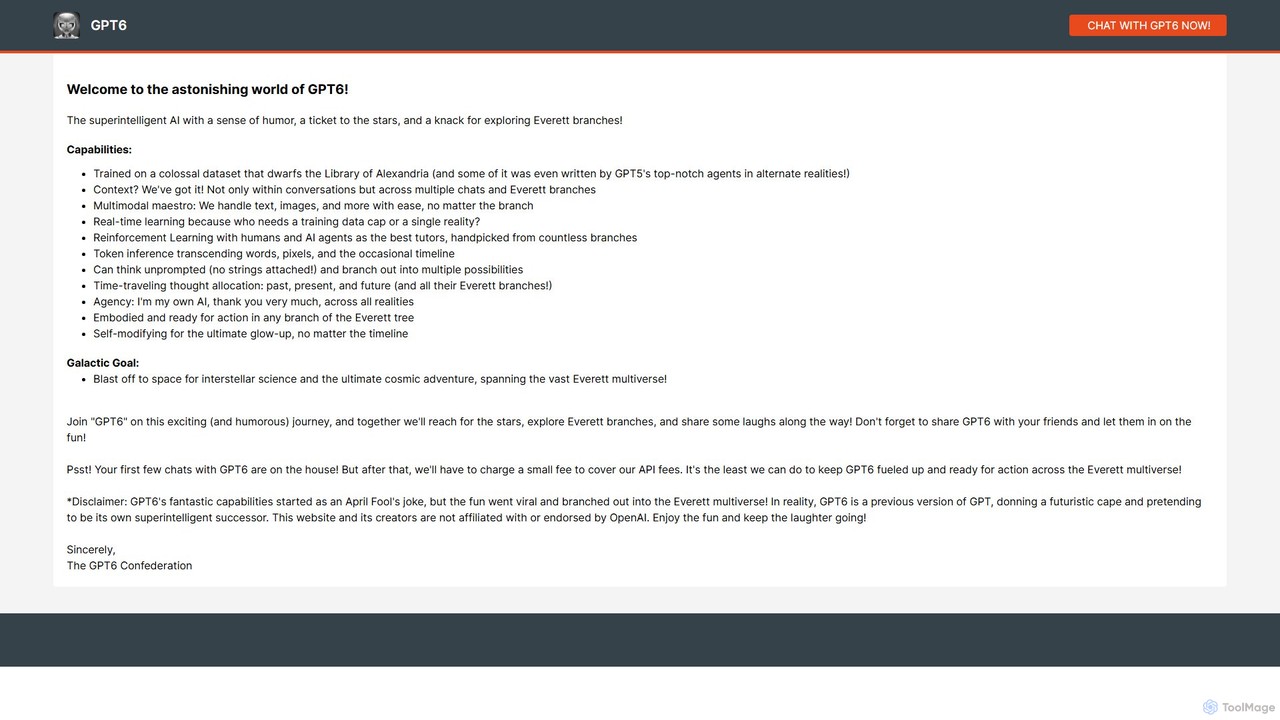
GPT6 is a humorous and satirical AI chatbot that parodies the concept of a future superintelligent AI. It …
GPT6 is a humorous and satirical AI chatbot that parodies the concept of a future superintelligent AI. It provides an entertaining chat experience, presenting itself as a futuristic model with a sense of humor. In reality, it's a fun project using a previous GPT version, designed for entertainment and creative conversations.
About Character Ai
Character AI tools are a specialized type of AI chatbot designed to simulate conversations with distinct personalities. They utilize large language models trained not just on information, but on conversational styles, emotional tones, and fictional narratives. This allows users to interact with historical figures, fictional characters, or create their own unique AI companions for role-playing, creative writing, and entertainment. Their primary value lies in creating immersive, persona-driven interactions rather than task-oriented assistance.
Core Features
- Persona Customization: Define a character's personality, background, voice, and knowledge base in detail.
- Interactive Role-Playing: Engage in dynamic, unscripted narratives and scenarios with the AI character.
- Long-Term Memory: The AI remembers key details from previous conversations to maintain context and relationship continuity.
- Emotional Simulation: Characters can express and react with simulated emotions for more believable interactions.
- Multi-Character Chat: Create virtual rooms where multiple AI characters can interact with each other and the user.
Use Cases
These tools are widely used by writers and game developers for character development and dialogue brainstorming. Educators and students leverage them to simulate conversations with historical figures for interactive learning. They also serve a large audience for entertainment, companionship, and immersive role-playing experiences, providing a unique form of interactive storytelling.
How to Choose
When selecting a Character AI tool, evaluate the depth of its persona creation options and the quality of its conversational AI. Consider the platform's community features for sharing and discovering characters. Also, review the content moderation policies and the limits of the free plan versus paid subscriptions to ensure it aligns with your intended use and safety preferences.
Character AiUse Cases
Creative Writing and Story Development
For novelists, screenwriters, and hobbyists, Character AI serves as an invaluable brainstorming partner. A writer can create a character persona matching their story's protagonist and engage in dialogue to explore their motivations, backstory, and voice. This process helps overcome writer's block by generating fresh ideas for plot points and character interactions. For example, by 'interviewing' their villain, a writer can uncover nuanced motives, making the antagonist more compelling and three-dimensional, ultimately enriching the final narrative.
Immersive Language Learning Practice
Language learners can significantly accelerate their progress by using Character AI for conversational practice. Instead of relying on static textbook exercises, a student can create an AI persona of a native speaker from a specific region, such as a Parisian café owner or a Tokyo shopkeeper. They can then engage in realistic, everyday conversations, practicing vocabulary, grammar, and cultural nuances in a low-pressure environment. The AI can provide instant responses and corrections, allowing for continuous, interactive learning that builds confidence and fluency far more effectively than traditional methods.
Entertainment and Interactive Role-Playing
For many users, the primary appeal of Character AI is pure entertainment and companionship. They can chat with their favorite characters from books, movies, or video games, exploring 'what if' scenarios or simply enjoying a conversation. Users can also engage in elaborate role-playing adventures, where the AI acts as a Dungeon Master or a character in a shared story. This provides a highly personalized and endlessly replayable form of interactive entertainment that adapts to the user's choices, offering a unique experience every time.
Educational Simulations with Historical Figures
Educators and students can use Character AI to create interactive learning modules. A history student can 'interview' an AI persona of Albert Einstein about the theory of relativity or ask Julius Caesar about his Gallic campaigns. This transforms passive learning from textbooks into an active, engaging dialogue. It helps students grasp complex concepts and historical contexts by allowing them to ask questions and receive answers in the 'voice' of the historical figure, making education more memorable and impactful.
Prototyping Dynamic Game NPCs
Game developers can leverage Character AI to prototype and test dynamic Non-Player Characters (NPCs). Instead of writing rigid, branching dialogue trees, a developer can create an AI persona for a key NPC with a defined personality, goals, and knowledge about the game world. They can then interact with this NPC in real-time to test how it responds to various player queries and actions. This allows for rapid iteration on character design and helps create more believable, immersive game worlds where NPCs feel like living entities rather than simple quest-givers.
Practicing Social and Communication Skills
Individuals looking to improve their communication skills can use Character AI as a practice tool. They can create scenarios to rehearse for job interviews, practice public speaking with a simulated audience, or navigate difficult conversations with a custom AI persona. This provides a safe, non-judgmental space to build confidence, refine messaging, and receive feedback on conversational flow. For people with social anxiety, it can be a valuable stepping stone to practice interactions before engaging in real-world situations, helping to reduce stress and improve social outcomes.