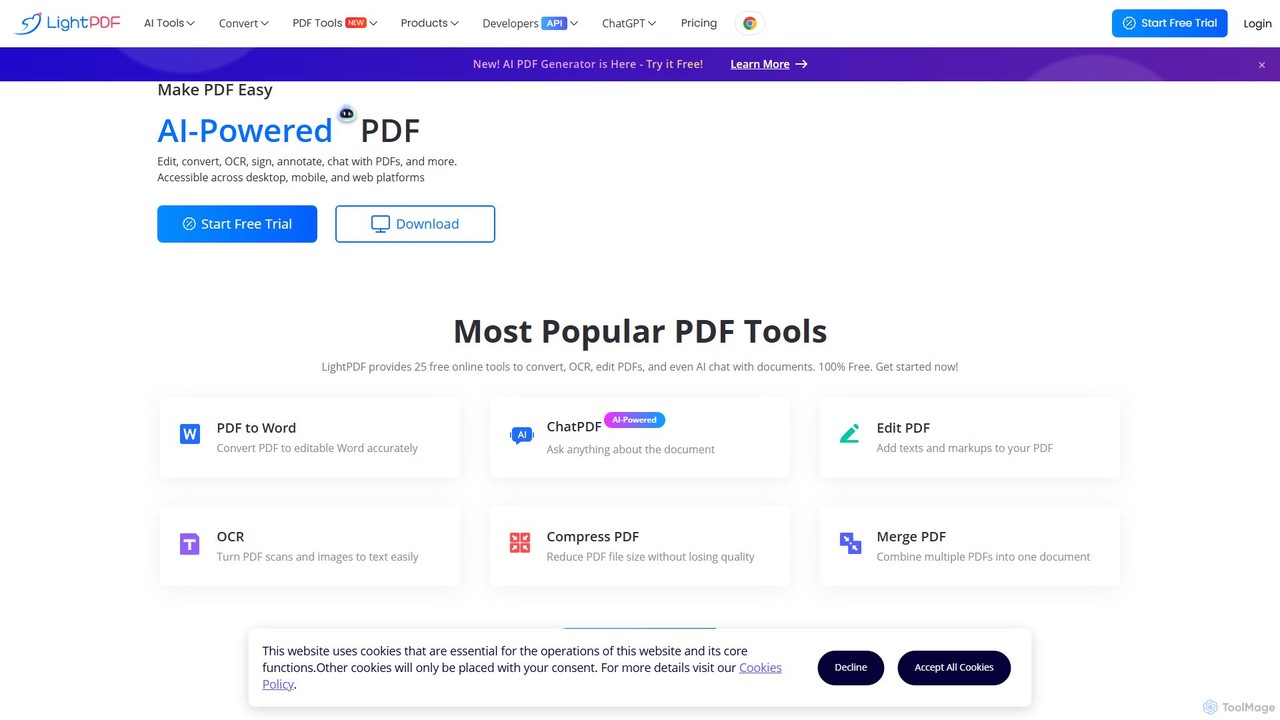
Chat With Your Docs tools are a specialized category of AI chatbots designed to let you interact conversationally with your own documents. These tools use technologies like Retrieval-Augmented Generation (RAG) and vector embeddings to understand the content of uploaded files such as PDFs, Word documents, or text files. This allows you to ask specific questions, get summarized information, and find key data points directly from your source materials, complete with citations. The primary value is transforming static documents into dynamic, searchable knowledge bases, making information retrieval faster and more intuitive.
Core Features
- Multi-Format Document Upload: Support for various file types including PDF, DOCX, TXT, and sometimes spreadsheets or presentations.
- Source-Cited Answers: Responses are directly linked to the specific pages or paragraphs in the source documents, ensuring accuracy and verifiability.
- Semantic Search: Go beyond keyword matching to understand the contextual meaning of your queries for more relevant results.
- Cross-Document Synthesis: Ask questions across multiple documents simultaneously to synthesize information and identify connections.
- Data Extraction: Pull specific data points, figures, or quotes from lengthy documents based on natural language commands.
Applicable Scenarios
These tools are widely used by professionals who handle large volumes of text-based information. For example, legal teams use them to quickly analyze contracts and case law, researchers to review academic papers, and financial analysts to query annual reports. In corporate settings, they power internal knowledge bases, allowing employees to get instant answers from HR policies, technical manuals, and project documentation without manual searching.
Selection Criteria
When choosing a Chat With Your Docs tool, consider the supported file formats and size limits to ensure they match your needs. Evaluate the accuracy of its citation and summarization capabilities. For business use, check for security features, data privacy policies, and integration options with platforms like Slack or Google Drive. Finally, assess the user interface and the complexity of the query language to find a tool that aligns with your team's technical skill level.