ToolMage
Sign in

Best 2 Assessment AI tools for Business

Popular Assessment AI tools in Business include Canditech and Go Platform, helping you work more efficiently.

Go Platform
Freemium

Go Platform

Go Platform is an AI-driven talent assessment platform designed to revolutionize hiring, internal mobility, and employee development. It leverages real-time market data and science-based assessments to accurately measure skills. With robust anti-cheat features and intelligent skill suggestions, it helps organizations make confident hiring decisions, reduce costs, and strategically upskill their workforce.

Assessment
Visits 5.4KFavorites 112Likes 105
Canditech
Freemium

Canditech

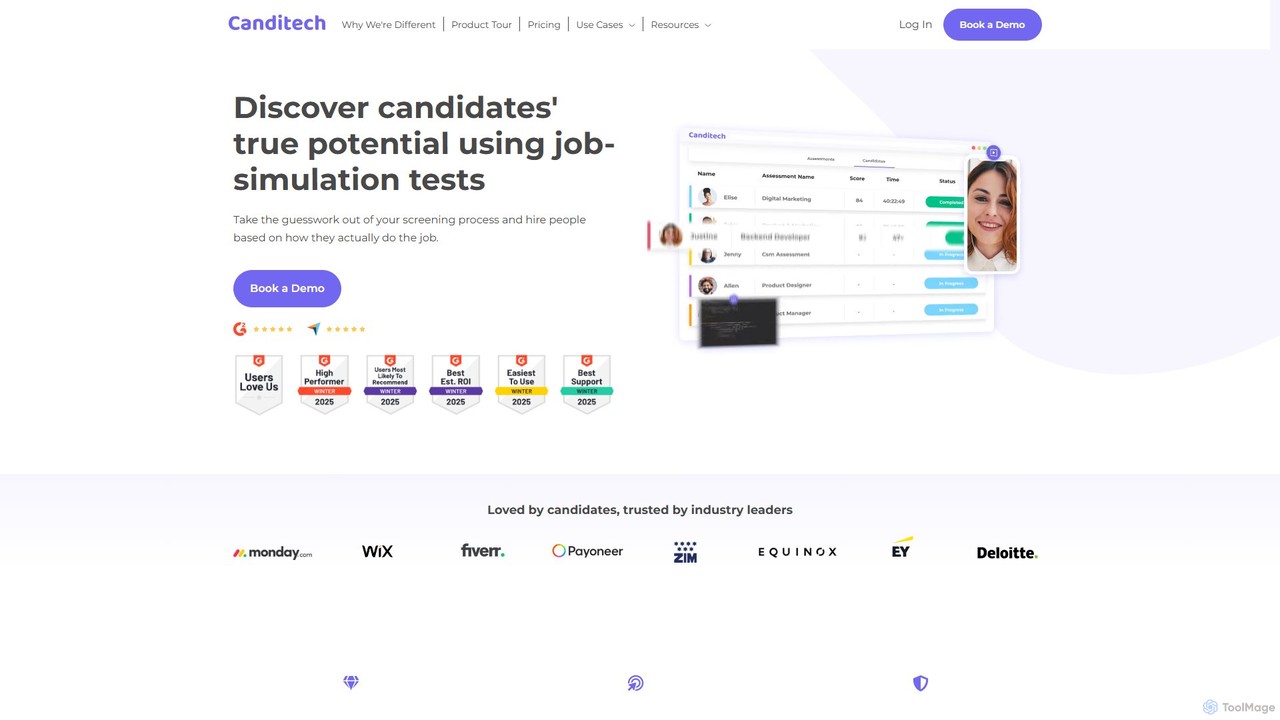
Canditech is an AI-powered skill assessment platform that helps companies streamline hiring with job-simulation tests. It offers a comprehensive suite for evaluating technical and soft skills, featuring video interviews, automated scoring, and advanced anti-cheating technology to ensure data-driven, bias-free recruitment.

Assessment
Visits 69.9KFavorites 128Likes 133

About Assessment

Assessment AI tools are a category of artificial intelligence applications designed to evaluate, analyze, and provide insights on various subjects. These tools leverage machine learning, natural language processing, and data analytics to automate and enhance traditional assessment processes. They offer objective, scalable, and data-driven evaluations, crucial for informed decision-making in business, education, and personal development. Their primary value lies in transforming complex data into actionable intelligence.

Core Features

  • Automated Scoring & Feedback: Automatically grades responses, provides instant feedback, and identifies areas for improvement.
  • Predictive Analytics: Forecasts future outcomes, such as job performance or market trends, based on historical data.
  • Bias Detection & Mitigation: Identifies and helps reduce human biases in evaluation processes, promoting fairness.
  • Personalized Assessment Paths: Adapts questions and difficulty levels based on individual user performance for tailored evaluations.
  • Data Visualization & Reporting: Presents complex assessment data through intuitive dashboards and comprehensive reports.

Use Cases

Businesses utilize these tools for pre-employment screening, employee performance reviews, and market analysis. Educational institutions employ them for student progress tracking and personalized learning recommendations, while financial sectors use them for risk assessment.

How to Choose

When selecting an Assessment AI tool, consider its specific evaluation domain (e.g., skills, personality, risk), the accuracy and transparency of its AI models, integration capabilities with existing systems, and compliance with data privacy regulations. Scalability, customization options, and the clarity of its reporting features are also vital for effective implementation.

Assessment use cases

1

Streamline Pre-employment Candidate Screening

HR managers can use AI assessment tools to objectively evaluate a large volume of job applicants. By analyzing resumes, coding tests, or video interviews, these tools identify candidates whose skills, personality traits, and cultural fit align best with job requirements, significantly reducing time-to-hire and improving hiring quality.

2

Enhance Employee Performance Evaluation

Team leaders and HR departments can deploy AI assessment platforms to conduct continuous, objective performance reviews. These tools analyze work output, project contributions, and feedback data to provide comprehensive insights into individual and team strengths, development areas, and potential for growth, fostering a data-driven performance culture.

3

Deliver Personalized Learning Paths

Educational institutions and corporate L&D teams leverage AI assessment to gauge learners' current knowledge and skill gaps. The tools then recommend tailored learning modules, resources, and practice exercises, ensuring that each individual receives targeted training that maximizes their learning efficiency and skill acquisition.

4

Analyze Market Trends and Competitors

Marketing and business intelligence teams can utilize AI assessment tools to analyze vast amounts of market data, including consumer behavior, social media sentiment, and competitor strategies. These tools identify emerging trends, predict market shifts, and evaluate competitive positioning, enabling proactive strategic planning and product development.

5

Automate Risk Assessment and Fraud Detection

Financial institutions and compliance officers employ AI assessment for real-time risk evaluation and fraud detection. By analyzing transaction patterns, user behavior, and historical data, these tools can identify anomalies and suspicious activities with high accuracy, minimizing financial losses and ensuring regulatory compliance.

6

Analyze Customer Feedback and Sentiment

Customer service and product development teams use AI assessment to process and analyze customer reviews, support tickets, and survey responses. These tools identify common pain points, measure overall sentiment, and categorize feedback themes, providing actionable insights to improve products, services, and customer satisfaction.

Assessment FAQ

What are AI Assessment tools?

AI Assessment tools are software applications that use artificial intelligence, such as machine learning and natural language processing, to evaluate and analyze various data points. They automate the process of judging skills, performance, personality, or data patterns, providing objective insights and predictions. These tools are widely used in HR, education, and business intelligence to make data-driven decisions.

How do AI Assessment tools work?

AI Assessment tools typically work by ingesting large datasets, which can include text, audio, video, or numerical data. They then apply machine learning algorithms to identify patterns, score responses, and make predictions or recommendations based on predefined criteria. For example, in a hiring context, they might analyze a candidate's responses against a model of successful employees to predict job fit.

What are the main benefits of using AI for assessments?

The main benefits include enhanced objectivity, as AI can reduce human bias; increased efficiency, by automating repetitive tasks; scalability, allowing for large-volume assessments; and deeper insights, through advanced data analysis. They also provide consistent evaluation standards and can offer personalized feedback or learning paths.

How do AI Assessment tools differ from traditional assessment methods?

AI Assessment tools differ from traditional methods primarily in their automation, data processing capabilities, and objectivity. Traditional methods often rely on manual scoring, human judgment, and limited data analysis. AI tools, conversely, can process vast amounts of data quickly, apply complex algorithms for scoring, and provide predictive analytics, often with less human intervention and potential for bias.

What should I consider when choosing an AI Assessment tool for my business?

When choosing an AI Assessment tool, consider its specific application (e.g., HR, marketing, education), the accuracy and transparency of its AI models, and its compliance with data privacy regulations (like GDPR). Also, evaluate its integration capabilities with your existing systems, the level of customization offered, the clarity and actionability of its reports, and the vendor's support and ethical AI practices.