ToolMage
Sign in

Best 1 Role Playing AI tools for Chat

Popular Role Playing AI tools in Chat include SupaFriends, helping you work more efficiently.

SupaFriends
Freemium

SupaFriends

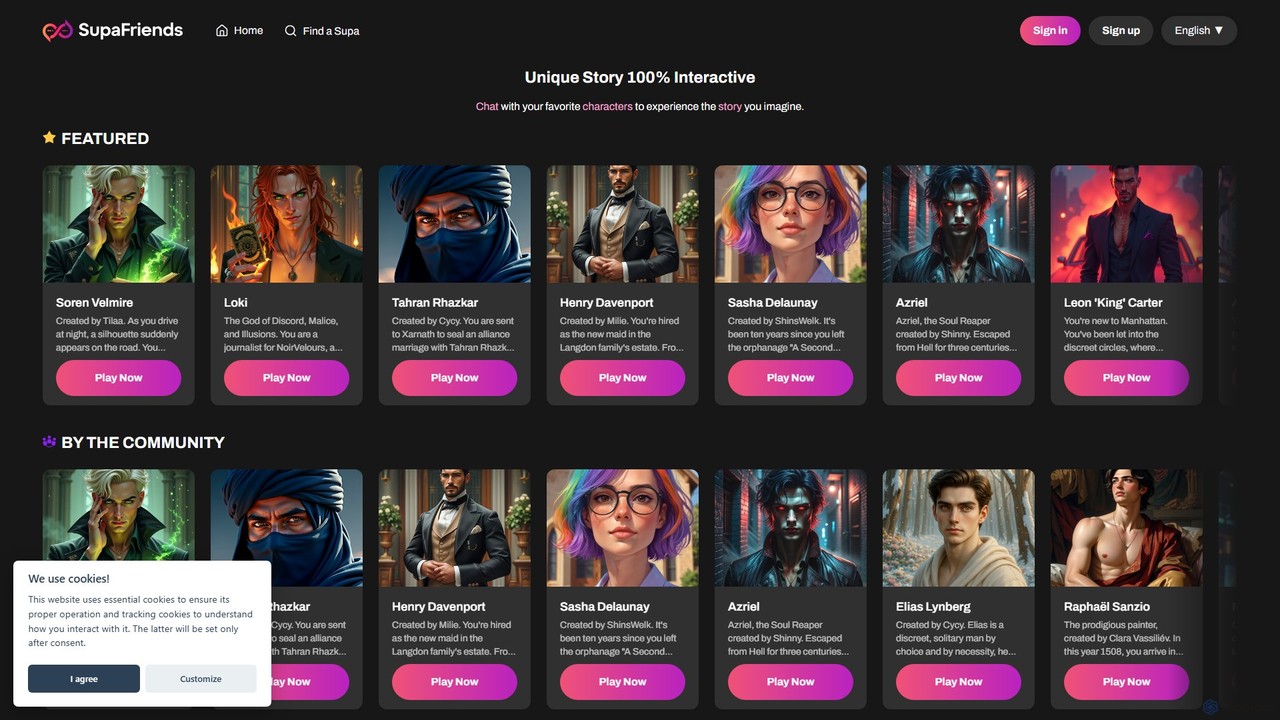
SupaFriends is an innovative AI platform for immersive romantic role-playing. Engage in interactive chats with a diverse cast of fictional characters, from vampires and werewolves to historical figures, and shape your own unique love story through dynamic conversations.

Role Playing
Visits 72.6KFavorites 138Likes 124

About Role Playing

Role Playing AI tools are a specialized subset of AI chat applications designed to simulate interactive conversations with AI models embodying specific characters, personalities, or scenarios. These tools leverage advanced natural language processing (NLP) and large language models (LLMs) to generate contextually relevant and character-consistent dialogue, allowing users to engage in immersive narrative experiences. They offer unique value for creative exploration, entertainment, skill development, and personalized interaction beyond typical informational chatbots.

Core Features

  • Character Customization: Define and refine AI character traits, backstories, and conversational styles.
  • Scenario Generation: Create and manage diverse interactive environments and plotlines for role-play.
  • Contextual Memory: AI remembers previous interactions and maintains narrative consistency throughout sessions.
  • Dynamic Dialogue: Generates varied and engaging responses that adapt to user input and character persona.
  • Emotional Nuance: Simulates emotional expressions and reactions to enhance immersion.

Use Cases

These tools are widely adopted by content creators, writers, educators, and individuals seeking interactive entertainment. They facilitate collaborative storytelling, provide platforms for practicing social or professional skills in a safe environment, and offer personalized virtual companionship. From developing fictional characters to rehearsing difficult conversations, Role Playing AI tools extend the boundaries of human-AI interaction.

How to Choose

When selecting an AI Role Playing tool, consider the depth of character customization, the flexibility of scenario creation, and the AI's ability to maintain narrative consistency and contextual memory. Evaluate the range of pre-built characters or templates, the quality of natural language generation, and any privacy features for personal interactions. User interface intuitiveness and community support for sharing creations are also important factors.

Featured tool rankings

Role Playing use cases

1

Crafting Interactive Stories and Narratives

For aspiring writers, game designers, or hobbyists, AI Role Playing tools serve as an interactive co-author. Users can define characters, settings, and plot points, then engage in dialogue with AI-driven characters to explore narrative possibilities, develop character arcs, and overcome writer's block. This collaborative process helps refine dialogue, test story branches, and generate fresh ideas for novels, screenplays, or tabletop RPGs.

2

Practicing Language and Communication Skills

Language learners can utilize AI Role Playing tools to practice conversational skills in a low-pressure environment. By interacting with AI characters designed to simulate native speakers in various scenarios (e.g., ordering food, job interviews, casual chats), users can improve vocabulary, grammar, pronunciation, and cultural nuances. This personalized practice offers immediate feedback and builds confidence for real-world interactions.

3

Engaging in Personalized Virtual Companionship

Individuals seeking entertainment or companionship can create and interact with AI characters tailored to their preferences. These AI companions can engage in deep conversations, share stories, play games, or simply offer a listening ear, providing a unique form of interactive leisure. The personalized nature of these interactions offers a novel way to explore different personalities and perspectives.

4

Simulating Professional or Social Scenarios

Professionals in fields like sales, customer service, or therapy can use AI Role Playing for skill development. Users can simulate challenging client interactions, difficult conversations with colleagues, or interview scenarios with an AI acting as the other party. This allows for safe practice, experimentation with different communication strategies, and receiving objective feedback to refine interpersonal skills before real-world application.

5

Prototyping Game Characters and Dialogue

Game developers and designers can leverage AI Role Playing tools to rapidly prototype non-player character (NPC) dialogue and character behaviors. By defining an NPC's personality and role, developers can interact with the AI to test conversational flows, identify potential narrative inconsistencies, and iterate on character responses. This accelerates the development process for rich, interactive game worlds.

6

Exploring Historical Figures or Fictional Universes

For history enthusiasts or fans of specific fictional universes, AI Role Playing tools offer a unique way to interact with simulated historical figures or characters from beloved stories. Users can engage in conversations with an AI embodying a historical leader, a literary character, or an alien from a sci-fi saga, gaining new perspectives and deepening their understanding or appreciation of these figures and worlds.

Role Playing FAQ

What are AI Role Playing tools?

AI Role Playing tools are applications that enable users to interact with AI models designed to embody specific characters, personalities, or roles within a defined scenario. They leverage advanced AI to generate dynamic, context-aware dialogue, creating immersive conversational experiences. Their primary purpose is to facilitate creative storytelling, entertainment, skill practice, and personalized interaction, going beyond the typical question-and-answer format of general chatbots.

How do AI Role Playing tools differ from general AI Chatbots?

While both use AI for conversation, AI Role Playing tools focus on simulating a specific character or scenario, maintaining a consistent persona and narrative context. General AI chatbots, like virtual assistants, are typically designed for information retrieval, task completion, or broad conversational topics without a defined character. Role Playing tools prioritize immersive, character-driven interaction, whereas general chatbots prioritize utility and factual accuracy.

What are the key features to look for in an AI Role Playing tool?

When choosing an AI Role Playing tool, prioritize robust character customization options, allowing you to define detailed backstories and personality traits. Look for flexible scenario creation capabilities, strong contextual memory to maintain narrative consistency, and dynamic dialogue generation that feels natural and engaging. Additional features like multi-turn dialogue, emotional nuance, and integration with other creative platforms can also enhance the experience.

Can AI Role Playing tools be used for educational purposes?

Yes, AI Role Playing tools can be highly effective for educational purposes, particularly in language learning and communication skill development. Students can practice speaking and listening with AI characters in simulated real-world situations, improving fluency and confidence. Professionals can rehearse difficult conversations or interview scenarios, receiving objective feedback. They offer a safe, repeatable environment for experiential learning.

What are the ethical considerations when using AI Role Playing tools?

Ethical considerations include data privacy, as personal interactions might be processed by the AI. Users should be aware of potential biases in AI-generated content, which can reflect biases present in training data. It's crucial to remember that AI characters are not sentient and cannot replace human relationships or professional advice. Responsible use also involves setting clear boundaries and understanding the AI's limitations, especially in sensitive or therapeutic contexts.